James P Long, Rishab Prakash, Paul Edelkamp, Mark Knafl, Anath C Lionel, Ranjit Nair, Sairah Ahmed, Paolo Strati, Luis E Malpica Castillo, Ajlan Al-Zaki, Kelly Chien, Dai Chihara, Jason Westin, Fareed Khawaja, Loretta J Nastoupil, Victor Mulanovich, Andrew Futreal, Scott E Woodman, Naval G Daver, Christopher R Flowers, Sattva Neelapu, Joanna-Grace Manzano, Swaminathan P Iyer
{"title":"Cytokine Storms in COVID-19, Hemophagocytic Lymphohistiocytosis, and CAR-T Therapy.","authors":"James P Long, Rishab Prakash, Paul Edelkamp, Mark Knafl, Anath C Lionel, Ranjit Nair, Sairah Ahmed, Paolo Strati, Luis E Malpica Castillo, Ajlan Al-Zaki, Kelly Chien, Dai Chihara, Jason Westin, Fareed Khawaja, Loretta J Nastoupil, Victor Mulanovich, Andrew Futreal, Scott E Woodman, Naval G Daver, Christopher R Flowers, Sattva Neelapu, Joanna-Grace Manzano, Swaminathan P Iyer","doi":"10.1001/jamanetworkopen.2025.3455","DOIUrl":null,"url":null,"abstract":"<p><strong>Importance: </strong>Cytokine storm (CS) is a hyperinflammatory syndrome causing multiorgan dysfunction and high mortality, especially in patients with malignant hematologic neoplasms. Triggers include malignant neoplasm-associated hemophagocytic lymphohistiocytosis (MN-HLH), cytokine release syndrome from chimeric antigen receptor T-cell therapy (CAR-T CRS), and COVID-19, but the underlying mechanisms of inflammation and their impact on outcomes are poorly understood.</p><p><strong>Objective: </strong>To delineate the inflammatory patterns characterizing different CS etiologies and their association with clinical outcomes.</p><p><strong>Design, setting, and participants: </strong>This retrospective cohort study was conducted at the MD Anderson Cancer Center in Houston, Texas, between March 1, 2020, and November 20, 2022, using the software-as-a-service Syntropy Foundry Platform. Participants were patients with malignant hematologic neoplasms who developed CS from COVID-19 (COVID-CS), MN-HLH, or CAR-T CRS.</p><p><strong>Exposure: </strong>Diagnostic criteria for COVID-CS were developed based on surging inflammatory markers (interleukin-6, C-reactive protein, and ferritin), while diagnosis of MN-HLH and CAR-T CRS followed established guidelines.</p><p><strong>Main outcomes and measures: </strong>The study compared cytokine levels, clinical characteristics, and survival outcomes across the 3 cohorts and focused on inflammatory markers, survival times, and key factors associated with survival identified through univariate and multivariable analyses.</p><p><strong>Results: </strong>A total of 671 patients met the inclusion criteria. Of those, 220 (33%) had CAR-T CRS, 227 (34%) had COVID-CS, and 224 (33%) had MN-HLH. Patients were predominantly male (435 [65%]), and 461 (69%) were White, with significant differences in median age (CAR-T CRS, 63 [IQR, 54-71] years; COVID-CS, 63 [IQR, 52-72] years; MN-HLH, 55 [IQR, 41-65] years; P < .001) as well as number of admission days and underlying cancer type across cohorts. Marked variations in cytokine levels and survival outcomes were observed, with the MN-HLH cohort exhibiting the highest levels of inflammatory markers (eg, median TNF-α, 105 pg/mL [IQR, 38-201 pg/mL] for MN-HLH vs 23 pg/mL [IQR, 17-42 pg/mL] for COVID-CS) and lowest fibrinogen and albumin levels. The cohort with CAR-T CRS showed substantially longer survival times compared with the cohort with COVID-CS (hazard ratio [HR], 2.93; 95% CI, 1.95-4.41) and the cohort with MN-HLH (HR, 8.12; 95% CI, 5.51-12.00). Clustering analysis showed overlapping patterns between COVID-CS and CAR-T CRS, while MN-HLH formed a distinct cluster.</p><p><strong>Conclusions and relevance: </strong>This study of CS syndromes found distinct immune responses within each cohort. The distinct clinical patterns and outcomes associated with different CS etiologies emphasize the importance of early diagnosis and timely intervention.</p>","PeriodicalId":14694,"journal":{"name":"JAMA Network Open","volume":"8 4","pages":"e253455"},"PeriodicalIF":9.7000,"publicationDate":"2025-04-01","publicationTypes":"Journal Article","fieldsOfStudy":null,"isOpenAccess":false,"openAccessPdf":"https://www.ncbi.nlm.nih.gov/pmc/articles/PMC11976493/pdf/","citationCount":"0","resultStr":null,"platform":"Semanticscholar","paperid":null,"PeriodicalName":"JAMA Network Open","FirstCategoryId":"3","ListUrlMain":"https://doi.org/10.1001/jamanetworkopen.2025.3455","RegionNum":1,"RegionCategory":"医学","ArticlePicture":[],"TitleCN":null,"AbstractTextCN":null,"PMCID":null,"EPubDate":"","PubModel":"","JCR":"Q1","JCRName":"MEDICINE, GENERAL & INTERNAL","Score":null,"Total":0}
引用次数: 0
Abstract
Importance: Cytokine storm (CS) is a hyperinflammatory syndrome causing multiorgan dysfunction and high mortality, especially in patients with malignant hematologic neoplasms. Triggers include malignant neoplasm-associated hemophagocytic lymphohistiocytosis (MN-HLH), cytokine release syndrome from chimeric antigen receptor T-cell therapy (CAR-T CRS), and COVID-19, but the underlying mechanisms of inflammation and their impact on outcomes are poorly understood.
Objective: To delineate the inflammatory patterns characterizing different CS etiologies and their association with clinical outcomes.
Design, setting, and participants: This retrospective cohort study was conducted at the MD Anderson Cancer Center in Houston, Texas, between March 1, 2020, and November 20, 2022, using the software-as-a-service Syntropy Foundry Platform. Participants were patients with malignant hematologic neoplasms who developed CS from COVID-19 (COVID-CS), MN-HLH, or CAR-T CRS.
Exposure: Diagnostic criteria for COVID-CS were developed based on surging inflammatory markers (interleukin-6, C-reactive protein, and ferritin), while diagnosis of MN-HLH and CAR-T CRS followed established guidelines.
Main outcomes and measures: The study compared cytokine levels, clinical characteristics, and survival outcomes across the 3 cohorts and focused on inflammatory markers, survival times, and key factors associated with survival identified through univariate and multivariable analyses.
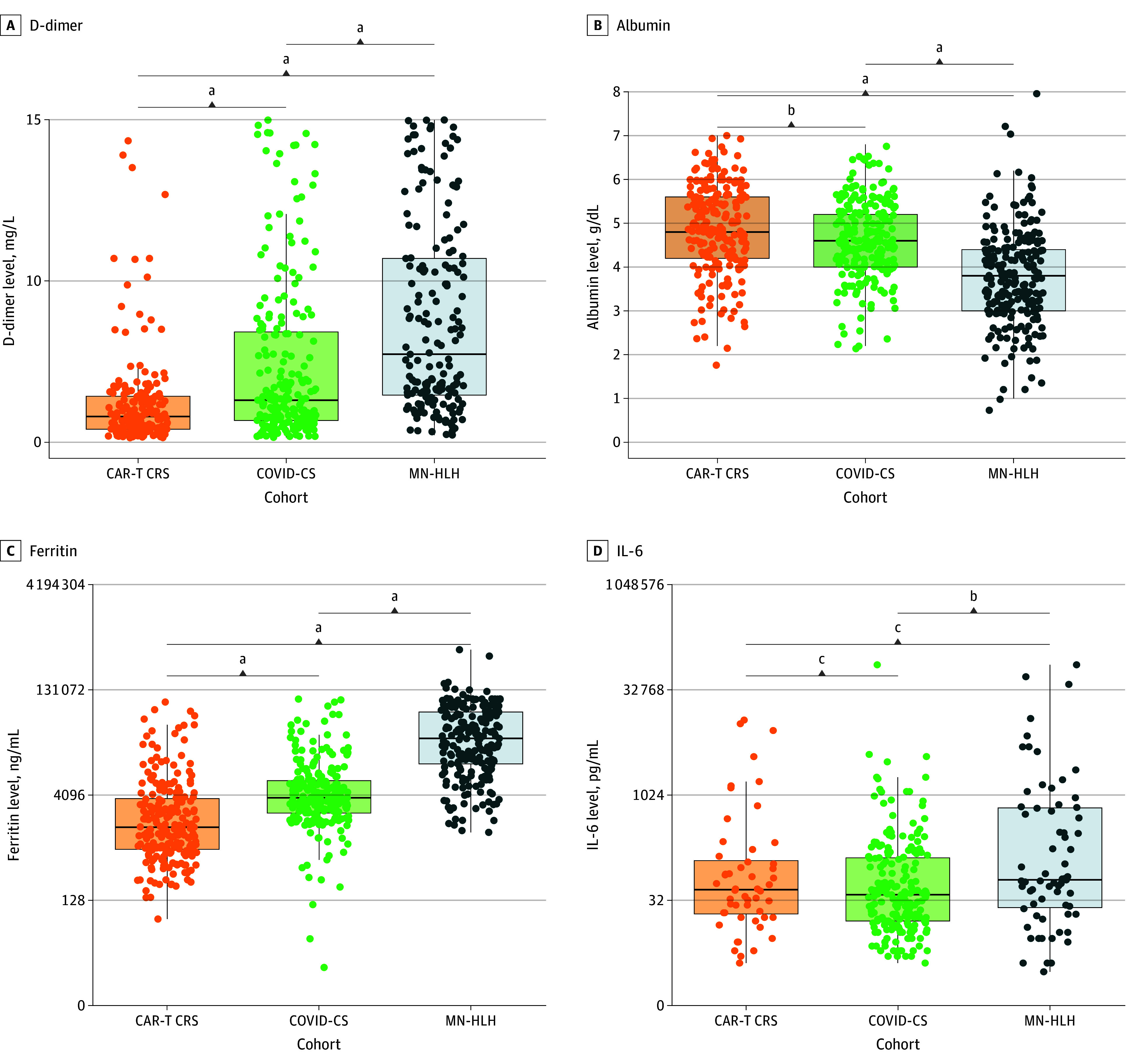
Results: A total of 671 patients met the inclusion criteria. Of those, 220 (33%) had CAR-T CRS, 227 (34%) had COVID-CS, and 224 (33%) had MN-HLH. Patients were predominantly male (435 [65%]), and 461 (69%) were White, with significant differences in median age (CAR-T CRS, 63 [IQR, 54-71] years; COVID-CS, 63 [IQR, 52-72] years; MN-HLH, 55 [IQR, 41-65] years; P < .001) as well as number of admission days and underlying cancer type across cohorts. Marked variations in cytokine levels and survival outcomes were observed, with the MN-HLH cohort exhibiting the highest levels of inflammatory markers (eg, median TNF-α, 105 pg/mL [IQR, 38-201 pg/mL] for MN-HLH vs 23 pg/mL [IQR, 17-42 pg/mL] for COVID-CS) and lowest fibrinogen and albumin levels. The cohort with CAR-T CRS showed substantially longer survival times compared with the cohort with COVID-CS (hazard ratio [HR], 2.93; 95% CI, 1.95-4.41) and the cohort with MN-HLH (HR, 8.12; 95% CI, 5.51-12.00). Clustering analysis showed overlapping patterns between COVID-CS and CAR-T CRS, while MN-HLH formed a distinct cluster.
Conclusions and relevance: This study of CS syndromes found distinct immune responses within each cohort. The distinct clinical patterns and outcomes associated with different CS etiologies emphasize the importance of early diagnosis and timely intervention.
期刊介绍:
JAMA Network Open, a member of the esteemed JAMA Network, stands as an international, peer-reviewed, open-access general medical journal.The publication is dedicated to disseminating research across various health disciplines and countries, encompassing clinical care, innovation in health care, health policy, and global health.
JAMA Network Open caters to clinicians, investigators, and policymakers, providing a platform for valuable insights and advancements in the medical field. As part of the JAMA Network, a consortium of peer-reviewed general medical and specialty publications, JAMA Network Open contributes to the collective knowledge and understanding within the medical community.





 京公网安备 11010802042870号
京ICP备2023020795号-1
京公网安备 11010802042870号
京ICP备2023020795号-1

 分享
分享
 求助内容:
求助内容: 应助结果提醒方式:
 扫码关注我们
