Ann E Davidson, Nora R W Straquadine, Sara A Cook, Christina G Liu, Chuhao Nie, Matthew C Spaulding, Julia Ganz
{"title":"A Rapid F0 CRISPR Screen in Zebrafish to Identify Regulator Genes of Neuronal Development in the Enteric Nervous System.","authors":"Ann E Davidson, Nora R W Straquadine, Sara A Cook, Christina G Liu, Chuhao Nie, Matthew C Spaulding, Julia Ganz","doi":"10.1111/nmo.70009","DOIUrl":null,"url":null,"abstract":"<p><strong>Background: </strong>The neural crest-derived enteric nervous system (ENS) provides the intrinsic innervation of the gut with diverse neuronal subtypes and glial cells. The ENS regulates all essential gut functions, such as motility, nutrient uptake, immune response, and microbiota colonization. Deficits in ENS neuron numbers and composition cause debilitating gut dysfunction. Yet, few studies have identified genes that control neuronal differentiation and the generation of the diverse neuronal subtypes in the ENS.</p><p><strong>Methods: </strong>Utilizing existing CRISPR/Cas9 genome editing technology in zebrafish, we have developed a rapid and scalable screening approach for identifying genes that regulate ENS neurogenesis.</p><p><strong>Key results: </strong>As a proof-of-concept, F0 guide RNA-injected larvae (F0 crispants) targeting the known ENS regulator genes sox10, ret, or phox2bb phenocopied known ENS phenotypes with high efficiency. We evaluated 10 transcription factor candidate genes as regulators of ENS neurogenesis and function. F0 crispants for five of the tested genes have fewer ENS neurons. Secondary assays in F0 crispants for a subset of the genes that had fewer neurons reveal no effect on enteric progenitor cell migration but differential changes in gut motility.</p><p><strong>Conclusions: </strong>Our multistep, yet straightforward CRISPR screening approach in zebrafish tests the genetic basis of ENS developmental and disease gene functions that will facilitate the high-throughput evaluation of candidate genes from transcriptomic, genome-wide association, or other ENS-omics studies. Such in vivo ENS F0 crispant screens will contribute to a better understanding of ENS neuronal development regulation in vertebrates and what goes awry in ENS disorders.</p>","PeriodicalId":19123,"journal":{"name":"Neurogastroenterology and Motility","volume":" ","pages":"e70009"},"PeriodicalIF":2.9000,"publicationDate":"2025-05-01","publicationTypes":"Journal Article","fieldsOfStudy":null,"isOpenAccess":false,"openAccessPdf":"https://www.ncbi.nlm.nih.gov/pmc/articles/PMC11996052/pdf/","citationCount":"0","resultStr":null,"platform":"Semanticscholar","paperid":null,"PeriodicalName":"Neurogastroenterology and Motility","FirstCategoryId":"3","ListUrlMain":"https://doi.org/10.1111/nmo.70009","RegionNum":3,"RegionCategory":"医学","ArticlePicture":[],"TitleCN":null,"AbstractTextCN":null,"PMCID":null,"EPubDate":"2025/4/6 0:00:00","PubModel":"Epub","JCR":"Q1","JCRName":"CLINICAL NEUROLOGY","Score":null,"Total":0}
引用次数: 0
Abstract
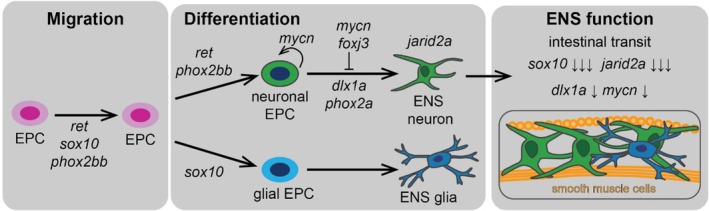
Background: The neural crest-derived enteric nervous system (ENS) provides the intrinsic innervation of the gut with diverse neuronal subtypes and glial cells. The ENS regulates all essential gut functions, such as motility, nutrient uptake, immune response, and microbiota colonization. Deficits in ENS neuron numbers and composition cause debilitating gut dysfunction. Yet, few studies have identified genes that control neuronal differentiation and the generation of the diverse neuronal subtypes in the ENS.
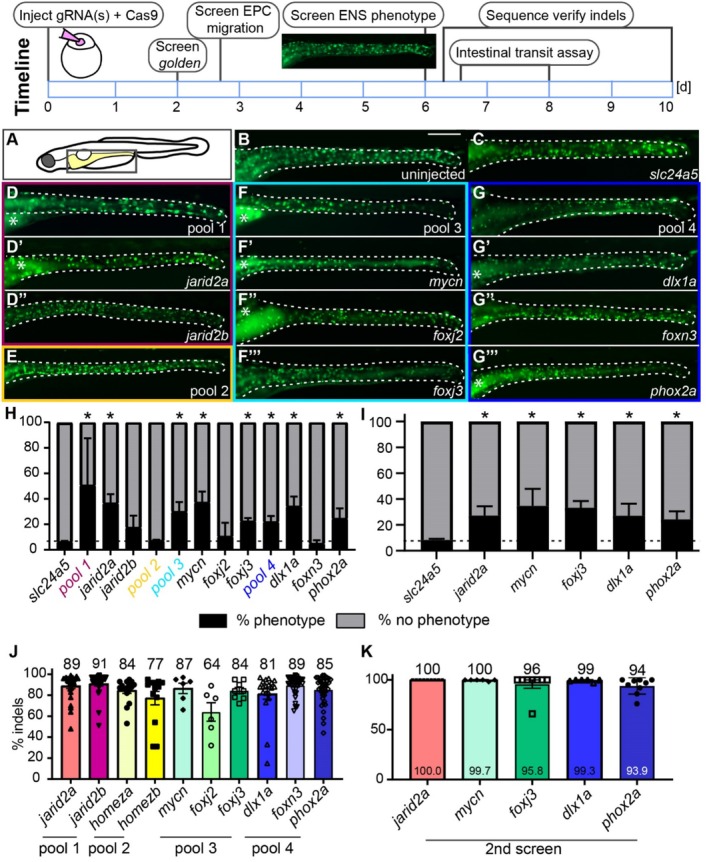
Methods: Utilizing existing CRISPR/Cas9 genome editing technology in zebrafish, we have developed a rapid and scalable screening approach for identifying genes that regulate ENS neurogenesis.
Key results: As a proof-of-concept, F0 guide RNA-injected larvae (F0 crispants) targeting the known ENS regulator genes sox10, ret, or phox2bb phenocopied known ENS phenotypes with high efficiency. We evaluated 10 transcription factor candidate genes as regulators of ENS neurogenesis and function. F0 crispants for five of the tested genes have fewer ENS neurons. Secondary assays in F0 crispants for a subset of the genes that had fewer neurons reveal no effect on enteric progenitor cell migration but differential changes in gut motility.
Conclusions: Our multistep, yet straightforward CRISPR screening approach in zebrafish tests the genetic basis of ENS developmental and disease gene functions that will facilitate the high-throughput evaluation of candidate genes from transcriptomic, genome-wide association, or other ENS-omics studies. Such in vivo ENS F0 crispant screens will contribute to a better understanding of ENS neuronal development regulation in vertebrates and what goes awry in ENS disorders.
期刊介绍:
Neurogastroenterology & Motility (NMO) is the official Journal of the European Society of Neurogastroenterology & Motility (ESNM) and the American Neurogastroenterology and Motility Society (ANMS). It is edited by James Galligan, Albert Bredenoord, and Stephen Vanner. The editorial and peer review process is independent of the societies affiliated to the journal and publisher: Neither the ANMS, the ESNM or the Publisher have editorial decision-making power. Whenever these are relevant to the content being considered or published, the editors, journal management committee and editorial board declare their interests and affiliations.




 京公网安备 11010802042870号
京ICP备2023020795号-1
京公网安备 11010802042870号
京ICP备2023020795号-1

 分享
分享
 求助内容:
求助内容: 应助结果提醒方式:
 扫码关注我们
