Jonathan Trach, Shawna Williams, Brendan Michalczyk, Cole Butler, Alkiviathes Meldrum, John Washington and Jonathan G. C. Veinot
{"title":"Sonochemically activated room temperature hydrosilylation of silicon nanoparticles †","authors":"Jonathan Trach, Shawna Williams, Brendan Michalczyk, Cole Butler, Alkiviathes Meldrum, John Washington and Jonathan G. C. Veinot","doi":"10.1039/D4NA01067A","DOIUrl":null,"url":null,"abstract":"<p >Hydrosilylation of terminal alkenes and alkynes on the surfaces of hydrogen-terminated silicon nanoparticles (H-SiNPs) has provided a convenient approach toward tailoring surface chemistry. These reactions have traditionally required thermal, photochemical, or chemical activation and are not necessarily compatible with all substrates and particle sizes. Herein, we demonstrate that hydrosilylation on silicon nanoparticles (Si NPs) can be promoted at room temperature by exposing the reaction mixture to a standard ultrasonic bath. This new approach provides surface coverages approaching 30% after 24 h. Introduction of traditional radical initiators to the reaction mixture followed by sonication reduced the reaction time by approximately 4-fold. The Si NPs functionalized using the presented sonochemical methods were compared with equivalent systems modified using conventional thermally- and radically-induced procedures and retain their appealing photoluminescent properties and were found to have slightly lower (<em>i.e.</em>, 27 <em>vs.</em> 33%), albeit comparable degrees of functionalization.</p>","PeriodicalId":18806,"journal":{"name":"Nanoscale Advances","volume":" 10","pages":" 3018-3027"},"PeriodicalIF":6.3000,"publicationDate":"2025-04-04","publicationTypes":"Journal Article","fieldsOfStudy":null,"isOpenAccess":false,"openAccessPdf":"https://www.ncbi.nlm.nih.gov/pmc/articles/PMC11969236/pdf/","citationCount":"0","resultStr":null,"platform":"Semanticscholar","paperid":null,"PeriodicalName":"Nanoscale Advances","FirstCategoryId":"88","ListUrlMain":"https://pubs.rsc.org/en/content/articlelanding/2025/na/d4na01067a","RegionNum":3,"RegionCategory":"材料科学","ArticlePicture":[],"TitleCN":null,"AbstractTextCN":null,"PMCID":null,"EPubDate":"","PubModel":"","JCR":"Q2","JCRName":"CHEMISTRY, MULTIDISCIPLINARY","Score":null,"Total":0}
引用次数: 0
Abstract
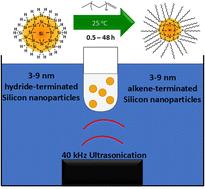
Hydrosilylation of terminal alkenes and alkynes on the surfaces of hydrogen-terminated silicon nanoparticles (H-SiNPs) has provided a convenient approach toward tailoring surface chemistry. These reactions have traditionally required thermal, photochemical, or chemical activation and are not necessarily compatible with all substrates and particle sizes. Herein, we demonstrate that hydrosilylation on silicon nanoparticles (Si NPs) can be promoted at room temperature by exposing the reaction mixture to a standard ultrasonic bath. This new approach provides surface coverages approaching 30% after 24 h. Introduction of traditional radical initiators to the reaction mixture followed by sonication reduced the reaction time by approximately 4-fold. The Si NPs functionalized using the presented sonochemical methods were compared with equivalent systems modified using conventional thermally- and radically-induced procedures and retain their appealing photoluminescent properties and were found to have slightly lower (i.e., 27 vs. 33%), albeit comparable degrees of functionalization.
末端烯烃和炔在端氢硅纳米颗粒(H-SiNPs)表面的硅氢化反应为定制表面化学提供了一种方便的方法。这些反应传统上需要热、光化学或化学激活,并且不一定与所有底物和颗粒尺寸兼容。在此,我们证明了在室温下,通过将反应混合物暴露在标准超声波浴中,可以促进硅纳米颗粒(Si NPs)上的硅氢化反应。这种新方法在24小时后提供了接近30%的表面覆盖率。在反应混合物中引入传统的自由基引发剂,然后进行超声处理,将反应时间缩短了大约4倍。使用声化学方法功能化的Si NPs与使用传统热诱导和自由基诱导方法修饰的等效系统进行了比较,并保留了其吸引人的光致发光特性,并且发现尽管功能化程度相当,但功能化程度略低(即27% vs 33%)。




 京公网安备 11010802042870号
京ICP备2023020795号-1
京公网安备 11010802042870号
京ICP备2023020795号-1

 分享
分享
 求助内容:
求助内容: 应助结果提醒方式:
 扫码关注我们
