{"title":"The Impact of Diabetes Self-Care, Healthy Lifestyle, Social Support, and Demographic Variables on Outcomes HbA1c in Patients With Type 2 Diabetes.","authors":"Wan-Ju Chen, Li-Ying Lin","doi":"10.1177/11795514251331907","DOIUrl":null,"url":null,"abstract":"<p><strong>Background: </strong>Controlling HbA1c can help reduce the symptoms and complications of diabetes. However, only about 25% of adults with diabetes achieve this diabetes care goal. It can be seen that diabetes requires more research investment and breakthroughs, as well as a more complete discussion of related factors that affect diabetes control, in order to better control the disease. This study explored the effects of diabetes self-care behavior, healthy lifestyle, diabetes symptoms, social support, demographic variables, and physical examination values on HbA1c levels in individuals with type 2 diabetes.</p><p><strong>Methods: </strong>This study used a cross-sectional design and recruited 305 subjects with type 2 diabetes at a medical center. Personal data were collected using a structured questionnaire and same-day outpatient medical records.</p><p><strong>Results: </strong>Multiple linear regression analysis identified significant predictors of HbA1c levels. These include insulin treatment (<i>P</i> < .001), age (<i>P</i> < .001), gender (<i>P</i> < .001), diabetes duration (<i>P</i> = .003), proteinuria (<i>P</i> < .001), diabetes self-care behaviors (<i>P</i> = .021), physical activity (running; <i>P</i> = .018), and spousal involvement in care (<i>P</i> = .031). Female gender, insulin treatment, longer diabetes duration, spousal involvement in care, and the presence of proteinuria were positively associated with higher HbA1c levels. In contrast, higher age, better diabetes self-care behaviors, and regular physical activity (running) were associated with lower HbA1c levels. These findings underscore the importance of considering both demographic factors and lifestyle behaviors in the management of HbA1c levels.</p><p><strong>Conclusions: </strong>For reasons that hinder subjects from controlling HbA1c levels, individual self-management intervention programs should be provided to improve the effectiveness of subjects in controlling HbA1c levels. The care giver should be included in the educational program of diabetes management. Running exercise contributes to the control of HbA1c levels.</p>","PeriodicalId":44715,"journal":{"name":"Clinical Medicine Insights-Endocrinology and Diabetes","volume":"18 ","pages":"11795514251331907"},"PeriodicalIF":3.0000,"publicationDate":"2025-04-04","publicationTypes":"Journal Article","fieldsOfStudy":null,"isOpenAccess":false,"openAccessPdf":"https://www.ncbi.nlm.nih.gov/pmc/articles/PMC11970087/pdf/","citationCount":"0","resultStr":null,"platform":"Semanticscholar","paperid":null,"PeriodicalName":"Clinical Medicine Insights-Endocrinology and Diabetes","FirstCategoryId":"1085","ListUrlMain":"https://doi.org/10.1177/11795514251331907","RegionNum":0,"RegionCategory":null,"ArticlePicture":[],"TitleCN":null,"AbstractTextCN":null,"PMCID":null,"EPubDate":"2025/1/1 0:00:00","PubModel":"eCollection","JCR":"Q3","JCRName":"ENDOCRINOLOGY & METABOLISM","Score":null,"Total":0}
引用次数: 0
Abstract
Background: Controlling HbA1c can help reduce the symptoms and complications of diabetes. However, only about 25% of adults with diabetes achieve this diabetes care goal. It can be seen that diabetes requires more research investment and breakthroughs, as well as a more complete discussion of related factors that affect diabetes control, in order to better control the disease. This study explored the effects of diabetes self-care behavior, healthy lifestyle, diabetes symptoms, social support, demographic variables, and physical examination values on HbA1c levels in individuals with type 2 diabetes.
Methods: This study used a cross-sectional design and recruited 305 subjects with type 2 diabetes at a medical center. Personal data were collected using a structured questionnaire and same-day outpatient medical records.
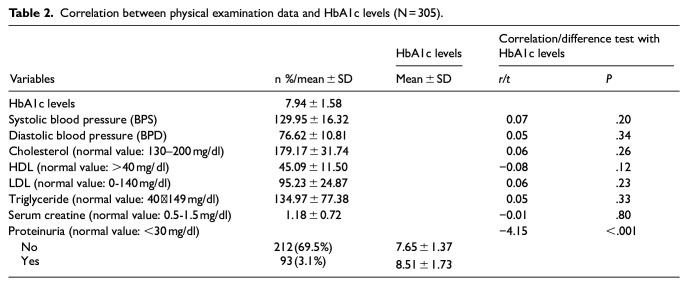
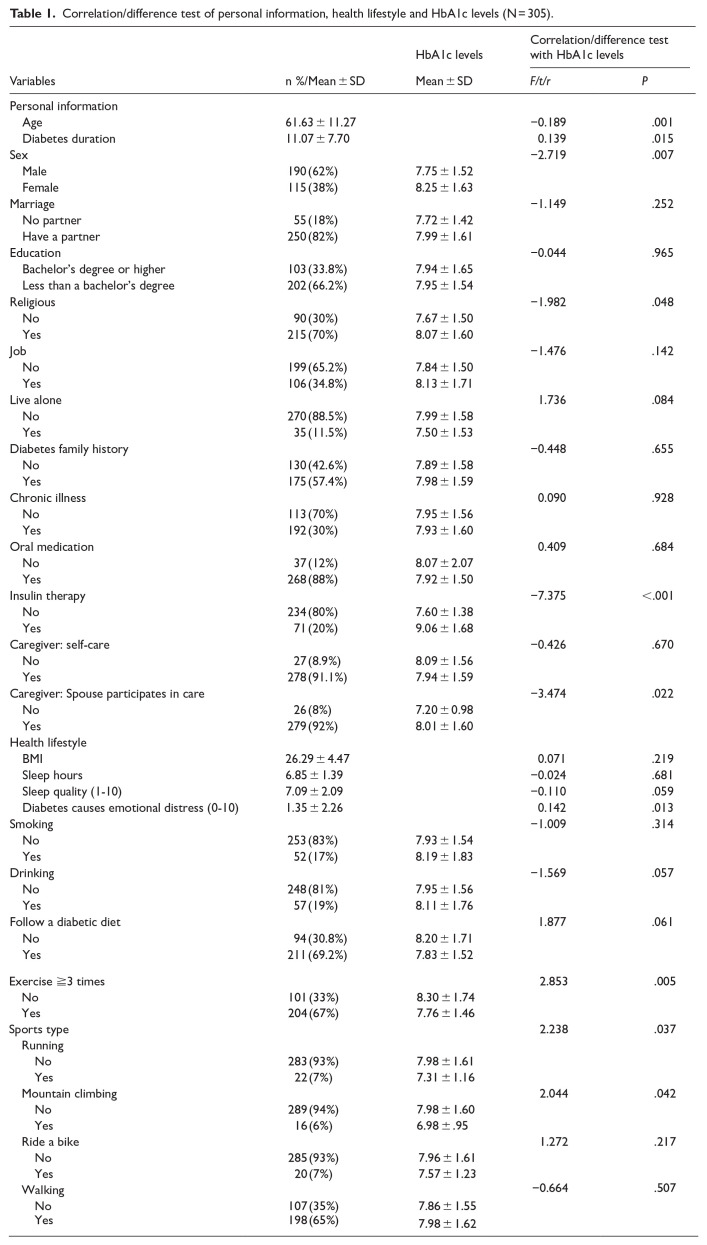
Results: Multiple linear regression analysis identified significant predictors of HbA1c levels. These include insulin treatment (P < .001), age (P < .001), gender (P < .001), diabetes duration (P = .003), proteinuria (P < .001), diabetes self-care behaviors (P = .021), physical activity (running; P = .018), and spousal involvement in care (P = .031). Female gender, insulin treatment, longer diabetes duration, spousal involvement in care, and the presence of proteinuria were positively associated with higher HbA1c levels. In contrast, higher age, better diabetes self-care behaviors, and regular physical activity (running) were associated with lower HbA1c levels. These findings underscore the importance of considering both demographic factors and lifestyle behaviors in the management of HbA1c levels.
Conclusions: For reasons that hinder subjects from controlling HbA1c levels, individual self-management intervention programs should be provided to improve the effectiveness of subjects in controlling HbA1c levels. The care giver should be included in the educational program of diabetes management. Running exercise contributes to the control of HbA1c levels.
背景:控制HbA1c有助于减少糖尿病的症状和并发症。然而,只有大约25%的成年糖尿病患者实现了这一糖尿病护理目标。可见,糖尿病需要更多的研究投入和突破,需要对影响糖尿病控制的相关因素进行更完整的探讨,才能更好地控制疾病。本研究探讨糖尿病自我护理行为、健康生活方式、糖尿病症状、社会支持、人口统计学变量和体检值对2型糖尿病患者HbA1c水平的影响。方法:本研究采用横断面设计,在某医疗中心招募了305名2型糖尿病患者。使用结构化问卷和当日门诊病历收集个人数据。结果:多元线性回归分析确定了HbA1c水平的显著预测因子。这些包括胰岛素治疗(P P P = 0.003),蛋白尿(P P = 0.021),体育活动(跑步;P = 0.018),配偶参与护理(P = 0.031)。女性、胰岛素治疗、较长的糖尿病病程、配偶参与护理和蛋白尿的存在与较高的HbA1c水平呈正相关。相比之下,年龄越大、糖尿病自我护理行为越好以及有规律的体育活动(跑步)与HbA1c水平降低有关。这些发现强调了在HbA1c水平管理中同时考虑人口因素和生活方式行为的重要性。结论:由于阻碍受试者控制HbA1c水平的原因,应提供个体自我管理干预方案,以提高受试者控制HbA1c水平的有效性。护理人员应被纳入糖尿病管理的教育计划。跑步运动有助于控制HbA1c水平。






 京公网安备 11010802042870号
京ICP备2023020795号-1
京公网安备 11010802042870号
京ICP备2023020795号-1

 分享
分享
 求助内容:
求助内容: 应助结果提醒方式:
 扫码关注我们
