{"title":"Global health security in the post-COVID-19 era: threats, preparation, and response.","authors":"Chaeshin Chu","doi":"10.24171/j.phrp.2025.0037","DOIUrl":null,"url":null,"abstract":"<p><p>Global health security threats in the post-coronavirus disease 2019 era include dense urban populations, increased human-animal proximity, migration driven by political or economic instability, climate change, humanitarian crises, antimicrobial resistance (AMR), and the misuse of biological research-including the accidental or intentional release of high-risk pathogens. The foundational preparation for these threats is to establish a robust, resilient public health system based on universal health coverage. The World Health Organization's International Health Regulations must continue to promote global solidarity by maintaining core capacities such as surveillance, national laboratories, and epidemiological investigations of emerging infectious diseases, with timely reporting and information sharing within the global health security community. A One Health approach is essential for addressing AMR. Infection prevention and control must be enhanced to reduce healthcare-associated infections in medical facilities. Additionally, regulations concerning biosafety and biosecurity should address dual-use research of concern as well as the accidental or intentional release of highrisk pathogens from laboratories. Global health security is a collective responsibility because these threats know no borders and require coordinated action.</p>","PeriodicalId":38949,"journal":{"name":"Osong Public Health and Research Perspectives","volume":" ","pages":"116-125"},"PeriodicalIF":1.6000,"publicationDate":"2025-04-01","publicationTypes":"Journal Article","fieldsOfStudy":null,"isOpenAccess":false,"openAccessPdf":"https://www.ncbi.nlm.nih.gov/pmc/articles/PMC12066230/pdf/","citationCount":"0","resultStr":null,"platform":"Semanticscholar","paperid":null,"PeriodicalName":"Osong Public Health and Research Perspectives","FirstCategoryId":"1085","ListUrlMain":"https://doi.org/10.24171/j.phrp.2025.0037","RegionNum":0,"RegionCategory":null,"ArticlePicture":[],"TitleCN":null,"AbstractTextCN":null,"PMCID":null,"EPubDate":"2025/4/4 0:00:00","PubModel":"Epub","JCR":"Q3","JCRName":"PUBLIC, ENVIRONMENTAL & OCCUPATIONAL HEALTH","Score":null,"Total":0}
引用次数: 0
Abstract
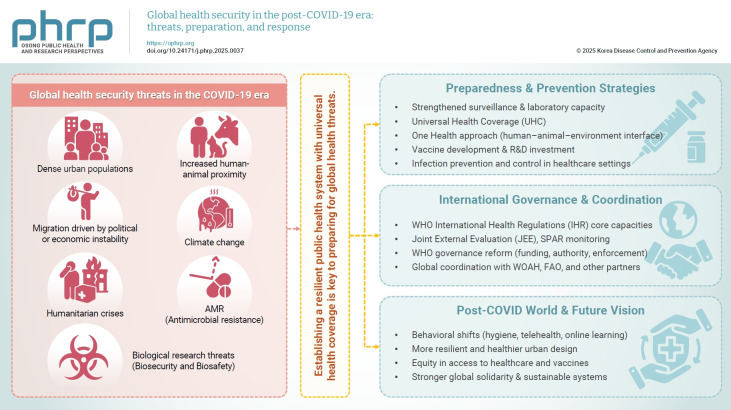
Global health security threats in the post-coronavirus disease 2019 era include dense urban populations, increased human-animal proximity, migration driven by political or economic instability, climate change, humanitarian crises, antimicrobial resistance (AMR), and the misuse of biological research-including the accidental or intentional release of high-risk pathogens. The foundational preparation for these threats is to establish a robust, resilient public health system based on universal health coverage. The World Health Organization's International Health Regulations must continue to promote global solidarity by maintaining core capacities such as surveillance, national laboratories, and epidemiological investigations of emerging infectious diseases, with timely reporting and information sharing within the global health security community. A One Health approach is essential for addressing AMR. Infection prevention and control must be enhanced to reduce healthcare-associated infections in medical facilities. Additionally, regulations concerning biosafety and biosecurity should address dual-use research of concern as well as the accidental or intentional release of highrisk pathogens from laboratories. Global health security is a collective responsibility because these threats know no borders and require coordinated action.




 京公网安备 11010802042870号
京ICP备2023020795号-1
京公网安备 11010802042870号
京ICP备2023020795号-1

 分享
分享
 求助内容:
求助内容: 应助结果提醒方式:
 扫码关注我们
