Ji Young Kim, Oh Kyung Lim, Ki Deok Park, Haeun Na, Ju Kang Lee
{"title":"Squatting Posture Grading System for Screening of Limited Ankle Dorsiflexion.","authors":"Ji Young Kim, Oh Kyung Lim, Ki Deok Park, Haeun Na, Ju Kang Lee","doi":"10.5535/arm.230008","DOIUrl":null,"url":null,"abstract":"<p><strong>Objective: </strong>To evaluate the effectiveness of a squatting posture grading system established to screen for limited ankle dorsiflexion.</p><p><strong>Methods: </strong>The squat posture grading system categorizes subjects' squat posture into three grades. Grade 1 is defined as being able to maintain a squatting posture with heels on the ground in full ankle dorsiflexion without effort. Grade 2 is defined as being able to perform the same position, but unable to maintain the position for more than 5 seconds or requiring trunk and leg muscle efforts to maintain the position. Grade 3 is defined as being unable to maintain the same position and falling backwards immediately if attempted to touch the ground with heels. Next, subjects' ankle dorsiflexion angles were directly measured in knee flexed and extended position by goniometer.</p><p><strong>Results: </strong>Out of the 92 total subjects, 35 were in grade 1, 18 were in grade 2, and 39 were in grade 3. The average ankle dorsiflexion angle with knee flexed position were 23.13° for grade 1, 16.03° for grade 2, and 9.31° for grade 3. The average ankle dorsiflexion angle with knee extended position were 15.16° for grade 1, 7.92° for grade 2, and 3.40° for grade 3. Ankle dorsiflexion angles showed a significant decrease from grade 1 to 3 (p<0.05).</p><p><strong>Conclusion: </strong>The squatting posture grading system defined in this study effectively graded the subjects based on the difference in their average ankle dorsiflexion angle. This system could be used as a quick screening method for limited ankle dorsiflexion.</p>","PeriodicalId":47738,"journal":{"name":"Annals of Rehabilitation Medicine-ARM","volume":" ","pages":"61-71"},"PeriodicalIF":2.9000,"publicationDate":"2025-04-01","publicationTypes":"Journal Article","fieldsOfStudy":null,"isOpenAccess":false,"openAccessPdf":"https://www.ncbi.nlm.nih.gov/pmc/articles/PMC12064286/pdf/","citationCount":"0","resultStr":null,"platform":"Semanticscholar","paperid":null,"PeriodicalName":"Annals of Rehabilitation Medicine-ARM","FirstCategoryId":"1085","ListUrlMain":"https://doi.org/10.5535/arm.230008","RegionNum":0,"RegionCategory":null,"ArticlePicture":[],"TitleCN":null,"AbstractTextCN":null,"PMCID":null,"EPubDate":"2025/4/7 0:00:00","PubModel":"Epub","JCR":"Q1","JCRName":"REHABILITATION","Score":null,"Total":0}
引用次数: 0
Abstract
Objective: To evaluate the effectiveness of a squatting posture grading system established to screen for limited ankle dorsiflexion.
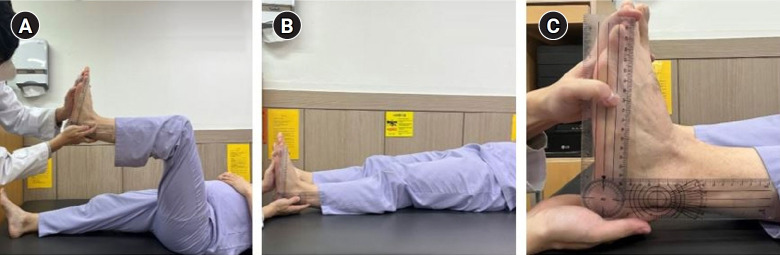
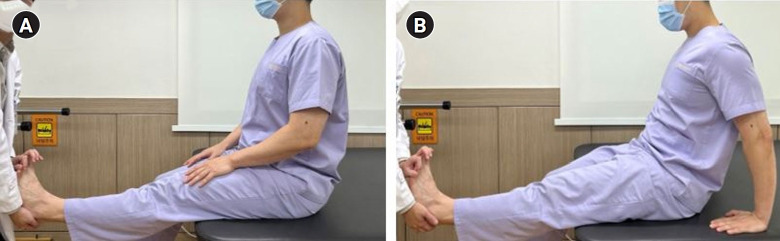
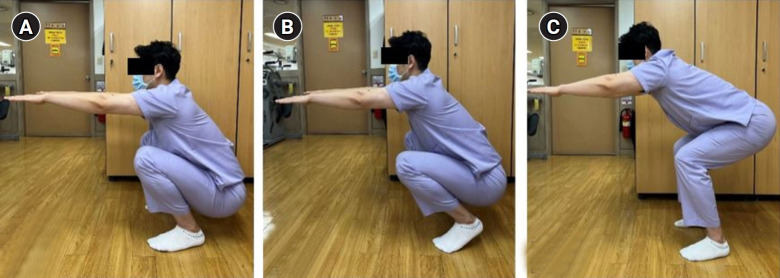
Methods: The squat posture grading system categorizes subjects' squat posture into three grades. Grade 1 is defined as being able to maintain a squatting posture with heels on the ground in full ankle dorsiflexion without effort. Grade 2 is defined as being able to perform the same position, but unable to maintain the position for more than 5 seconds or requiring trunk and leg muscle efforts to maintain the position. Grade 3 is defined as being unable to maintain the same position and falling backwards immediately if attempted to touch the ground with heels. Next, subjects' ankle dorsiflexion angles were directly measured in knee flexed and extended position by goniometer.
Results: Out of the 92 total subjects, 35 were in grade 1, 18 were in grade 2, and 39 were in grade 3. The average ankle dorsiflexion angle with knee flexed position were 23.13° for grade 1, 16.03° for grade 2, and 9.31° for grade 3. The average ankle dorsiflexion angle with knee extended position were 15.16° for grade 1, 7.92° for grade 2, and 3.40° for grade 3. Ankle dorsiflexion angles showed a significant decrease from grade 1 to 3 (p<0.05).
Conclusion: The squatting posture grading system defined in this study effectively graded the subjects based on the difference in their average ankle dorsiflexion angle. This system could be used as a quick screening method for limited ankle dorsiflexion.




 京公网安备 11010802042870号
京ICP备2023020795号-1
京公网安备 11010802042870号
京ICP备2023020795号-1

 分享
分享
 求助内容:
求助内容: 应助结果提醒方式:
 扫码关注我们
