{"title":"Pressure-induced water production using a copper–chromium Prussian blue analog†","authors":"Shintaro Akagi, Mayuko Tanaka, Junhao Wang, Hisao Kiuchi, Yoshihisa Harada, Yizhou Chen, Kazuhiro Marumoto, Kenta Imoto, Shin-ichi Ohkoshi and Hiroko Tokoro","doi":"10.1039/D4TA08305A","DOIUrl":null,"url":null,"abstract":"<p >To address the deterioration of water resources, on-site water production technologies have garnered attention. Herein, we demonstrate the example of pressure-induced water production using a copper–chromium Prussian blue analog (CuCr PBA). Applying pressure caused water droplets to generate from the CuCr PBA. Collecting the water droplets with a pipette revealed that approximately 240 g of water was obtained per 1 kg of CuCr PBA. One possible mechanism of water production could be the hydrophobization of pores at defect sites based on partial electron transfer from the oxygen of ligand water to copper upon pressure application. This article presents a new approach to water production, which is an important step towards the further development of the water environmental improvement technology.</p>","PeriodicalId":82,"journal":{"name":"Journal of Materials Chemistry A","volume":" 23","pages":" 18007-18013"},"PeriodicalIF":9.5000,"publicationDate":"2025-04-08","publicationTypes":"Journal Article","fieldsOfStudy":null,"isOpenAccess":false,"openAccessPdf":"","citationCount":"0","resultStr":null,"platform":"Semanticscholar","paperid":null,"PeriodicalName":"Journal of Materials Chemistry A","FirstCategoryId":"88","ListUrlMain":"https://pubs.rsc.org/en/content/articlelanding/2025/ta/d4ta08305a","RegionNum":2,"RegionCategory":"材料科学","ArticlePicture":[],"TitleCN":null,"AbstractTextCN":null,"PMCID":null,"EPubDate":"","PubModel":"","JCR":"Q1","JCRName":"CHEMISTRY, PHYSICAL","Score":null,"Total":0}
引用次数: 0
Abstract
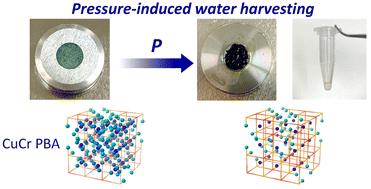
To address the deterioration of water resources, on-site water production technologies have garnered attention. Herein, we demonstrate the example of pressure-induced water production using a copper–chromium Prussian blue analog (CuCr PBA). Applying pressure caused water droplets to generate from the CuCr PBA. Collecting the water droplets with a pipette revealed that approximately 240 g of water was obtained per 1 kg of CuCr PBA. One possible mechanism of water production could be the hydrophobization of pores at defect sites based on partial electron transfer from the oxygen of ligand water to copper upon pressure application. This article presents a new approach to water production, which is an important step towards the further development of the water environmental improvement technology.
期刊介绍:
The Journal of Materials Chemistry A, B & C covers a wide range of high-quality studies in the field of materials chemistry, with each section focusing on specific applications of the materials studied. Journal of Materials Chemistry A emphasizes applications in energy and sustainability, including topics such as artificial photosynthesis, batteries, and fuel cells. Journal of Materials Chemistry B focuses on applications in biology and medicine, while Journal of Materials Chemistry C covers applications in optical, magnetic, and electronic devices. Example topic areas within the scope of Journal of Materials Chemistry A include catalysis, green/sustainable materials, sensors, and water treatment, among others.



 京公网安备 11010802042870号
京ICP备2023020795号-1
京公网安备 11010802042870号
京ICP备2023020795号-1

 分享
分享
 求助内容:
求助内容: 应助结果提醒方式:
 扫码关注我们
