Sikandar Iqbal, Aadil Nabi Chishti, Moazzam Ali, Javed Rehman, Fakhr uz Zaman, Ting Luo, Muhammad Ali, Samia Aman, Hamid Hussain, Huiqin Huang, Shakeel Ahmad Khandy, Yinzhu Jiang and Muhammad Yousaf
{"title":"Introduction of a multifunctional percolated framework into Na metal for highly stable sodium metal batteries†","authors":"Sikandar Iqbal, Aadil Nabi Chishti, Moazzam Ali, Javed Rehman, Fakhr uz Zaman, Ting Luo, Muhammad Ali, Samia Aman, Hamid Hussain, Huiqin Huang, Shakeel Ahmad Khandy, Yinzhu Jiang and Muhammad Yousaf","doi":"10.1039/D4TA09090J","DOIUrl":null,"url":null,"abstract":"<p >Introducing highly sodiophilic skeletons is a highly efficient approach to mitigating the challenges of sodium metal anodes (SMAs). However, the limited functionality of skeletons and poor processability of bare sodium metal further obstruct the practical application of SMAs. Herein, a stable SMA with high processability is realized by introducing a percolated multi-functional NPC/Na<small><sub>2</sub></small>Se framework throughout metallic Na using simple heating infusion and rolling/folding processes. This percolated framework provides mechanical strength to mitigate cracking and facilitates interconnected pathways for the rapid and even distribution of charges, reducing hotspots and promoting homogeneous Na deposition. Moreover, the Na<small><sub>2</sub></small>Se in the NPC/Na<small><sub>2</sub></small>Se framework produces a stable solid electrolyte interphase (SEI) for fast Na<small><sup>+</sup></small> diffusion. At the same time, the NPC acts as a 3D matrix to confine the Na and buffer the huge volume change. Consequently, the modified Na@NPC/Na<small><sub>2</sub></small>Se anode demonstrates excellent performance in both low-cost carbonate (1200 h at 1.0 mA cm<small><sup>−2</sup></small>) and ether-based (8000 h at 5.0 mA cm<small><sup>−2</sup></small>) electrolytes with high coulombic efficiency (99.89% after 200 h of plating/stripping). More remarkably, the Na@NPC/Na<small><sub>2</sub></small>Se‖NVP full cell manifests unprecedented cycling (85 mA h g<small><sup>−1</sup></small> at 20C after 4000 cycles) and excellent rate capability (∼105 mA h g<small><sup>−1</sup></small> at 50C). This electrode featuring a multi-functional framework creates new opportunities for the development of SMAs and can be extended to anode free batteries.</p>","PeriodicalId":82,"journal":{"name":"Journal of Materials Chemistry A","volume":" 20","pages":" 14982-14994"},"PeriodicalIF":9.5000,"publicationDate":"2025-04-08","publicationTypes":"Journal Article","fieldsOfStudy":null,"isOpenAccess":false,"openAccessPdf":"","citationCount":"0","resultStr":null,"platform":"Semanticscholar","paperid":null,"PeriodicalName":"Journal of Materials Chemistry A","FirstCategoryId":"88","ListUrlMain":"https://pubs.rsc.org/en/content/articlelanding/2025/ta/d4ta09090j","RegionNum":2,"RegionCategory":"材料科学","ArticlePicture":[],"TitleCN":null,"AbstractTextCN":null,"PMCID":null,"EPubDate":"","PubModel":"","JCR":"Q1","JCRName":"CHEMISTRY, PHYSICAL","Score":null,"Total":0}
引用次数: 0
Abstract
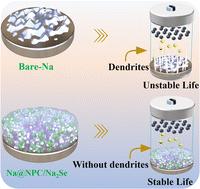
Introducing highly sodiophilic skeletons is a highly efficient approach to mitigating the challenges of sodium metal anodes (SMAs). However, the limited functionality of skeletons and poor processability of bare sodium metal further obstruct the practical application of SMAs. Herein, a stable SMA with high processability is realized by introducing a percolated multi-functional NPC/Na2Se framework throughout metallic Na using simple heating infusion and rolling/folding processes. This percolated framework provides mechanical strength to mitigate cracking and facilitates interconnected pathways for the rapid and even distribution of charges, reducing hotspots and promoting homogeneous Na deposition. Moreover, the Na2Se in the NPC/Na2Se framework produces a stable solid electrolyte interphase (SEI) for fast Na+ diffusion. At the same time, the NPC acts as a 3D matrix to confine the Na and buffer the huge volume change. Consequently, the modified Na@NPC/Na2Se anode demonstrates excellent performance in both low-cost carbonate (1200 h at 1.0 mA cm−2) and ether-based (8000 h at 5.0 mA cm−2) electrolytes with high coulombic efficiency (99.89% after 200 h of plating/stripping). More remarkably, the Na@NPC/Na2Se‖NVP full cell manifests unprecedented cycling (85 mA h g−1 at 20C after 4000 cycles) and excellent rate capability (∼105 mA h g−1 at 50C). This electrode featuring a multi-functional framework creates new opportunities for the development of SMAs and can be extended to anode free batteries.
引入高度亲钠骨架是缓解金属钠阳极(SMA)挑战的一种高效方法。然而,骨架的有限功能和裸金属钠的加工性差进一步阻碍了SMA的实际应用。本文通过简单的加热注入和轧制/折叠工艺,在金属Na中引入渗透性多功能NPC/Na2Se框架,实现了具有高加工性能的稳定SMA。这种渗透的框架提供了机械强度来减轻开裂,并促进了电荷快速均匀分布的相互连接途径,减少了热点,促进了均匀的Na沉积。此外,NPC/Na2Se框架中的Na2Se产生了稳定的固体电解质界面(SEI),用于Na+的快速扩散。同时,NPC作为一个3D矩阵来限制Na并缓冲巨大的体积变化。因此,改性Na@NPC/Na2Se阳极在低成本碳酸盐(在1.0 mA cm-2下1200 h)和醚基(在5.0 mA cm-2下8000 h)电解质中均表现出优异的性能,并具有高库仑效率(电镀/剥离200 h时达到99.89%)。更值得注意的是,Na@NPC/Na2Se||NVP全电池具有前所未有的循环能力(循环4000次后在20C下循环85 m Ah g-1)和优异的倍率能力(50C下~105 m Ah g-1)。这种具有多功能框架的电极为SMA的发展创造了新的机会,并可扩展到无阳极电池。
期刊介绍:
The Journal of Materials Chemistry A, B & C covers a wide range of high-quality studies in the field of materials chemistry, with each section focusing on specific applications of the materials studied. Journal of Materials Chemistry A emphasizes applications in energy and sustainability, including topics such as artificial photosynthesis, batteries, and fuel cells. Journal of Materials Chemistry B focuses on applications in biology and medicine, while Journal of Materials Chemistry C covers applications in optical, magnetic, and electronic devices. Example topic areas within the scope of Journal of Materials Chemistry A include catalysis, green/sustainable materials, sensors, and water treatment, among others.



 京公网安备 11010802042870号
京ICP备2023020795号-1
京公网安备 11010802042870号
京ICP备2023020795号-1

 分享
分享
 求助内容:
求助内容: 应助结果提醒方式:
 扫码关注我们
