Covalent organic framework encapsulated multi-walled carbon nanotubes for ultrasensitive electrochemical determination of lead ions in water and e-cigarette samples†
Hao Zhang, Hao Cheng, Dan Chen, Chunqiong Wang, Jingtao Mao, Zhihua Yang, Wen-Tong Chen, Lijun Li and Guangzhi Hu
{"title":"Covalent organic framework encapsulated multi-walled carbon nanotubes for ultrasensitive electrochemical determination of lead ions in water and e-cigarette samples†","authors":"Hao Zhang, Hao Cheng, Dan Chen, Chunqiong Wang, Jingtao Mao, Zhihua Yang, Wen-Tong Chen, Lijun Li and Guangzhi Hu","doi":"10.1039/D4NR04871G","DOIUrl":null,"url":null,"abstract":"<p >Trace amounts of lead ions present in aqueous solutions pose significant health risks to humans. Therefore, it is crucial to develop a sensor capable of rapidly detecting trace amounts of Pb(<small>II</small>). We developed a material utilising covalent organic frameworks encapsulating multi-walled carbon nanotubes (Tp-Bpy-COF@MWCNTs). The physicochemical properties of Tp-Bpy-COF@MWCNTs were analysed using transmission electron microscopy (TEM), scanning electron microscopy (SEM), X-ray photoelectron spectroscopy (XPS), X-ray diffraction (XRD), and Fourier transform infrared spectroscopy (FTIR), confirming the successful encapsulation of MWCNTs by the COF. Tp-Bpy-COF@MWCNTs exhibited excellent conductivity and a porous structure. Using the Tp-Bpy-COF@MWCNT sensor for Pb(<small>II</small>) detection, the detection limit reached 0.0749 μg L<small><sup>−1</sup></small>, demonstrating higher sensitivity at 0.221 μA μM<small><sup>−1</sup></small> cm<small><sup>2</sup></small> compared to existing technologies. Additionally, the sensor showed good recovery and repeatability for detecting Pb(<small>II</small>) in actual water samples, indicating its potential for Pb(<small>II</small>) detection applications.</p>","PeriodicalId":92,"journal":{"name":"Nanoscale","volume":" 17","pages":" 10876-10885"},"PeriodicalIF":5.1000,"publicationDate":"2025-04-08","publicationTypes":"Journal Article","fieldsOfStudy":null,"isOpenAccess":false,"openAccessPdf":"","citationCount":"0","resultStr":null,"platform":"Semanticscholar","paperid":null,"PeriodicalName":"Nanoscale","FirstCategoryId":"88","ListUrlMain":"https://pubs.rsc.org/en/content/articlelanding/2025/nr/d4nr04871g","RegionNum":3,"RegionCategory":"材料科学","ArticlePicture":[],"TitleCN":null,"AbstractTextCN":null,"PMCID":null,"EPubDate":"","PubModel":"","JCR":"Q1","JCRName":"CHEMISTRY, MULTIDISCIPLINARY","Score":null,"Total":0}
引用次数: 0
Abstract
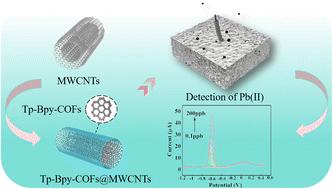
Trace amounts of lead ions present in aqueous solutions pose significant health risks to humans. Therefore, it is crucial to develop a sensor capable of rapidly detecting trace amounts of Pb(II). We developed a material utilising covalent organic frameworks encapsulating multi-walled carbon nanotubes (Tp-Bpy-COF@MWCNTs). The physicochemical properties of Tp-Bpy-COF@MWCNTs were analysed using transmission electron microscopy (TEM), scanning electron microscopy (SEM), X-ray photoelectron spectroscopy (XPS), X-ray diffraction (XRD), and Fourier transform infrared spectroscopy (FTIR), confirming the successful encapsulation of MWCNTs by the COF. Tp-Bpy-COF@MWCNTs exhibited excellent conductivity and a porous structure. Using the Tp-Bpy-COF@MWCNT sensor for Pb(II) detection, the detection limit reached 0.0749 μg L−1, demonstrating higher sensitivity at 0.221 μA μM−1 cm2 compared to existing technologies. Additionally, the sensor showed good recovery and repeatability for detecting Pb(II) in actual water samples, indicating its potential for Pb(II) detection applications.
期刊介绍:
Nanoscale is a high-impact international journal, publishing high-quality research across nanoscience and nanotechnology. Nanoscale publishes a full mix of research articles on experimental and theoretical work, including reviews, communications, and full papers.Highly interdisciplinary, this journal appeals to scientists, researchers and professionals interested in nanoscience and nanotechnology, quantum materials and quantum technology, including the areas of physics, chemistry, biology, medicine, materials, energy/environment, information technology, detection science, healthcare and drug discovery, and electronics.





 京公网安备 11010802042870号
京ICP备2023020795号-1
京公网安备 11010802042870号
京ICP备2023020795号-1

 分享
分享
 求助内容:
求助内容: 应助结果提醒方式:
 扫码关注我们
