Yaxin Zheng, Xinyue Ma, Shuyao Zhou, Wenwen Lei, Xuan Luo, Lei Zhou, Keming Xu, Wenying Zhong
{"title":"Alkaline Phosphatase and ATG4B Sequentially Activated Fluorescent Probe for Cancer Cell-Specific Live Imaging of Autophagy","authors":"Yaxin Zheng, Xinyue Ma, Shuyao Zhou, Wenwen Lei, Xuan Luo, Lei Zhou, Keming Xu, Wenying Zhong","doi":"10.1021/acs.analchem.4c06950","DOIUrl":null,"url":null,"abstract":"Tracking autophagy in cancer cells is crucial for enhancing cancer therapies. Existing methods are often inefficient and cannot distinguish cancer from normal cells during autophagy. Herein, a sequentially activated peptide probe, NBD-1p-Dabcyl, was developed for achieving cancer cell-specific imaging of autophagy. The probe self-assembled and fluoresced brightly upon sequential processing by alkaline phosphatase (ALP) and autophagy-related protease (ATG4B), where NBD-1p-Dabcyl was dephosphorylated by ALP to give NBD-1-Dabcyl, which was then processed by ATG4B into nanofibers emitting strong fluorescence. Notably, the bright fluorescence of NBD was observed in cancer cells MDA-MB-231 and HeLa, while normal cells NIH3T3 exhibited weaker fluorescence, allowing differentiation between cancer and normal cells using a rapamycin (Rap)-induced autophagy cell model. The enhanced fluorescence in cancer cells was attributed to the higher activities of intracellular ALP and ATG4B. Next, NBD-1p-Dabcyl was used to assess the inhibition efficiency of an autophagy inhibitor NSC 185058 in MDA-MB-231 cells, where a strong correlation between fluorescence intensity and inhibitor concentration suggested that NBD-1p-Dabcyl could predict the activity of autophagy inhibitors. Finally, animal experiments revealed that NBD-1p-Dabcyl effectively facilitated in situ fluorescence imaging of autophagy in tumor tissues. The design of this sequentially activated peptide probe offers a practical approach for monitoring autophagy in cancer cells, enabling high-throughput screening of autophagy inhibitors for cancer therapy.","PeriodicalId":27,"journal":{"name":"Analytical Chemistry","volume":"29 1","pages":""},"PeriodicalIF":6.7000,"publicationDate":"2025-04-08","publicationTypes":"Journal Article","fieldsOfStudy":null,"isOpenAccess":false,"openAccessPdf":"","citationCount":"0","resultStr":null,"platform":"Semanticscholar","paperid":null,"PeriodicalName":"Analytical Chemistry","FirstCategoryId":"92","ListUrlMain":"https://doi.org/10.1021/acs.analchem.4c06950","RegionNum":1,"RegionCategory":"化学","ArticlePicture":[],"TitleCN":null,"AbstractTextCN":null,"PMCID":null,"EPubDate":"","PubModel":"","JCR":"Q1","JCRName":"CHEMISTRY, ANALYTICAL","Score":null,"Total":0}
引用次数: 0
Abstract
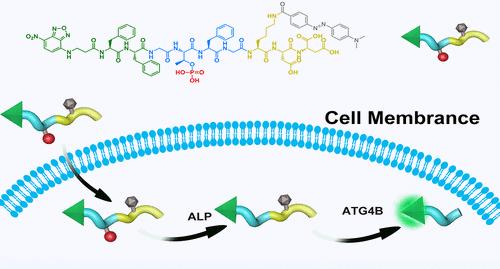
Tracking autophagy in cancer cells is crucial for enhancing cancer therapies. Existing methods are often inefficient and cannot distinguish cancer from normal cells during autophagy. Herein, a sequentially activated peptide probe, NBD-1p-Dabcyl, was developed for achieving cancer cell-specific imaging of autophagy. The probe self-assembled and fluoresced brightly upon sequential processing by alkaline phosphatase (ALP) and autophagy-related protease (ATG4B), where NBD-1p-Dabcyl was dephosphorylated by ALP to give NBD-1-Dabcyl, which was then processed by ATG4B into nanofibers emitting strong fluorescence. Notably, the bright fluorescence of NBD was observed in cancer cells MDA-MB-231 and HeLa, while normal cells NIH3T3 exhibited weaker fluorescence, allowing differentiation between cancer and normal cells using a rapamycin (Rap)-induced autophagy cell model. The enhanced fluorescence in cancer cells was attributed to the higher activities of intracellular ALP and ATG4B. Next, NBD-1p-Dabcyl was used to assess the inhibition efficiency of an autophagy inhibitor NSC 185058 in MDA-MB-231 cells, where a strong correlation between fluorescence intensity and inhibitor concentration suggested that NBD-1p-Dabcyl could predict the activity of autophagy inhibitors. Finally, animal experiments revealed that NBD-1p-Dabcyl effectively facilitated in situ fluorescence imaging of autophagy in tumor tissues. The design of this sequentially activated peptide probe offers a practical approach for monitoring autophagy in cancer cells, enabling high-throughput screening of autophagy inhibitors for cancer therapy.
期刊介绍:
Analytical Chemistry, a peer-reviewed research journal, focuses on disseminating new and original knowledge across all branches of analytical chemistry. Fundamental articles may explore general principles of chemical measurement science and need not directly address existing or potential analytical methodology. They can be entirely theoretical or report experimental results. Contributions may cover various phases of analytical operations, including sampling, bioanalysis, electrochemistry, mass spectrometry, microscale and nanoscale systems, environmental analysis, separations, spectroscopy, chemical reactions and selectivity, instrumentation, imaging, surface analysis, and data processing. Papers discussing known analytical methods should present a significant, original application of the method, a notable improvement, or results on an important analyte.



 京公网安备 11010802042870号
京ICP备2023020795号-1
京公网安备 11010802042870号
京ICP备2023020795号-1

 分享
分享
 求助内容:
求助内容: 应助结果提醒方式:
 扫码关注我们
