Lexun Li, Shuang Liu, Chundi Zhu, Shuxuan Shao, Fan Yang, Qiaoling Liu, Weihong Tan
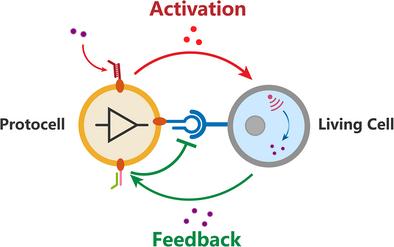
{"title":"DNA-Based Signal Circuit for Self-Regulated Bidirectional Communication in Protocell-Living Cell Communities","authors":"Lexun Li, Shuang Liu, Chundi Zhu, Shuxuan Shao, Fan Yang, Qiaoling Liu, Weihong Tan","doi":"10.1002/anie.202503903","DOIUrl":null,"url":null,"abstract":"<p>Developing synthetic biology tools to control cell-to-cell signaling can provide new capabilities to engineer cell-cell communication and program desired cellular behaviors. As cell mimics, abiotic protocells provide an attractive opportunity to modulate the intercellular communication with design-based regulatory features. Despite the chemical communication of protocells that interact with living cells have been demonstrated, the autonomous regulation of intercellular signal transmission in protocell/living cell community remains a critical challenge. Herein, we designed a DNA circuit consisting of a recognition module, activation module, and feedback module that enables protocells to self-regulate the interaction with living cells by sensing and responding to the signal released from living cells. The feedback module with renewable capability is capable of processing the signal transduction on the membrane surface of protocells and controlling intercellular adhesion. Once dissociated from living cells, the disengaged protocells allow the following interaction with multiple target living cells in succession. Overall, this work provides an avenue to control and program dynamic signal propagation in protocell/living cell community. The designed communication with living cells would open new ways to tune cellular behavior and apply them to cell-based therapeutics.</p>","PeriodicalId":125,"journal":{"name":"Angewandte Chemie International Edition","volume":"64 24","pages":""},"PeriodicalIF":16.9000,"publicationDate":"2025-04-07","publicationTypes":"Journal Article","fieldsOfStudy":null,"isOpenAccess":false,"openAccessPdf":"","citationCount":"0","resultStr":null,"platform":"Semanticscholar","paperid":null,"PeriodicalName":"Angewandte Chemie International Edition","FirstCategoryId":"92","ListUrlMain":"https://onlinelibrary.wiley.com/doi/10.1002/anie.202503903","RegionNum":1,"RegionCategory":"化学","ArticlePicture":[],"TitleCN":null,"AbstractTextCN":null,"PMCID":null,"EPubDate":"","PubModel":"","JCR":"Q1","JCRName":"CHEMISTRY, MULTIDISCIPLINARY","Score":null,"Total":0}
引用次数: 0
Abstract
Developing synthetic biology tools to control cell-to-cell signaling can provide new capabilities to engineer cell-cell communication and program desired cellular behaviors. As cell mimics, abiotic protocells provide an attractive opportunity to modulate the intercellular communication with design-based regulatory features. Despite the chemical communication of protocells that interact with living cells have been demonstrated, the autonomous regulation of intercellular signal transmission in protocell/living cell community remains a critical challenge. Herein, we designed a DNA circuit consisting of a recognition module, activation module, and feedback module that enables protocells to self-regulate the interaction with living cells by sensing and responding to the signal released from living cells. The feedback module with renewable capability is capable of processing the signal transduction on the membrane surface of protocells and controlling intercellular adhesion. Once dissociated from living cells, the disengaged protocells allow the following interaction with multiple target living cells in succession. Overall, this work provides an avenue to control and program dynamic signal propagation in protocell/living cell community. The designed communication with living cells would open new ways to tune cellular behavior and apply them to cell-based therapeutics.
期刊介绍:
Angewandte Chemie, a journal of the German Chemical Society (GDCh), maintains a leading position among scholarly journals in general chemistry with an impressive Impact Factor of 16.6 (2022 Journal Citation Reports, Clarivate, 2023). Published weekly in a reader-friendly format, it features new articles almost every day. Established in 1887, Angewandte Chemie is a prominent chemistry journal, offering a dynamic blend of Review-type articles, Highlights, Communications, and Research Articles on a weekly basis, making it unique in the field.



 京公网安备 11010802042870号
京ICP备2023020795号-1
京公网安备 11010802042870号
京ICP备2023020795号-1

 分享
分享
 求助内容:
求助内容: 应助结果提醒方式:
 扫码关注我们
