Development of Squaramides as Allosteric Modulators of the CB1 Receptor: Synthesis, Computational Studies, Biological Characterization, and Effects against Cocaine-Induced Behavioral Sensitization and Reinstatement in Rats
Thuy Nguyen, Ann M. Decker, Daniel G. Barrus, Chi Hyuck Song, Jianfeng Liu, Thomas F. Gamage, Danni L. Harris, Jun-Xu Li, Yanan Zhang
{"title":"Development of Squaramides as Allosteric Modulators of the CB1 Receptor: Synthesis, Computational Studies, Biological Characterization, and Effects against Cocaine-Induced Behavioral Sensitization and Reinstatement in Rats","authors":"Thuy Nguyen, Ann M. Decker, Daniel G. Barrus, Chi Hyuck Song, Jianfeng Liu, Thomas F. Gamage, Danni L. Harris, Jun-Xu Li, Yanan Zhang","doi":"10.1021/acs.jmedchem.5c00383","DOIUrl":null,"url":null,"abstract":"Cannabinoid receptor type 1 (CB<sub>1</sub>) negative allosteric modulators have emerged as an alternate approach to CB<sub>1</sub> orthosteric antagonists/inverse agonists for cocaine addiction treatment. This study explores aryl-alkyl squaramides as CB<sub>1</sub> allosteric modulators, featuring RTICBM-262 (<b>3</b>) with good in vitro potencies in CB<sub>1</sub> calcium mobilization, [<sup>35</sup>S]GTPγS binding, and cAMP assays. Molecular modeling studies suggest <b>3</b> bound in a similar pocket as Org27569, forming π-stacking with key residues H154<sup>2.41</sup> and W241<sup>4.50</sup>, and the potential C98–C107 disulfide bond had limited impact on its binding or receptor activation. ADME and in vivo pharmacokinetic studies suggest that <b>3</b> had reasonable metabolic stability, brain penetration, and selectivity against a panel of ∼ 50 targets but poor solubility and high protein binding. At 5.6 mg/kg (i.p.), <b>3</b> significantly attenuated both cocaine-seeking behavior specific to cue-induced reinstatement and cocaine-induced behavioral sensitization without altering locomotor activity. These results support squaramides as promising candidates for further investigation for cocaine addiction treatment.","PeriodicalId":46,"journal":{"name":"Journal of Medicinal Chemistry","volume":"14 1","pages":""},"PeriodicalIF":6.8000,"publicationDate":"2025-04-08","publicationTypes":"Journal Article","fieldsOfStudy":null,"isOpenAccess":false,"openAccessPdf":"","citationCount":"0","resultStr":null,"platform":"Semanticscholar","paperid":null,"PeriodicalName":"Journal of Medicinal Chemistry","FirstCategoryId":"3","ListUrlMain":"https://doi.org/10.1021/acs.jmedchem.5c00383","RegionNum":1,"RegionCategory":"医学","ArticlePicture":[],"TitleCN":null,"AbstractTextCN":null,"PMCID":null,"EPubDate":"","PubModel":"","JCR":"Q1","JCRName":"CHEMISTRY, MEDICINAL","Score":null,"Total":0}
引用次数: 0
Abstract
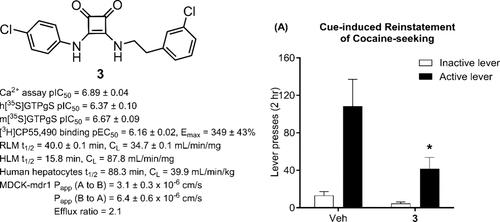
Cannabinoid receptor type 1 (CB1) negative allosteric modulators have emerged as an alternate approach to CB1 orthosteric antagonists/inverse agonists for cocaine addiction treatment. This study explores aryl-alkyl squaramides as CB1 allosteric modulators, featuring RTICBM-262 (3) with good in vitro potencies in CB1 calcium mobilization, [35S]GTPγS binding, and cAMP assays. Molecular modeling studies suggest 3 bound in a similar pocket as Org27569, forming π-stacking with key residues H1542.41 and W2414.50, and the potential C98–C107 disulfide bond had limited impact on its binding or receptor activation. ADME and in vivo pharmacokinetic studies suggest that 3 had reasonable metabolic stability, brain penetration, and selectivity against a panel of ∼ 50 targets but poor solubility and high protein binding. At 5.6 mg/kg (i.p.), 3 significantly attenuated both cocaine-seeking behavior specific to cue-induced reinstatement and cocaine-induced behavioral sensitization without altering locomotor activity. These results support squaramides as promising candidates for further investigation for cocaine addiction treatment.
期刊介绍:
The Journal of Medicinal Chemistry is a prestigious biweekly peer-reviewed publication that focuses on the multifaceted field of medicinal chemistry. Since its inception in 1959 as the Journal of Medicinal and Pharmaceutical Chemistry, it has evolved to become a cornerstone in the dissemination of research findings related to the design, synthesis, and development of therapeutic agents.
The Journal of Medicinal Chemistry is recognized for its significant impact in the scientific community, as evidenced by its 2022 impact factor of 7.3. This metric reflects the journal's influence and the importance of its content in shaping the future of drug discovery and development. The journal serves as a vital resource for chemists, pharmacologists, and other researchers interested in the molecular mechanisms of drug action and the optimization of therapeutic compounds.



 京公网安备 11010802042870号
京ICP备2023020795号-1
京公网安备 11010802042870号
京ICP备2023020795号-1

 分享
分享
 求助内容:
求助内容: 应助结果提醒方式:
 扫码关注我们
