Mengna Feng , Haiyue Qiu , Huimin Jiang , Wenjie Gao , Jing Lin , Xing Liu
{"title":"Accompanying Bi clusters can effectively enhance the photocatalytic H2O2 production performance of Bi2Sn2O7/g-C3N4 S-Scheme heterostructures","authors":"Mengna Feng , Haiyue Qiu , Huimin Jiang , Wenjie Gao , Jing Lin , Xing Liu","doi":"10.1016/j.carbon.2025.120253","DOIUrl":null,"url":null,"abstract":"<div><div>The construction of graphite-phase carbon nitride (g-C<sub>3</sub>N<sub>4</sub>) based heterojunction composites using the S-Scheme charge transfer mechanism is an effective strategy to enhance the photocatalytic production of H<sub>2</sub>O<sub>2</sub>. Herein, Bi<sub>2</sub>Sn<sub>2</sub>O<sub>7</sub>/g-C<sub>3</sub>N<sub>4</sub> heterojunction composites, featuring Bi clusters as charge transport mediators, were synthesized using self-assembly and in situ generation methods. Synchrotron radiation tests revealed the presence of Bi–Bi bonds, as well as Bi–N bonds, which not only facilitates the effective adsorption of reactive substances but also enhances charge transport at the interface. The successful construction of the S-Scheme charge transfer mechanism promotes the spatial separation of carriers in the conduction band, thereby inhibiting their recombination while maintaining a strong redox potential. This enhancement increases both the quantity and diversity of free radical species, ultimately boosting the generation of H<sub>2</sub>O<sub>2</sub>. Theoretical analyses indicate that the presence of Bi clusters reduces the adsorption energy of ∗OOH during the reaction. Notably, under visible light and simulated sunlight irradiation, the H<sub>2</sub>O<sub>2</sub> generation rates of B–BSO/g-CN reached 191.1 μmol L<sup>−1</sup> h<sup>−1</sup> and 156.1 μmol L<sup>−1</sup> h<sup>−1</sup>, which represent increases of 7.5 and 8.5 times, respectively, compared to pristine g-CN. This study underscores the significance of modulating the photocatalytic pathway through the targeted selection of metal clusters and reaction processes.</div></div>","PeriodicalId":262,"journal":{"name":"Carbon","volume":"238 ","pages":"Article 120253"},"PeriodicalIF":12.7000,"publicationDate":"2025-05-05","publicationTypes":"Journal Article","fieldsOfStudy":null,"isOpenAccess":false,"openAccessPdf":"","citationCount":"0","resultStr":null,"platform":"Semanticscholar","paperid":null,"PeriodicalName":"Carbon","FirstCategoryId":"88","ListUrlMain":"https://www.sciencedirect.com/science/article/pii/S0008622325002696","RegionNum":2,"RegionCategory":"材料科学","ArticlePicture":[],"TitleCN":null,"AbstractTextCN":null,"PMCID":null,"EPubDate":"2025/3/21 0:00:00","PubModel":"Epub","JCR":"Q1","JCRName":"CHEMISTRY, PHYSICAL","Score":null,"Total":0}
引用次数: 0
Abstract
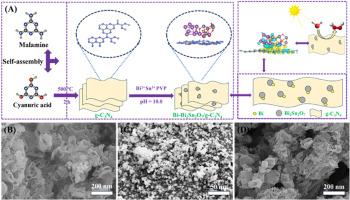
The construction of graphite-phase carbon nitride (g-C3N4) based heterojunction composites using the S-Scheme charge transfer mechanism is an effective strategy to enhance the photocatalytic production of H2O2. Herein, Bi2Sn2O7/g-C3N4 heterojunction composites, featuring Bi clusters as charge transport mediators, were synthesized using self-assembly and in situ generation methods. Synchrotron radiation tests revealed the presence of Bi–Bi bonds, as well as Bi–N bonds, which not only facilitates the effective adsorption of reactive substances but also enhances charge transport at the interface. The successful construction of the S-Scheme charge transfer mechanism promotes the spatial separation of carriers in the conduction band, thereby inhibiting their recombination while maintaining a strong redox potential. This enhancement increases both the quantity and diversity of free radical species, ultimately boosting the generation of H2O2. Theoretical analyses indicate that the presence of Bi clusters reduces the adsorption energy of ∗OOH during the reaction. Notably, under visible light and simulated sunlight irradiation, the H2O2 generation rates of B–BSO/g-CN reached 191.1 μmol L−1 h−1 and 156.1 μmol L−1 h−1, which represent increases of 7.5 and 8.5 times, respectively, compared to pristine g-CN. This study underscores the significance of modulating the photocatalytic pathway through the targeted selection of metal clusters and reaction processes.
期刊介绍:
The journal Carbon is an international multidisciplinary forum for communicating scientific advances in the field of carbon materials. It reports new findings related to the formation, structure, properties, behaviors, and technological applications of carbons. Carbons are a broad class of ordered or disordered solid phases composed primarily of elemental carbon, including but not limited to carbon black, carbon fibers and filaments, carbon nanotubes, diamond and diamond-like carbon, fullerenes, glassy carbon, graphite, graphene, graphene-oxide, porous carbons, pyrolytic carbon, and other sp2 and non-sp2 hybridized carbon systems. Carbon is the companion title to the open access journal Carbon Trends. Relevant application areas for carbon materials include biology and medicine, catalysis, electronic, optoelectronic, spintronic, high-frequency, and photonic devices, energy storage and conversion systems, environmental applications and water treatment, smart materials and systems, and structural and thermal applications.




 京公网安备 11010802042870号
京ICP备2023020795号-1
京公网安备 11010802042870号
京ICP备2023020795号-1

 分享
分享
 求助内容:
求助内容: 应助结果提醒方式:
 扫码关注我们
