Abbas Sabahi Namini , Sunghoon Jung , Nazmiye Gökçe Altınçekiç , Hyunho Noh , Mohammad A. Khalilzadeh , Zhengchun Liu , Rajender S. Varma , Ho Won Jang , Dokyoon Kim , Mohammadreza Shokouhimehr
{"title":"Utilization of sustainable nanocatalysts for the conversion of vulnerable waste oil into biodiesel","authors":"Abbas Sabahi Namini , Sunghoon Jung , Nazmiye Gökçe Altınçekiç , Hyunho Noh , Mohammad A. Khalilzadeh , Zhengchun Liu , Rajender S. Varma , Ho Won Jang , Dokyoon Kim , Mohammadreza Shokouhimehr","doi":"10.1016/j.molstruc.2025.142166","DOIUrl":null,"url":null,"abstract":"<div><div>With the increasing use of fossil fuels, there is a strong demand to shift energy reliance toward biodiesel as a sustainable and alternative energy resource. The viability of producing biofuels by converting different raw materials, including rapeseed oil, palm oil, sunflower oil, soybean oil, leftover cooking oil, waste frying oil, dairy scum, chicken fat, and others, has been the subject of a focused inquiry. Catalytic transesterifications have been popular methods for producing biodiesel due to their simplicity in operation, cost-effectiveness in commercial exploitation, higher biodiesel productivity, and conversion efficiency. In industrial chemical processes, heterogeneous catalysts are widely exploited because they are easy to separate from the final product and generally maintain their catalytic activity after being recycled repeatedly. Highly advanced heterogeneous catalysts, known as nanocatalysts, are frequently deployed to accelerate biodiesel production because of their remarkable catalytic activity. This review article examines the transesterification reactions facilitated by various nanocatalysts to explore their potential for promoting sustainable processes. Selected nanocatalysts are highlighted due to their exceptional catalytic efficiency and capacity to be reused. The conclusive summary discusses the numerous existing impediments in the production of biodiesel and proposes potential future research avenues in the utilization of advanced nanocatalysts.</div></div>","PeriodicalId":16414,"journal":{"name":"Journal of Molecular Structure","volume":"1338 ","pages":"Article 142166"},"PeriodicalIF":4.7000,"publicationDate":"2025-04-09","publicationTypes":"Journal Article","fieldsOfStudy":null,"isOpenAccess":false,"openAccessPdf":"","citationCount":"0","resultStr":null,"platform":"Semanticscholar","paperid":null,"PeriodicalName":"Journal of Molecular Structure","FirstCategoryId":"92","ListUrlMain":"https://www.sciencedirect.com/science/article/pii/S0022286025008506","RegionNum":2,"RegionCategory":"化学","ArticlePicture":[],"TitleCN":null,"AbstractTextCN":null,"PMCID":null,"EPubDate":"","PubModel":"","JCR":"Q2","JCRName":"CHEMISTRY, PHYSICAL","Score":null,"Total":0}
引用次数: 0
Abstract
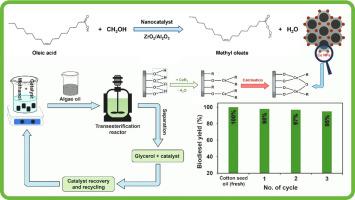
With the increasing use of fossil fuels, there is a strong demand to shift energy reliance toward biodiesel as a sustainable and alternative energy resource. The viability of producing biofuels by converting different raw materials, including rapeseed oil, palm oil, sunflower oil, soybean oil, leftover cooking oil, waste frying oil, dairy scum, chicken fat, and others, has been the subject of a focused inquiry. Catalytic transesterifications have been popular methods for producing biodiesel due to their simplicity in operation, cost-effectiveness in commercial exploitation, higher biodiesel productivity, and conversion efficiency. In industrial chemical processes, heterogeneous catalysts are widely exploited because they are easy to separate from the final product and generally maintain their catalytic activity after being recycled repeatedly. Highly advanced heterogeneous catalysts, known as nanocatalysts, are frequently deployed to accelerate biodiesel production because of their remarkable catalytic activity. This review article examines the transesterification reactions facilitated by various nanocatalysts to explore their potential for promoting sustainable processes. Selected nanocatalysts are highlighted due to their exceptional catalytic efficiency and capacity to be reused. The conclusive summary discusses the numerous existing impediments in the production of biodiesel and proposes potential future research avenues in the utilization of advanced nanocatalysts.
期刊介绍:
The Journal of Molecular Structure is dedicated to the publication of full-length articles and review papers, providing important new structural information on all types of chemical species including:
• Stable and unstable molecules in all types of environments (vapour, molecular beam, liquid, solution, liquid crystal, solid state, matrix-isolated, surface-absorbed etc.)
• Chemical intermediates
• Molecules in excited states
• Biological molecules
• Polymers.
The methods used may include any combination of spectroscopic and non-spectroscopic techniques, for example:
• Infrared spectroscopy (mid, far, near)
• Raman spectroscopy and non-linear Raman methods (CARS, etc.)
• Electronic absorption spectroscopy
• Optical rotatory dispersion and circular dichroism
• Fluorescence and phosphorescence techniques
• Electron spectroscopies (PES, XPS), EXAFS, etc.
• Microwave spectroscopy
• Electron diffraction
• NMR and ESR spectroscopies
• Mössbauer spectroscopy
• X-ray crystallography
• Charge Density Analyses
• Computational Studies (supplementing experimental methods)
We encourage publications combining theoretical and experimental approaches. The structural insights gained by the studies should be correlated with the properties, activity and/ or reactivity of the molecule under investigation and the relevance of this molecule and its implications should be discussed.




 京公网安备 11010802042870号
京ICP备2023020795号-1
京公网安备 11010802042870号
京ICP备2023020795号-1

 分享
分享
 求助内容:
求助内容: 应助结果提醒方式:
 扫码关注我们
