Junjie Wei , Xiangyi Gong , Dongliang Wang , Jiaqing He , Houmei Dai , Kai Wang , Yuxin Li , Yuxiao Li , Ziguo Liu , Jiaquan Zhang
{"title":"Selective hydrogen peroxide production through water oxidation reaction on Ti/SnO2-Sb-F electrode: Exploring the role of fluorine doping","authors":"Junjie Wei , Xiangyi Gong , Dongliang Wang , Jiaqing He , Houmei Dai , Kai Wang , Yuxin Li , Yuxiao Li , Ziguo Liu , Jiaquan Zhang","doi":"10.1016/j.jelechem.2025.119107","DOIUrl":null,"url":null,"abstract":"<div><div>The two-electron water oxidation reaction (WOR) is a promising approach for hydrogen peroxide production, which have many advantages over two-electron oxygen reduction reaction and traditional anthraquinone process. However, the WOR are ordinarily prone to proceed in four-electron path which ends in molecular oxygen production for most water oxidation scenarios. Developing high selective 2 electron WOR catalyst is needed. In this research, a group of fluorine and antimony doped sin dioxide coated titanium electrodes (Ti/SnO<sub>2</sub>-Sb-F) were synthesized to study the effect of fluorine doping on hydrogen peroxide production through WOR. The hydrogen peroxide production on Ti/SnO<sub>2</sub>-Sb-F-2 can reached 10.34 μmol·cm<sup>−1</sup>·min<sup>−1</sup> with a faradic efficiency of 30.13 % in sodium carbonate electrolyte solution. The production rate was 2.12 times higher than that of Ti/SnO<sub>2</sub>-Sb-F-0 without fluorine doping. Electrochemical characterization revealed that fluorine doping improved the conductivity of SnO<sub>2</sub> and resulted in high electrochemical activity for WOR. Theoretical calculation manifested fluorine doping makes WOR more energetically favorable toward hydrogen peroxide production. This paper provides a substantial approach for selection and synthesis of effective catalyst for 2 e<sup>−</sup> WOR.</div></div>","PeriodicalId":355,"journal":{"name":"Journal of Electroanalytical Chemistry","volume":"987 ","pages":"Article 119107"},"PeriodicalIF":4.1000,"publicationDate":"2025-06-15","publicationTypes":"Journal Article","fieldsOfStudy":null,"isOpenAccess":false,"openAccessPdf":"","citationCount":"0","resultStr":null,"platform":"Semanticscholar","paperid":null,"PeriodicalName":"Journal of Electroanalytical Chemistry","FirstCategoryId":"92","ListUrlMain":"https://www.sciencedirect.com/science/article/pii/S157266572500181X","RegionNum":3,"RegionCategory":"化学","ArticlePicture":[],"TitleCN":null,"AbstractTextCN":null,"PMCID":null,"EPubDate":"2025/4/4 0:00:00","PubModel":"Epub","JCR":"Q1","JCRName":"CHEMISTRY, ANALYTICAL","Score":null,"Total":0}
引用次数: 0
Abstract
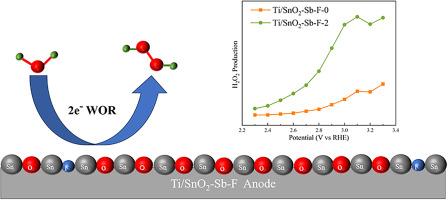
The two-electron water oxidation reaction (WOR) is a promising approach for hydrogen peroxide production, which have many advantages over two-electron oxygen reduction reaction and traditional anthraquinone process. However, the WOR are ordinarily prone to proceed in four-electron path which ends in molecular oxygen production for most water oxidation scenarios. Developing high selective 2 electron WOR catalyst is needed. In this research, a group of fluorine and antimony doped sin dioxide coated titanium electrodes (Ti/SnO2-Sb-F) were synthesized to study the effect of fluorine doping on hydrogen peroxide production through WOR. The hydrogen peroxide production on Ti/SnO2-Sb-F-2 can reached 10.34 μmol·cm−1·min−1 with a faradic efficiency of 30.13 % in sodium carbonate electrolyte solution. The production rate was 2.12 times higher than that of Ti/SnO2-Sb-F-0 without fluorine doping. Electrochemical characterization revealed that fluorine doping improved the conductivity of SnO2 and resulted in high electrochemical activity for WOR. Theoretical calculation manifested fluorine doping makes WOR more energetically favorable toward hydrogen peroxide production. This paper provides a substantial approach for selection and synthesis of effective catalyst for 2 e− WOR.
期刊介绍:
The Journal of Electroanalytical Chemistry is the foremost international journal devoted to the interdisciplinary subject of electrochemistry in all its aspects, theoretical as well as applied.
Electrochemistry is a wide ranging area that is in a state of continuous evolution. Rather than compiling a long list of topics covered by the Journal, the editors would like to draw particular attention to the key issues of novelty, topicality and quality. Papers should present new and interesting electrochemical science in a way that is accessible to the reader. The presentation and discussion should be at a level that is consistent with the international status of the Journal. Reports describing the application of well-established techniques to problems that are essentially technical will not be accepted. Similarly, papers that report observations but fail to provide adequate interpretation will be rejected by the Editors. Papers dealing with technical electrochemistry should be submitted to other specialist journals unless the authors can show that their work provides substantially new insights into electrochemical processes.



 京公网安备 11010802042870号
京ICP备2023020795号-1
京公网安备 11010802042870号
京ICP备2023020795号-1

 分享
分享
 求助内容:
求助内容: 应助结果提醒方式:
 扫码关注我们
