Nandini Robin Nadar , J. Deepak , S.C. Sharma , B.R. Radha Krushna , Chitathoor Sridhar , Subhashree Ray , R. Vini , H. Nagabhushana , R. Sowjanya , Puneeth B
{"title":"Novel scandium-doped cobalt chromate: Dopamine sensing and superior supercapacitor performance","authors":"Nandini Robin Nadar , J. Deepak , S.C. Sharma , B.R. Radha Krushna , Chitathoor Sridhar , Subhashree Ray , R. Vini , H. Nagabhushana , R. Sowjanya , Puneeth B","doi":"10.1016/j.mseb.2025.118306","DOIUrl":null,"url":null,"abstract":"<div><div>This study explores the electrochemical properties of scandium-doped cobalt chromate (SCC) for use in supercapacitors and dopamine sensors. The SCC-modified carbon paste electrode (MCPE) demonstrated a significantly enhanced electrochemically active surface area. Additionally, the SCC MCPE showed superior selectivity for dopamine (DA) detection, with a limit of detection (LOD) of 0.329 µM and an exceptional linear response (R<sup>2</sup> = 0.998) distinguishing DA from uric acid (UA), alongside a stability of approximately 91 % over 20 cycles. Cyclic voltammetry (CV) indicated enhanced redox behavior due to the incorporation of scandium. For supercapacitor applications, SCC nanocomposites were evaluated using CV and galvanostatic charge/discharge techniques, showing a specific capacitance of 250.53F g<sup>−1</sup> at 2 mV s<sup>−1</sup>, excellent stability over 5000 cycles with an 83.33 % retention rate, and notable energy storage and power delivery capabilities as illustrated by the Ragone plot. These findings underscore the potential of SCC nanocomposites for advanced electrochemical applications.</div></div>","PeriodicalId":18233,"journal":{"name":"Materials Science and Engineering: B","volume":"318 ","pages":"Article 118306"},"PeriodicalIF":4.6000,"publicationDate":"2025-04-09","publicationTypes":"Journal Article","fieldsOfStudy":null,"isOpenAccess":false,"openAccessPdf":"","citationCount":"0","resultStr":null,"platform":"Semanticscholar","paperid":null,"PeriodicalName":"Materials Science and Engineering: B","FirstCategoryId":"88","ListUrlMain":"https://www.sciencedirect.com/science/article/pii/S0921510725003290","RegionNum":3,"RegionCategory":"材料科学","ArticlePicture":[],"TitleCN":null,"AbstractTextCN":null,"PMCID":null,"EPubDate":"","PubModel":"","JCR":"Q2","JCRName":"MATERIALS SCIENCE, MULTIDISCIPLINARY","Score":null,"Total":0}
引用次数: 0
Abstract
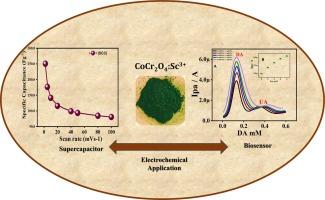
This study explores the electrochemical properties of scandium-doped cobalt chromate (SCC) for use in supercapacitors and dopamine sensors. The SCC-modified carbon paste electrode (MCPE) demonstrated a significantly enhanced electrochemically active surface area. Additionally, the SCC MCPE showed superior selectivity for dopamine (DA) detection, with a limit of detection (LOD) of 0.329 µM and an exceptional linear response (R2 = 0.998) distinguishing DA from uric acid (UA), alongside a stability of approximately 91 % over 20 cycles. Cyclic voltammetry (CV) indicated enhanced redox behavior due to the incorporation of scandium. For supercapacitor applications, SCC nanocomposites were evaluated using CV and galvanostatic charge/discharge techniques, showing a specific capacitance of 250.53F g−1 at 2 mV s−1, excellent stability over 5000 cycles with an 83.33 % retention rate, and notable energy storage and power delivery capabilities as illustrated by the Ragone plot. These findings underscore the potential of SCC nanocomposites for advanced electrochemical applications.
期刊介绍:
The journal provides an international medium for the publication of theoretical and experimental studies and reviews related to the electronic, electrochemical, ionic, magnetic, optical, and biosensing properties of solid state materials in bulk, thin film and particulate forms. Papers dealing with synthesis, processing, characterization, structure, physical properties and computational aspects of nano-crystalline, crystalline, amorphous and glassy forms of ceramics, semiconductors, layered insertion compounds, low-dimensional compounds and systems, fast-ion conductors, polymers and dielectrics are viewed as suitable for publication. Articles focused on nano-structured aspects of these advanced solid-state materials will also be considered suitable.



 京公网安备 11010802042870号
京ICP备2023020795号-1
京公网安备 11010802042870号
京ICP备2023020795号-1

 分享
分享
 求助内容:
求助内容: 应助结果提醒方式:
 扫码关注我们
