Sixian Wang, Zhuoer Chen, Shuang Jiang, Xiaoling Zheng, Yueyang Ren, Xunqing Nie, Wenyu Xiang, Xianlu Lei, Qi Sun, Tao Le
{"title":"Aptamer-based lateral flow strip for rapid detection of AFB1 in peanuts, soybeans, corn, and rice","authors":"Sixian Wang, Zhuoer Chen, Shuang Jiang, Xiaoling Zheng, Yueyang Ren, Xunqing Nie, Wenyu Xiang, Xianlu Lei, Qi Sun, Tao Le","doi":"10.1016/j.lwt.2025.117741","DOIUrl":null,"url":null,"abstract":"<div><div>Aflatoxin B1 (AFB1), a Group 1 carcinogenic mycotoxin, poses a significant threat to human health by contaminating crops. It is urgent to establish a simple and rapid detection method to promptly identify the risk of AFB1 residues, thereby mitigating its adverse health effects and reducing economic losses. In this study, a lateral flow strip (LFS) via a high-performance aptamer as the recognition element was developed for the detection of AFB1 in crops. Firstly, Aptamer7 was selected from 8 reported AFB1 aptamers employing molecular dynamics and the SYBR Green I assay, demonstrating good affinity and stability. Subsequently, gold nanoparticles (AuNPs)-based LFS was prepared with the application of Aptamer7. The results showed that the linear detection range was 1–200 ng/mL, with a limit of detection (LOD) of 0.23 ng/mL and strong anti-interference capability. Finally, the method's reliability was evaluated through AFB1-spiked samples. The average recoveries ranged from 92.51 to 119.21 %, with coefficients of variation (CV) between 1.47 and 6.32 % in peanuts, soybeans, corn, and rice. Moreover, the test results generated via the established method showed high consistency with those derived from high-performance liquid chromatography (HPLC), indicating that the LFS provides an alternative and promising strategy for monitoring AFB1 in crops.</div></div>","PeriodicalId":382,"journal":{"name":"LWT - Food Science and Technology","volume":"223 ","pages":"Article 117741"},"PeriodicalIF":6.6000,"publicationDate":"2025-05-01","publicationTypes":"Journal Article","fieldsOfStudy":null,"isOpenAccess":false,"openAccessPdf":"","citationCount":"0","resultStr":null,"platform":"Semanticscholar","paperid":null,"PeriodicalName":"LWT - Food Science and Technology","FirstCategoryId":"97","ListUrlMain":"https://www.sciencedirect.com/science/article/pii/S0023643825004256","RegionNum":1,"RegionCategory":"农林科学","ArticlePicture":[],"TitleCN":null,"AbstractTextCN":null,"PMCID":null,"EPubDate":"2025/4/5 0:00:00","PubModel":"Epub","JCR":"Q1","JCRName":"FOOD SCIENCE & TECHNOLOGY","Score":null,"Total":0}
引用次数: 0
Abstract
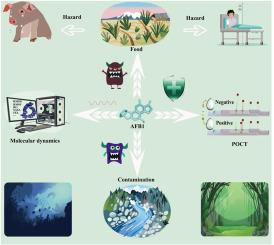
Aflatoxin B1 (AFB1), a Group 1 carcinogenic mycotoxin, poses a significant threat to human health by contaminating crops. It is urgent to establish a simple and rapid detection method to promptly identify the risk of AFB1 residues, thereby mitigating its adverse health effects and reducing economic losses. In this study, a lateral flow strip (LFS) via a high-performance aptamer as the recognition element was developed for the detection of AFB1 in crops. Firstly, Aptamer7 was selected from 8 reported AFB1 aptamers employing molecular dynamics and the SYBR Green I assay, demonstrating good affinity and stability. Subsequently, gold nanoparticles (AuNPs)-based LFS was prepared with the application of Aptamer7. The results showed that the linear detection range was 1–200 ng/mL, with a limit of detection (LOD) of 0.23 ng/mL and strong anti-interference capability. Finally, the method's reliability was evaluated through AFB1-spiked samples. The average recoveries ranged from 92.51 to 119.21 %, with coefficients of variation (CV) between 1.47 and 6.32 % in peanuts, soybeans, corn, and rice. Moreover, the test results generated via the established method showed high consistency with those derived from high-performance liquid chromatography (HPLC), indicating that the LFS provides an alternative and promising strategy for monitoring AFB1 in crops.
期刊介绍:
LWT - Food Science and Technology is an international journal that publishes innovative papers in the fields of food chemistry, biochemistry, microbiology, technology and nutrition. The work described should be innovative either in the approach or in the methods used. The significance of the results either for the science community or for the food industry must also be specified. Contributions written in English are welcomed in the form of review articles, short reviews, research papers, and research notes. Papers featuring animal trials and cell cultures are outside the scope of the journal and will not be considered for publication.



 京公网安备 11010802042870号
京ICP备2023020795号-1
京公网安备 11010802042870号
京ICP备2023020795号-1

 分享
分享
 求助内容:
求助内容: 应助结果提醒方式:
 扫码关注我们
