Atsuomi Shundo, Mika Aoki, Satoru Yamamoto and Keiji Tanaka
{"title":"Impact of cross-linking on the time–temperature superposition of creep rupture in epoxy resins†","authors":"Atsuomi Shundo, Mika Aoki, Satoru Yamamoto and Keiji Tanaka","doi":"10.1039/D4SM01540A","DOIUrl":null,"url":null,"abstract":"<p >Epoxy resins are an important class of thermosetting resins, and their network structure, formed by the curing reaction of epoxy and amine compounds, plays a crucial role in determining material properties, including creep behavior. We here applied the time–temperature superposition (TTS) principle to analyze the creep behavior of epoxy resins with well-defined network structures that were systematically varied based on the length of the <em>n</em>-alkyl diamine used. The superposition of isothermal creep curves under small stress was achieved through horizontal and vertical shifting, regardless of the length of the <em>n</em>-alkyl diamine. The temperature dependence of the horizontal shift factor was well described by the Williams–Landel–Ferry equation. Creep rupture measurements under large stress conditions revealed specimen rupture, and the time to rupture was plotted against the imposed stress. These plots, acquired at various temperatures, could be superimposed through horizontal shifting. As the diamine length decreased—namely, the distance between cross-linking points—the temperature dependence of the horizontal shift factors deviated from the WLF equation and exhibited Arrhenius-type behavior. The deviation was associated with differences in the fracture process involving chain scission, which became more pronounced as the diamine length decreased. The insights gained in this study should be valuable for controlling creep response and predicting the long-term durability of epoxy resins.</p>","PeriodicalId":103,"journal":{"name":"Soft Matter","volume":" 25","pages":" 5005-5013"},"PeriodicalIF":2.8000,"publicationDate":"2025-04-01","publicationTypes":"Journal Article","fieldsOfStudy":null,"isOpenAccess":false,"openAccessPdf":"https://pubs.rsc.org/en/content/articlepdf/2025/sm/d4sm01540a?page=search","citationCount":"0","resultStr":null,"platform":"Semanticscholar","paperid":null,"PeriodicalName":"Soft Matter","FirstCategoryId":"92","ListUrlMain":"https://pubs.rsc.org/en/content/articlelanding/2025/sm/d4sm01540a","RegionNum":3,"RegionCategory":"化学","ArticlePicture":[],"TitleCN":null,"AbstractTextCN":null,"PMCID":null,"EPubDate":"","PubModel":"","JCR":"Q3","JCRName":"CHEMISTRY, PHYSICAL","Score":null,"Total":0}
引用次数: 0
Abstract
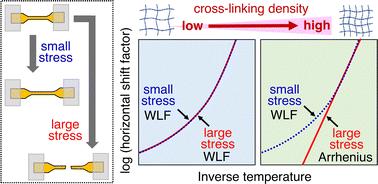
Epoxy resins are an important class of thermosetting resins, and their network structure, formed by the curing reaction of epoxy and amine compounds, plays a crucial role in determining material properties, including creep behavior. We here applied the time–temperature superposition (TTS) principle to analyze the creep behavior of epoxy resins with well-defined network structures that were systematically varied based on the length of the n-alkyl diamine used. The superposition of isothermal creep curves under small stress was achieved through horizontal and vertical shifting, regardless of the length of the n-alkyl diamine. The temperature dependence of the horizontal shift factor was well described by the Williams–Landel–Ferry equation. Creep rupture measurements under large stress conditions revealed specimen rupture, and the time to rupture was plotted against the imposed stress. These plots, acquired at various temperatures, could be superimposed through horizontal shifting. As the diamine length decreased—namely, the distance between cross-linking points—the temperature dependence of the horizontal shift factors deviated from the WLF equation and exhibited Arrhenius-type behavior. The deviation was associated with differences in the fracture process involving chain scission, which became more pronounced as the diamine length decreased. The insights gained in this study should be valuable for controlling creep response and predicting the long-term durability of epoxy resins.
期刊介绍:
Soft Matter is an international journal published by the Royal Society of Chemistry using Engineering-Materials Science: A Synthesis as its research focus. It publishes original research articles, review articles, and synthesis articles related to this field, reporting the latest discoveries in the relevant theoretical, practical, and applied disciplines in a timely manner, and aims to promote the rapid exchange of scientific information in this subject area. The journal is an open access journal. The journal is an open access journal and has not been placed on the alert list in the last three years.



 京公网安备 11010802042870号
京ICP备2023020795号-1
京公网安备 11010802042870号
京ICP备2023020795号-1

 分享
分享
 求助内容:
求助内容: 应助结果提醒方式:
 扫码关注我们
