Johannes Schwan, Merlin Kleoff, Gesa H. Dreyhsig, Patrick Voßnacker, Traute Fiedler, Marian Rosental, Sebastian Riedel
{"title":"Rethinking Chlorine: Essential Chemical or Replaceable Risk?","authors":"Johannes Schwan, Merlin Kleoff, Gesa H. Dreyhsig, Patrick Voßnacker, Traute Fiedler, Marian Rosental, Sebastian Riedel","doi":"10.1002/cssc.202402697","DOIUrl":null,"url":null,"abstract":"<p>This review critically examines the dual nature of chlorine as both an indispensable base chemical and a potential risk. Chlorine and its byproduct hydrogen chloride play essential roles in the production of pharmaceuticals, plastics, agrochemicals, and disinfectants. However, their inherent toxicity, risks of handling, and environmental impacts necessitate a reassessment of their use and sustainability. The review explores emerging and established chlorine-free technologies, such as the hydrogen peroxide to propylene oxide process and phosgene-free routes for polycarbonate production, evaluating their potential to reduce reliance on chlorine. For applications where chlorine remains indispensable, innovations such as trichloride- and bichloride-based ionic liquids provide safer storage and handling options for chlorine and hydrogen chloride, respectively. These ionic liquids not only enhance safety but also support renewable energy integration through their potential as indirect energy storage solutions. While chlorine is unlikely to be fully replaced in the near future, ongoing innovations in chlorine-free processes and safer technologies may redefine its industrial use, contributing to a more sustainable and secure chemical industry.</p>","PeriodicalId":149,"journal":{"name":"ChemSusChem","volume":"18 13","pages":""},"PeriodicalIF":6.6000,"publicationDate":"2025-04-08","publicationTypes":"Journal Article","fieldsOfStudy":null,"isOpenAccess":false,"openAccessPdf":"https://onlinelibrary.wiley.com/doi/epdf/10.1002/cssc.202402697","citationCount":"0","resultStr":null,"platform":"Semanticscholar","paperid":null,"PeriodicalName":"ChemSusChem","FirstCategoryId":"92","ListUrlMain":"https://chemistry-europe.onlinelibrary.wiley.com/doi/10.1002/cssc.202402697","RegionNum":2,"RegionCategory":"化学","ArticlePicture":[],"TitleCN":null,"AbstractTextCN":null,"PMCID":null,"EPubDate":"","PubModel":"","JCR":"Q1","JCRName":"CHEMISTRY, MULTIDISCIPLINARY","Score":null,"Total":0}
引用次数: 0
Abstract
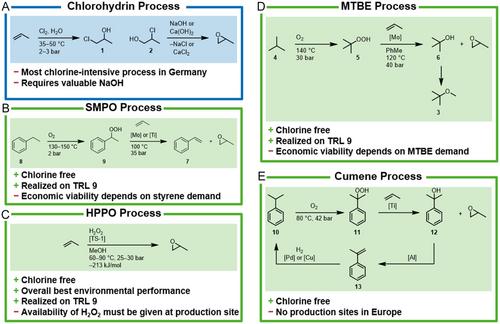
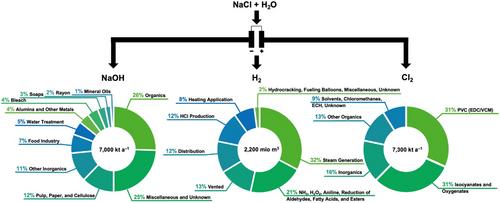
This review critically examines the dual nature of chlorine as both an indispensable base chemical and a potential risk. Chlorine and its byproduct hydrogen chloride play essential roles in the production of pharmaceuticals, plastics, agrochemicals, and disinfectants. However, their inherent toxicity, risks of handling, and environmental impacts necessitate a reassessment of their use and sustainability. The review explores emerging and established chlorine-free technologies, such as the hydrogen peroxide to propylene oxide process and phosgene-free routes for polycarbonate production, evaluating their potential to reduce reliance on chlorine. For applications where chlorine remains indispensable, innovations such as trichloride- and bichloride-based ionic liquids provide safer storage and handling options for chlorine and hydrogen chloride, respectively. These ionic liquids not only enhance safety but also support renewable energy integration through their potential as indirect energy storage solutions. While chlorine is unlikely to be fully replaced in the near future, ongoing innovations in chlorine-free processes and safer technologies may redefine its industrial use, contributing to a more sustainable and secure chemical industry.
期刊介绍:
ChemSusChem
Impact Factor (2016): 7.226
Scope:
Interdisciplinary journal
Focuses on research at the interface of chemistry and sustainability
Features the best research on sustainability and energy
Areas Covered:
Chemistry
Materials Science
Chemical Engineering
Biotechnology





 京公网安备 11010802042870号
京ICP备2023020795号-1
京公网安备 11010802042870号
京ICP备2023020795号-1

 分享
分享
 求助内容:
求助内容: 应助结果提醒方式:
 扫码关注我们
