Jordan Klein, Lorène Schad, Thérèse E. Malliavin and Martin Michael Müller
{"title":"Protein–membrane interactions with a twist†","authors":"Jordan Klein, Lorène Schad, Thérèse E. Malliavin and Martin Michael Müller","doi":"10.1039/D4SM01494D","DOIUrl":null,"url":null,"abstract":"<p >Within a framework of elasticity theory and geometry, the twister mechanism has been proposed some years ago for describing the interaction between a biofilament containing a twisted hydrophobic strip and a lipid membrane: this mechanism is capable of inducing deformations of the membrane, which can lead to its opening. The present work intends to extend this model to the interactions between a membrane and protein regions conserving their folds using coarse-grained molecular dynamics simulations. The protein region is modeled as a cylinder stabilized by a tensegrity scheme, leading to an elasticity similar to that observed in real proteins. Recording molecular dynamics trajectories of this cylinder in the presence of a fluid lipid bilayer membrane allows investigation of the effect of the positions of the hydrophobic parts on the interaction with the membrane. The entire configuration space is explored by systematically varying the hydrophobic strip width, the twisting of the strip as well as the range of hydrophobic interactions between the cylinder and the membrane. Three different states are observed: no interaction between the cylinder and membrane, the cylinder in contact with the membrane surface and the cylinder inserted into the membrane with a variable tilt angle. The variations of the tilt angle are explained using a qualitative model based on the total hydrophobic moment of the cylinder. A deformation pattern of the membrane, previously predicted for the filament–membrane interaction by the twister model, is observed for the state when the cylinder is in contact with the membrane surface, which allows estimation of the applied torques.</p>","PeriodicalId":103,"journal":{"name":"Soft Matter","volume":" 22","pages":" 4336-4350"},"PeriodicalIF":2.8000,"publicationDate":"2025-04-08","publicationTypes":"Journal Article","fieldsOfStudy":null,"isOpenAccess":false,"openAccessPdf":"https://pubs.rsc.org/en/content/articlepdf/2025/sm/d4sm01494d?page=search","citationCount":"0","resultStr":null,"platform":"Semanticscholar","paperid":null,"PeriodicalName":"Soft Matter","FirstCategoryId":"92","ListUrlMain":"https://pubs.rsc.org/en/content/articlelanding/2025/sm/d4sm01494d","RegionNum":3,"RegionCategory":"化学","ArticlePicture":[],"TitleCN":null,"AbstractTextCN":null,"PMCID":null,"EPubDate":"","PubModel":"","JCR":"Q3","JCRName":"CHEMISTRY, PHYSICAL","Score":null,"Total":0}
引用次数: 0
Abstract
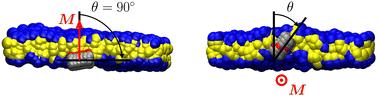
Within a framework of elasticity theory and geometry, the twister mechanism has been proposed some years ago for describing the interaction between a biofilament containing a twisted hydrophobic strip and a lipid membrane: this mechanism is capable of inducing deformations of the membrane, which can lead to its opening. The present work intends to extend this model to the interactions between a membrane and protein regions conserving their folds using coarse-grained molecular dynamics simulations. The protein region is modeled as a cylinder stabilized by a tensegrity scheme, leading to an elasticity similar to that observed in real proteins. Recording molecular dynamics trajectories of this cylinder in the presence of a fluid lipid bilayer membrane allows investigation of the effect of the positions of the hydrophobic parts on the interaction with the membrane. The entire configuration space is explored by systematically varying the hydrophobic strip width, the twisting of the strip as well as the range of hydrophobic interactions between the cylinder and the membrane. Three different states are observed: no interaction between the cylinder and membrane, the cylinder in contact with the membrane surface and the cylinder inserted into the membrane with a variable tilt angle. The variations of the tilt angle are explained using a qualitative model based on the total hydrophobic moment of the cylinder. A deformation pattern of the membrane, previously predicted for the filament–membrane interaction by the twister model, is observed for the state when the cylinder is in contact with the membrane surface, which allows estimation of the applied torques.
期刊介绍:
Soft Matter is an international journal published by the Royal Society of Chemistry using Engineering-Materials Science: A Synthesis as its research focus. It publishes original research articles, review articles, and synthesis articles related to this field, reporting the latest discoveries in the relevant theoretical, practical, and applied disciplines in a timely manner, and aims to promote the rapid exchange of scientific information in this subject area. The journal is an open access journal. The journal is an open access journal and has not been placed on the alert list in the last three years.



 京公网安备 11010802042870号
京ICP备2023020795号-1
京公网安备 11010802042870号
京ICP备2023020795号-1

 分享
分享
 求助内容:
求助内容: 应助结果提醒方式:
 扫码关注我们
