{"title":"Synthesis and Structure of Naphthoyl Thiourea-Based Binuclear Ruthenium(II) Arene Complexes: Studies on Anticancer Activity and Apoptotic Mechanism","authors":"Abirami Arunachalam, Ramesh Rengan","doi":"10.1002/cbic.202500057","DOIUrl":null,"url":null,"abstract":"<p>Herein, the synthesis, characterization, and anticancer activity of ruthenium(II) <i>p</i>-cymene complexes comprising naphthoyl thiourea-based ligands are described. The synthesized N^O and N^S chelating ruthenium(II) complexes (<b>1–3</b>) are fully characterized by elemental analysis and spectral (fourier transform-infrared, Ultraviolet-visible, nuclear magnetic resonance, mass) methods. The structure of complex 2 has been elucidated by employing single-crystal X-ray diffraction, which verifies the two bidentate N^O and N^S coordination of the thiourea ligand to two Ru(II) centers. All the complexes have been screened for their anticancer efficacy in breast (MCF-7), colon (HT-29), liver (HepG2) cancerous cells, and noncancerous kidney (Hek-293) cells. Among them, complex <b>2</b> with an IC<sub>50</sub> concentration of 3.59 ± 0.72 μ<span>m</span> exhibits the most potent activity in HT-29 cells, surpassing the positive control, cisplatin. This may be due to the hydrophobic nature of the <i>p</i>-cymene moiety and electron-releasing methoxy group in the ligand scaffold. In addition, acridine orange-ethidium bromide and Hoechst labeling of all the complexes (<b>1–3</b>) on HT-29 cells reveal morphological alterations such as nuclear fragmentation and chromatin condensation resulting from the death of cancerous cells via apoptosis. Biochemical assays such as reactive oxygen species, mitochondrial membrane potential, and flow cytometry strongly confirm the cell death via mitochondrial dysfunction-mediated apoptosis.</p>","PeriodicalId":140,"journal":{"name":"ChemBioChem","volume":"26 10","pages":""},"PeriodicalIF":2.8000,"publicationDate":"2025-04-07","publicationTypes":"Journal Article","fieldsOfStudy":null,"isOpenAccess":false,"openAccessPdf":"","citationCount":"0","resultStr":null,"platform":"Semanticscholar","paperid":null,"PeriodicalName":"ChemBioChem","FirstCategoryId":"99","ListUrlMain":"https://chemistry-europe.onlinelibrary.wiley.com/doi/10.1002/cbic.202500057","RegionNum":4,"RegionCategory":"生物学","ArticlePicture":[],"TitleCN":null,"AbstractTextCN":null,"PMCID":null,"EPubDate":"","PubModel":"","JCR":"Q3","JCRName":"BIOCHEMISTRY & MOLECULAR BIOLOGY","Score":null,"Total":0}
引用次数: 0
Abstract
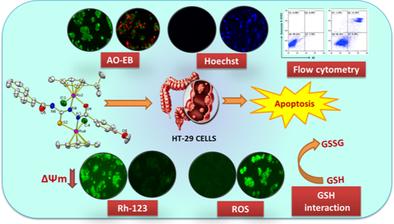
Herein, the synthesis, characterization, and anticancer activity of ruthenium(II) p-cymene complexes comprising naphthoyl thiourea-based ligands are described. The synthesized N^O and N^S chelating ruthenium(II) complexes (1–3) are fully characterized by elemental analysis and spectral (fourier transform-infrared, Ultraviolet-visible, nuclear magnetic resonance, mass) methods. The structure of complex 2 has been elucidated by employing single-crystal X-ray diffraction, which verifies the two bidentate N^O and N^S coordination of the thiourea ligand to two Ru(II) centers. All the complexes have been screened for their anticancer efficacy in breast (MCF-7), colon (HT-29), liver (HepG2) cancerous cells, and noncancerous kidney (Hek-293) cells. Among them, complex 2 with an IC50 concentration of 3.59 ± 0.72 μm exhibits the most potent activity in HT-29 cells, surpassing the positive control, cisplatin. This may be due to the hydrophobic nature of the p-cymene moiety and electron-releasing methoxy group in the ligand scaffold. In addition, acridine orange-ethidium bromide and Hoechst labeling of all the complexes (1–3) on HT-29 cells reveal morphological alterations such as nuclear fragmentation and chromatin condensation resulting from the death of cancerous cells via apoptosis. Biochemical assays such as reactive oxygen species, mitochondrial membrane potential, and flow cytometry strongly confirm the cell death via mitochondrial dysfunction-mediated apoptosis.
期刊介绍:
ChemBioChem (Impact Factor 2018: 2.641) publishes important breakthroughs across all areas at the interface of chemistry and biology, including the fields of chemical biology, bioorganic chemistry, bioinorganic chemistry, synthetic biology, biocatalysis, bionanotechnology, and biomaterials. It is published on behalf of Chemistry Europe, an association of 16 European chemical societies, and supported by the Asian Chemical Editorial Society (ACES).





 京公网安备 11010802042870号
京ICP备2023020795号-1
京公网安备 11010802042870号
京ICP备2023020795号-1

 分享
分享
 求助内容:
求助内容: 应助结果提醒方式:
 扫码关注我们
