Utilization of phenolic lignin dimer models for the quantification of monolignols in biomass and in its derived organosolv lignins via thioacidolysis and GC-MS analysis†
T. Tran Ho, Olivia-Stella Salm, Tiit Lukk and Maria Kulp
{"title":"Utilization of phenolic lignin dimer models for the quantification of monolignols in biomass and in its derived organosolv lignins via thioacidolysis and GC-MS analysis†","authors":"T. Tran Ho, Olivia-Stella Salm, Tiit Lukk and Maria Kulp","doi":"10.1039/D5AY00073D","DOIUrl":null,"url":null,"abstract":"<p >A thorough understanding of lignin's fundamental chemistry in lignocellulosic materials is essential for maximizing the efficiency of biorefineries. Thioacidolysis, followed by gas chromatography-mass spectrometry (GC-MS), has emerged as a reliable method for quantifying uncondensed monolignols, which are linked by labile aryl ether bonds within lignin network. However, the lack of commercially available pure thioethylated lignin monomers for GC analysis poses a challenge. This necessitates a multi-step synthesis process, which may not be feasible for all laboratories. We propose a novel approach that utilizes readily available phenolic lignin model dimers to establish a calibration curve for thioacidolysis quantification. These dimers, guaiacylglycerol-β-guaiacyl ether (GGE) and syringylglycerol-β-guaiacyl ether (SGE), upon thioacidolysis, yield thioethylated non-condensed guaiacyl (G) and syringyl (S) monomers. The GC-MS responses of these monomers are compared to those of bisphenol E, an internal standard (IS) to generate the calibration curve. This methodology exhibits excellent performance characteristics and was successfully employed to determine the thioethylated monomer contents and calculate of S/G ratios in three representative biomasses: aspen, barley straw, pine, and their organosolv lignin extracts.</p>","PeriodicalId":64,"journal":{"name":"Analytical Methods","volume":" 16","pages":" 3283-3289"},"PeriodicalIF":2.6000,"publicationDate":"2025-04-08","publicationTypes":"Journal Article","fieldsOfStudy":null,"isOpenAccess":false,"openAccessPdf":"https://pubs.rsc.org/en/content/articlepdf/2025/ay/d5ay00073d?page=search","citationCount":"0","resultStr":null,"platform":"Semanticscholar","paperid":null,"PeriodicalName":"Analytical Methods","FirstCategoryId":"92","ListUrlMain":"https://pubs.rsc.org/en/content/articlelanding/2025/ay/d5ay00073d","RegionNum":3,"RegionCategory":"化学","ArticlePicture":[],"TitleCN":null,"AbstractTextCN":null,"PMCID":null,"EPubDate":"","PubModel":"","JCR":"Q2","JCRName":"CHEMISTRY, ANALYTICAL","Score":null,"Total":0}
引用次数: 0
Abstract
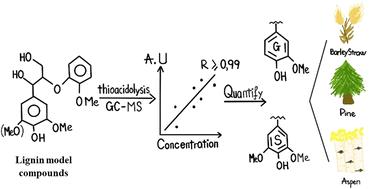
A thorough understanding of lignin's fundamental chemistry in lignocellulosic materials is essential for maximizing the efficiency of biorefineries. Thioacidolysis, followed by gas chromatography-mass spectrometry (GC-MS), has emerged as a reliable method for quantifying uncondensed monolignols, which are linked by labile aryl ether bonds within lignin network. However, the lack of commercially available pure thioethylated lignin monomers for GC analysis poses a challenge. This necessitates a multi-step synthesis process, which may not be feasible for all laboratories. We propose a novel approach that utilizes readily available phenolic lignin model dimers to establish a calibration curve for thioacidolysis quantification. These dimers, guaiacylglycerol-β-guaiacyl ether (GGE) and syringylglycerol-β-guaiacyl ether (SGE), upon thioacidolysis, yield thioethylated non-condensed guaiacyl (G) and syringyl (S) monomers. The GC-MS responses of these monomers are compared to those of bisphenol E, an internal standard (IS) to generate the calibration curve. This methodology exhibits excellent performance characteristics and was successfully employed to determine the thioethylated monomer contents and calculate of S/G ratios in three representative biomasses: aspen, barley straw, pine, and their organosolv lignin extracts.




 京公网安备 11010802042870号
京ICP备2023020795号-1
京公网安备 11010802042870号
京ICP备2023020795号-1

 分享
分享
 求助内容:
求助内容: 应助结果提醒方式:
 扫码关注我们
