Huan He, Zi Yang Zhou, Di Zhan, Yong Zhang, Wen Cheng Xia, Bo Fu, Feng Juan Lan, Xiu Xiang Tao, Zai Xing Huang
{"title":"Adsorption characteristics of sulfate reducing bacteria Clostridium sp. on lignite surface","authors":"Huan He, Zi Yang Zhou, Di Zhan, Yong Zhang, Wen Cheng Xia, Bo Fu, Feng Juan Lan, Xiu Xiang Tao, Zai Xing Huang","doi":"10.1007/s11356-025-36319-1","DOIUrl":null,"url":null,"abstract":"<div><p>Biogenic coal bed methane has attracted great attention in recent years. During the process of biogas production, the interaction between microorganisms and coal is a crucial step. Sulfate-reducing bacteria (SRB) play an important role in biogas production. However, the interaction between SRB and coal has always remained an open problem. In the present work, the SRB strain <i>Clostridium</i> sp. and lignite were used to investigate the adsorption process with the extended DLVO (XDLVO) theory, calorimetry, and scanning electron microscopy (SEM). The results showed that the adsorption rate has a positive correlation with pH when it went from 3 to 8. XDLVO theoretical analysis was in good agreement with the adsorption experimental result. Acid–base potential energy is a more critical factor driving the adsorption comparing with electrostatic potential energy and Lifshitz-van Der Waals potential energy. The adsorption process of <i>Clostridium</i> sp. cells on lignite surface can be divided into three main stages: the direct adsorption, or reversible adsorption; desorption process; and irreversible adsorption. From the SEM results, the intercellular cohesion is also a very important adsorption form. The morphology and roughness of coal surface may also have a key effect on adsorption. Overall, our results provide some insights into the surface energy changes of <i>Clostridium</i> sp. adsorbed on coal and their interactions from the perspective of adsorption kinetics.</p></div>","PeriodicalId":545,"journal":{"name":"Environmental Science and Pollution Research","volume":"32 17","pages":"11052 - 11062"},"PeriodicalIF":5.8000,"publicationDate":"2025-04-07","publicationTypes":"Journal Article","fieldsOfStudy":null,"isOpenAccess":false,"openAccessPdf":"","citationCount":"0","resultStr":null,"platform":"Semanticscholar","paperid":null,"PeriodicalName":"Environmental Science and Pollution Research","FirstCategoryId":"93","ListUrlMain":"https://link.springer.com/article/10.1007/s11356-025-36319-1","RegionNum":3,"RegionCategory":"环境科学与生态学","ArticlePicture":[],"TitleCN":null,"AbstractTextCN":null,"PMCID":null,"EPubDate":"","PubModel":"","JCR":"0","JCRName":"ENVIRONMENTAL SCIENCES","Score":null,"Total":0}
引用次数: 0
Abstract
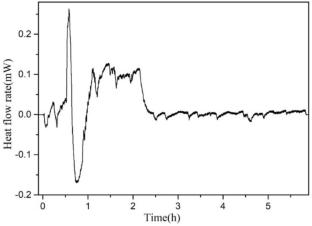
Biogenic coal bed methane has attracted great attention in recent years. During the process of biogas production, the interaction between microorganisms and coal is a crucial step. Sulfate-reducing bacteria (SRB) play an important role in biogas production. However, the interaction between SRB and coal has always remained an open problem. In the present work, the SRB strain Clostridium sp. and lignite were used to investigate the adsorption process with the extended DLVO (XDLVO) theory, calorimetry, and scanning electron microscopy (SEM). The results showed that the adsorption rate has a positive correlation with pH when it went from 3 to 8. XDLVO theoretical analysis was in good agreement with the adsorption experimental result. Acid–base potential energy is a more critical factor driving the adsorption comparing with electrostatic potential energy and Lifshitz-van Der Waals potential energy. The adsorption process of Clostridium sp. cells on lignite surface can be divided into three main stages: the direct adsorption, or reversible adsorption; desorption process; and irreversible adsorption. From the SEM results, the intercellular cohesion is also a very important adsorption form. The morphology and roughness of coal surface may also have a key effect on adsorption. Overall, our results provide some insights into the surface energy changes of Clostridium sp. adsorbed on coal and their interactions from the perspective of adsorption kinetics.
期刊介绍:
Environmental Science and Pollution Research (ESPR) serves the international community in all areas of Environmental Science and related subjects with emphasis on chemical compounds. This includes:
- Terrestrial Biology and Ecology
- Aquatic Biology and Ecology
- Atmospheric Chemistry
- Environmental Microbiology/Biobased Energy Sources
- Phytoremediation and Ecosystem Restoration
- Environmental Analyses and Monitoring
- Assessment of Risks and Interactions of Pollutants in the Environment
- Conservation Biology and Sustainable Agriculture
- Impact of Chemicals/Pollutants on Human and Animal Health
It reports from a broad interdisciplinary outlook.



 京公网安备 11010802042870号
京ICP备2023020795号-1
京公网安备 11010802042870号
京ICP备2023020795号-1

 分享
分享
 求助内容:
求助内容: 应助结果提醒方式:
 扫码关注我们
