{"title":"Synaptic Plasticity Linked to Ionotropic Glutamate Receptors After Nicotine Exposure.","authors":"Aqsa Kazmi, Eun Sang Choe","doi":"10.2174/011570159X365159250311142852","DOIUrl":null,"url":null,"abstract":"<p><p>Tobacco dependence is a chronic, relapsing disorder with significant socioeconomic and health impacts that lead to considerable morbidity and mortality worldwide. Nicotine is the primary component responsible for the initiation and continuation of tobacco use. Nicotine exposure causes multiple alterations in the structure and function of the brain's reward system. Evidence shows that synaptic plasticity, a key event that modifies neural circuit structure and function, is largely influenced by changes in glutamatergic neurotransmission in the forebrain's reward pathways. It is now widely accepted that α-amino-3-hydroxy-5-methyl-4-isoxazolepropionic acid receptors (AMPARs) modify synaptic strength within the reward circuitry. Dendritic spines, the primary sites of synaptic plasticity, exhibit an array of structural adaptations in size and shape influenced by neural activity, which correlates with alterations in the strength of synaptic connections. Such alterations in dendritic spine morphology largely depend on the remodeling of the underlying actin cytoskeleton. The dynamics of the actin cytoskeleton are regulated by several modulators, including actin-binding proteins, protein kinases, and small GTPases. This review focuses on the restructuring of the dendritic spine machinery and the relevant changes in synaptic strength mediated by AMPARs in key brain areas involved in addiction. However, our understanding of the neural pathways governing the emergence and significance of the structural and functional changes that lead to addiction-like behaviors after prolonged nicotine exposure remains insufficient. Comprehending these essential neural processes could deepen our insight into the progression and maintenance of nicotine dependence.</p>","PeriodicalId":10905,"journal":{"name":"Current Neuropharmacology","volume":" ","pages":"1380-1392"},"PeriodicalIF":5.3000,"publicationDate":"2025-01-01","publicationTypes":"Journal Article","fieldsOfStudy":null,"isOpenAccess":false,"openAccessPdf":"https://www.ncbi.nlm.nih.gov/pmc/articles/PMC12616546/pdf/","citationCount":"0","resultStr":null,"platform":"Semanticscholar","paperid":null,"PeriodicalName":"Current Neuropharmacology","FirstCategoryId":"3","ListUrlMain":"https://doi.org/10.2174/011570159X365159250311142852","RegionNum":2,"RegionCategory":"医学","ArticlePicture":[],"TitleCN":null,"AbstractTextCN":null,"PMCID":null,"EPubDate":"","PubModel":"","JCR":"Q1","JCRName":"NEUROSCIENCES","Score":null,"Total":0}
引用次数: 0
Abstract
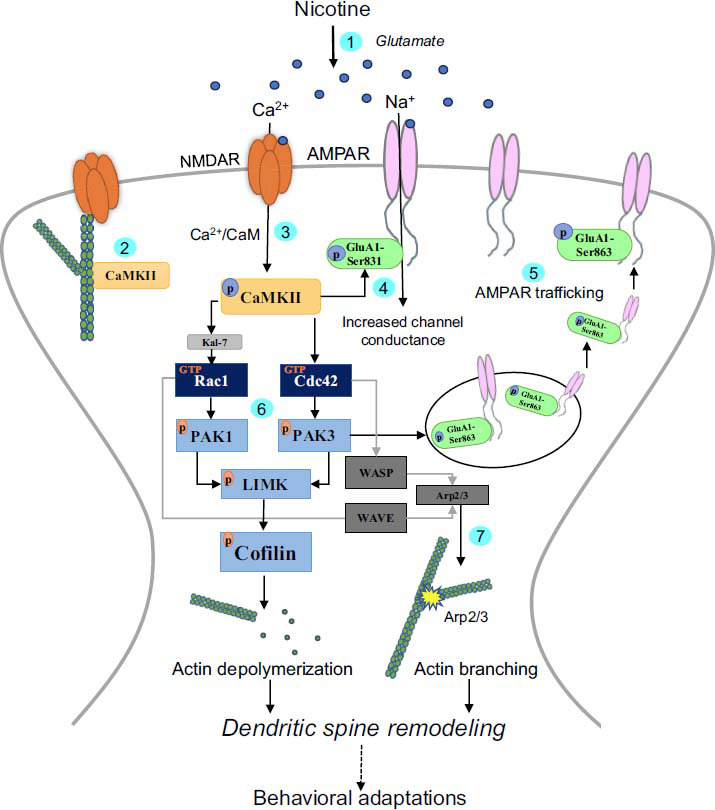
Tobacco dependence is a chronic, relapsing disorder with significant socioeconomic and health impacts that lead to considerable morbidity and mortality worldwide. Nicotine is the primary component responsible for the initiation and continuation of tobacco use. Nicotine exposure causes multiple alterations in the structure and function of the brain's reward system. Evidence shows that synaptic plasticity, a key event that modifies neural circuit structure and function, is largely influenced by changes in glutamatergic neurotransmission in the forebrain's reward pathways. It is now widely accepted that α-amino-3-hydroxy-5-methyl-4-isoxazolepropionic acid receptors (AMPARs) modify synaptic strength within the reward circuitry. Dendritic spines, the primary sites of synaptic plasticity, exhibit an array of structural adaptations in size and shape influenced by neural activity, which correlates with alterations in the strength of synaptic connections. Such alterations in dendritic spine morphology largely depend on the remodeling of the underlying actin cytoskeleton. The dynamics of the actin cytoskeleton are regulated by several modulators, including actin-binding proteins, protein kinases, and small GTPases. This review focuses on the restructuring of the dendritic spine machinery and the relevant changes in synaptic strength mediated by AMPARs in key brain areas involved in addiction. However, our understanding of the neural pathways governing the emergence and significance of the structural and functional changes that lead to addiction-like behaviors after prolonged nicotine exposure remains insufficient. Comprehending these essential neural processes could deepen our insight into the progression and maintenance of nicotine dependence.
期刊介绍:
Current Neuropharmacology aims to provide current, comprehensive/mini reviews and guest edited issues of all areas of neuropharmacology and related matters of neuroscience. The reviews cover the fields of molecular, cellular, and systems/behavioural aspects of neuropharmacology and neuroscience.
The journal serves as a comprehensive, multidisciplinary expert forum for neuropharmacologists and neuroscientists.



 京公网安备 11010802042870号
京ICP备2023020795号-1
京公网安备 11010802042870号
京ICP备2023020795号-1

 分享
分享
 求助内容:
求助内容: 应助结果提醒方式:
 扫码关注我们
