Zhi-Jun Zhang, Ru Gao, Yu-Tong Lu, Zhi-Liang Zuo, Yu-Huan Li, Shan Liu, Si-Yuan Song, Yi Wang, Hongyan Lai
{"title":"Factors affecting dysbiosis of the gut microbiota in the elderly and the progress of interventions in traditional Chinese and Western medicine.","authors":"Zhi-Jun Zhang, Ru Gao, Yu-Tong Lu, Zhi-Liang Zuo, Yu-Huan Li, Shan Liu, Si-Yuan Song, Yi Wang, Hongyan Lai","doi":"10.3389/fcimb.2025.1529347","DOIUrl":null,"url":null,"abstract":"<p><p>As the population ages, intestinal health in the elderly has become a key area of concern, with gut microbiota dysbiosis emerging as a significant issue. This review summarizes the factors influencing dysbiosis and interventions from both traditional Chinese medicine (TCM) and Western medicine, offering a reference for future research. A comprehensive search of global databases up to March 2024 identified 617 original studies on gut microbiota dysbiosis in individuals aged 65 and older. After applying strict PRISMA guidelines, 20 articles met the inclusion criteria. Key findings are summarized in four areas: 1) the definition and mechanisms of dysbiosis, 2) evaluation tools for gut microbiota imbalance, 3) factors contributing to dysbiosis in the elderly, and 4) pharmacological treatments. Both TCM and Western medicine offer unique advantages in managing gut microbiota dysbiosis, and the choice of intervention should be tailored to the individual's condition. Future research should focus on optimizing integrated TCM and Western medicine approaches to improve outcomes for elderly patients with gut microbiota dysbiosis.</p>","PeriodicalId":12458,"journal":{"name":"Frontiers in Cellular and Infection Microbiology","volume":"15 ","pages":"1529347"},"PeriodicalIF":4.8000,"publicationDate":"2025-03-24","publicationTypes":"Journal Article","fieldsOfStudy":null,"isOpenAccess":false,"openAccessPdf":"https://www.ncbi.nlm.nih.gov/pmc/articles/PMC11973376/pdf/","citationCount":"0","resultStr":null,"platform":"Semanticscholar","paperid":null,"PeriodicalName":"Frontiers in Cellular and Infection Microbiology","FirstCategoryId":"3","ListUrlMain":"https://doi.org/10.3389/fcimb.2025.1529347","RegionNum":2,"RegionCategory":"医学","ArticlePicture":[],"TitleCN":null,"AbstractTextCN":null,"PMCID":null,"EPubDate":"2025/1/1 0:00:00","PubModel":"eCollection","JCR":"Q2","JCRName":"IMMUNOLOGY","Score":null,"Total":0}
引用次数: 0
Abstract
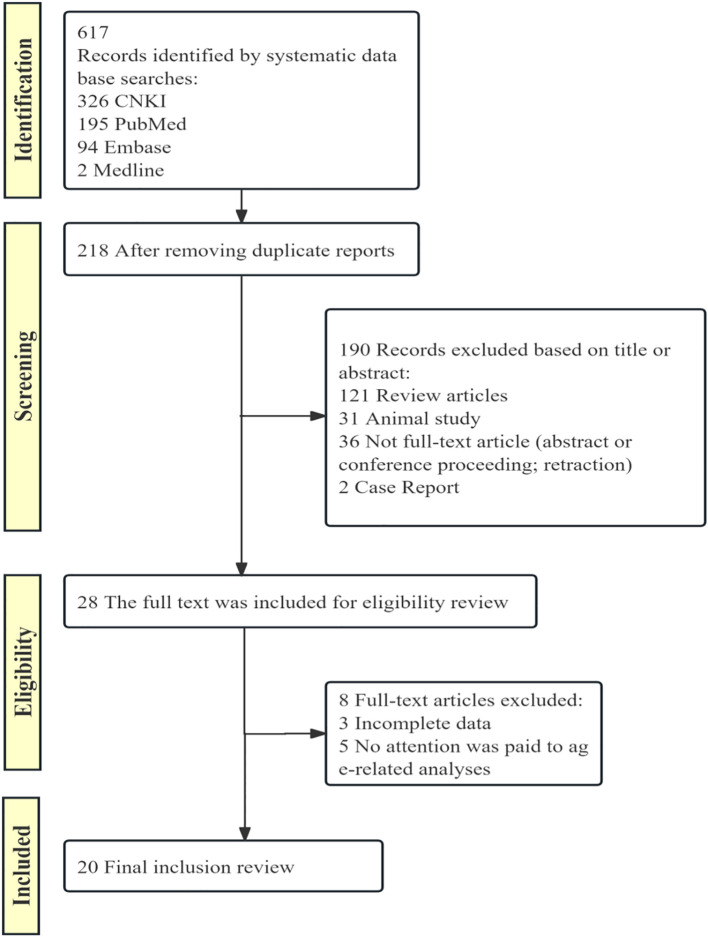
As the population ages, intestinal health in the elderly has become a key area of concern, with gut microbiota dysbiosis emerging as a significant issue. This review summarizes the factors influencing dysbiosis and interventions from both traditional Chinese medicine (TCM) and Western medicine, offering a reference for future research. A comprehensive search of global databases up to March 2024 identified 617 original studies on gut microbiota dysbiosis in individuals aged 65 and older. After applying strict PRISMA guidelines, 20 articles met the inclusion criteria. Key findings are summarized in four areas: 1) the definition and mechanisms of dysbiosis, 2) evaluation tools for gut microbiota imbalance, 3) factors contributing to dysbiosis in the elderly, and 4) pharmacological treatments. Both TCM and Western medicine offer unique advantages in managing gut microbiota dysbiosis, and the choice of intervention should be tailored to the individual's condition. Future research should focus on optimizing integrated TCM and Western medicine approaches to improve outcomes for elderly patients with gut microbiota dysbiosis.
期刊介绍:
Frontiers in Cellular and Infection Microbiology is a leading specialty journal, publishing rigorously peer-reviewed research across all pathogenic microorganisms and their interaction with their hosts. Chief Editor Yousef Abu Kwaik, University of Louisville is supported by an outstanding Editorial Board of international experts. This multidisciplinary open-access journal is at the forefront of disseminating and communicating scientific knowledge and impactful discoveries to researchers, academics, clinicians and the public worldwide.
Frontiers in Cellular and Infection Microbiology includes research on bacteria, fungi, parasites, viruses, endosymbionts, prions and all microbial pathogens as well as the microbiota and its effect on health and disease in various hosts. The research approaches include molecular microbiology, cellular microbiology, gene regulation, proteomics, signal transduction, pathogenic evolution, genomics, structural biology, and virulence factors as well as model hosts. Areas of research to counteract infectious agents by the host include the host innate and adaptive immune responses as well as metabolic restrictions to various pathogenic microorganisms, vaccine design and development against various pathogenic microorganisms, and the mechanisms of antibiotic resistance and its countermeasures.







 京公网安备 11010802042870号
京ICP备2023020795号-1
京公网安备 11010802042870号
京ICP备2023020795号-1

 分享
分享
 求助内容:
求助内容: 应助结果提醒方式:
 扫码关注我们
