{"title":"AI Applications for Chronic Condition Self-Management: Scoping Review.","authors":"Misun Hwang, Yaguang Zheng, Youmin Cho, Yun Jiang","doi":"10.2196/59632","DOIUrl":null,"url":null,"abstract":"<p><strong>Background: </strong>Artificial intelligence (AI) has potential in promoting and supporting self-management in patients with chronic conditions. However, the development and application of current AI technologies to meet patients' needs and improve their performance in chronic condition self-management tasks remain poorly understood. It is crucial to gather comprehensive information to guide the development and selection of effective AI solutions tailored for self-management in patients with chronic conditions.</p><p><strong>Objective: </strong>This scoping review aimed to provide a comprehensive overview of AI applications for chronic condition self-management based on 3 essential self-management tasks, medical, behavioral, and emotional self-management, and to identify the current developmental stages and knowledge gaps of AI applications for chronic condition self-management.</p><p><strong>Methods: </strong>A literature review was conducted for studies published in English between January 2011 and October 2024. In total, 4 databases, including PubMed, Web of Science, CINAHL, and PsycINFO, were searched using combined terms related to self-management and AI. The inclusion criteria included studies focused on the adult population with any type of chronic condition and AI technologies supporting self-management. This review was conducted following the PRISMA-ScR (Preferred Reporting Items for Systematic Reviews and Meta-Analyses Extension for Scoping Reviews) guidelines.</p><p><strong>Results: </strong>Of the 1873 articles retrieved from the search, 66 (3.5%) were eligible and included in this review. The most studied chronic condition was diabetes (20/66, 30%). Regarding self-management tasks, most studies aimed to support medical (45/66, 68%) or behavioral self-management (27/66, 41%), and fewer studies focused on emotional self-management (14/66, 21%). Conversational AI (21/66, 32%) and multiple machine learning algorithms (16/66, 24%) were the most used AI technologies. However, most AI technologies remained in the algorithm development (25/66, 38%) or early feasibility testing stages (25/66, 38%).</p><p><strong>Conclusions: </strong>A variety of AI technologies have been developed and applied in chronic condition self-management, primarily for medication, symptoms, and lifestyle self-management. Fewer AI technologies were developed for emotional self-management tasks, and most AIs remained in the early developmental stages. More research is needed to generate evidence for integrating AI into chronic condition self-management to obtain optimal health outcomes.</p>","PeriodicalId":16337,"journal":{"name":"Journal of Medical Internet Research","volume":"27 ","pages":"e59632"},"PeriodicalIF":6.0000,"publicationDate":"2025-04-08","publicationTypes":"Journal Article","fieldsOfStudy":null,"isOpenAccess":false,"openAccessPdf":"https://www.ncbi.nlm.nih.gov/pmc/articles/PMC12015343/pdf/","citationCount":"0","resultStr":null,"platform":"Semanticscholar","paperid":null,"PeriodicalName":"Journal of Medical Internet Research","FirstCategoryId":"3","ListUrlMain":"https://doi.org/10.2196/59632","RegionNum":2,"RegionCategory":"医学","ArticlePicture":[],"TitleCN":null,"AbstractTextCN":null,"PMCID":null,"EPubDate":"","PubModel":"","JCR":"Q1","JCRName":"HEALTH CARE SCIENCES & SERVICES","Score":null,"Total":0}
引用次数: 0
Abstract
Background: Artificial intelligence (AI) has potential in promoting and supporting self-management in patients with chronic conditions. However, the development and application of current AI technologies to meet patients' needs and improve their performance in chronic condition self-management tasks remain poorly understood. It is crucial to gather comprehensive information to guide the development and selection of effective AI solutions tailored for self-management in patients with chronic conditions.
Objective: This scoping review aimed to provide a comprehensive overview of AI applications for chronic condition self-management based on 3 essential self-management tasks, medical, behavioral, and emotional self-management, and to identify the current developmental stages and knowledge gaps of AI applications for chronic condition self-management.
Methods: A literature review was conducted for studies published in English between January 2011 and October 2024. In total, 4 databases, including PubMed, Web of Science, CINAHL, and PsycINFO, were searched using combined terms related to self-management and AI. The inclusion criteria included studies focused on the adult population with any type of chronic condition and AI technologies supporting self-management. This review was conducted following the PRISMA-ScR (Preferred Reporting Items for Systematic Reviews and Meta-Analyses Extension for Scoping Reviews) guidelines.
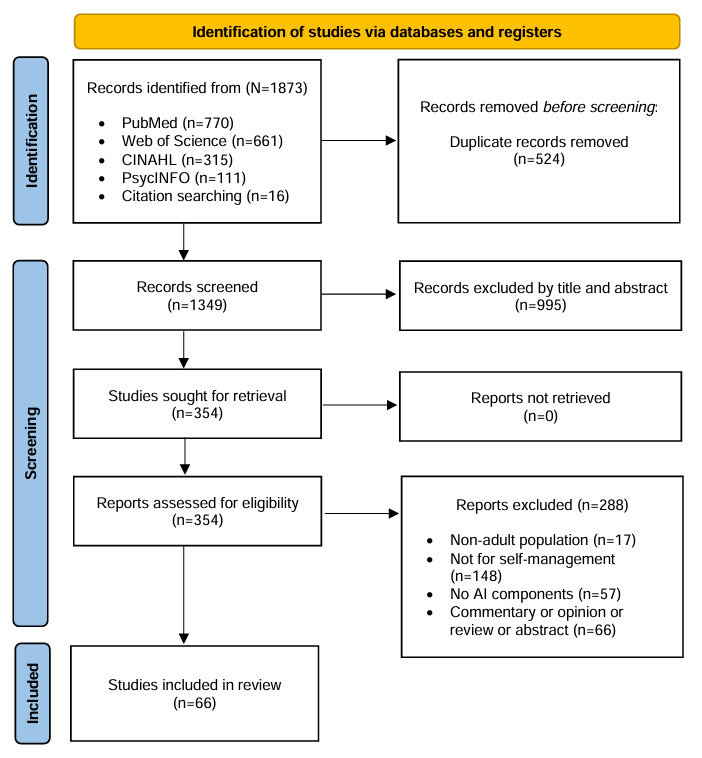
Results: Of the 1873 articles retrieved from the search, 66 (3.5%) were eligible and included in this review. The most studied chronic condition was diabetes (20/66, 30%). Regarding self-management tasks, most studies aimed to support medical (45/66, 68%) or behavioral self-management (27/66, 41%), and fewer studies focused on emotional self-management (14/66, 21%). Conversational AI (21/66, 32%) and multiple machine learning algorithms (16/66, 24%) were the most used AI technologies. However, most AI technologies remained in the algorithm development (25/66, 38%) or early feasibility testing stages (25/66, 38%).
Conclusions: A variety of AI technologies have been developed and applied in chronic condition self-management, primarily for medication, symptoms, and lifestyle self-management. Fewer AI technologies were developed for emotional self-management tasks, and most AIs remained in the early developmental stages. More research is needed to generate evidence for integrating AI into chronic condition self-management to obtain optimal health outcomes.
背景:人工智能(AI)在促进和支持慢性病患者自我管理方面具有潜力。然而,目前人工智能技术的发展和应用,以满足患者的需求,提高他们在慢性疾病自我管理任务中的表现,仍然知之甚少。至关重要的是要收集全面的信息,以指导制定和选择针对慢性疾病患者自我管理的有效人工智能解决方案。目的:基于医学、行为和情绪自我管理这3个基本自我管理任务,对人工智能在慢性疾病自我管理中的应用进行综述,并确定人工智能在慢性疾病自我管理中的应用目前的发展阶段和知识空白。方法:回顾性分析2011年1月至2024年10月间发表的英文文献。总共有4个数据库,包括PubMed、Web of Science、CINAHL和PsycINFO,使用与自我管理和人工智能相关的组合术语进行了搜索。纳入标准包括关注患有任何类型慢性病的成年人群和支持自我管理的人工智能技术的研究。本综述遵循PRISMA-ScR(系统评价优选报告项目和荟萃分析扩展范围评价)指南进行。结果:在检索到的1873篇文章中,66篇(3.5%)符合条件并纳入本综述。研究最多的慢性疾病是糖尿病(20/66,30%)。关于自我管理任务,大多数研究旨在支持医学(45/66,68%)或行为自我管理(27/66,41%),较少的研究侧重于情绪自我管理(14/66,21%)。会话式人工智能(21/66,32%)和多机器学习算法(16/66,24%)是使用最多的人工智能技术。然而,大多数人工智能技术仍处于算法开发阶段(25/66,38%)或早期可行性测试阶段(25/66,38%)。结论:多种人工智能技术已被开发并应用于慢性病自我管理,主要用于药物、症状和生活方式的自我管理。用于情绪自我管理任务的人工智能技术较少,大多数人工智能仍处于早期发展阶段。需要更多的研究来提供证据,将人工智能纳入慢性病自我管理,以获得最佳的健康结果。
期刊介绍:
The Journal of Medical Internet Research (JMIR) is a highly respected publication in the field of health informatics and health services. With a founding date in 1999, JMIR has been a pioneer in the field for over two decades.
As a leader in the industry, the journal focuses on digital health, data science, health informatics, and emerging technologies for health, medicine, and biomedical research. It is recognized as a top publication in these disciplines, ranking in the first quartile (Q1) by Impact Factor.
Notably, JMIR holds the prestigious position of being ranked #1 on Google Scholar within the "Medical Informatics" discipline.



 京公网安备 11010802042870号
京ICP备2023020795号-1
京公网安备 11010802042870号
京ICP备2023020795号-1

 分享
分享

 求助内容:
求助内容: 应助结果提醒方式:
 扫码关注我们
