Michaela-Kristina Keck, Anna Tietze, Brigitte Bison, Shivaram Avula, Julien Engelhardt, Cécile Faure-Conter, Tanguy Fenouil, Dominique Figarella-Branger, Einar Goebell, Johannes Gojo, Christine Haberler, Juhana Hakumäki, James T Hayden, Laura S Korhonen, Ewa Koscielniak, Christof M Kramm, Mariëtte E G Kranendonk, Maarten Lequin, Louise E Ludlow, David Meyronet, Per Nyman, Ingrid Øra, Thomas Perwein, Jouni Pesola, Tuomas Rauramaa, Roel Reddingius, David Samuel, Antoinette Y N Schouten-van Meeteren, Alexandra Sexton-Oates, Alexandre Vasiljevic, Thekla von Kalle, Annika K Wefers, Pieter Wesseling, Josef Zamecnik, Michal Zapotocky, Katja von Hoff, David T W Jones
{"title":"Comparative Clinical and Imaging-Based Evaluation of Therapeutic Modalities in CNS Embryonal Tumours With PLAGL Amplification.","authors":"Michaela-Kristina Keck, Anna Tietze, Brigitte Bison, Shivaram Avula, Julien Engelhardt, Cécile Faure-Conter, Tanguy Fenouil, Dominique Figarella-Branger, Einar Goebell, Johannes Gojo, Christine Haberler, Juhana Hakumäki, James T Hayden, Laura S Korhonen, Ewa Koscielniak, Christof M Kramm, Mariëtte E G Kranendonk, Maarten Lequin, Louise E Ludlow, David Meyronet, Per Nyman, Ingrid Øra, Thomas Perwein, Jouni Pesola, Tuomas Rauramaa, Roel Reddingius, David Samuel, Antoinette Y N Schouten-van Meeteren, Alexandra Sexton-Oates, Alexandre Vasiljevic, Thekla von Kalle, Annika K Wefers, Pieter Wesseling, Josef Zamecnik, Michal Zapotocky, Katja von Hoff, David T W Jones","doi":"10.1111/nan.70015","DOIUrl":null,"url":null,"abstract":"<p><strong>Aims: </strong>Embryonal tumours with PLAGL1 or PLAGL2 amplification (ET, PLAGL) show substantial heterogeneity regarding their clinical characteristics and have been treated inconsistently, resulting in diverse outcomes. In this study, we aimed to evaluate the clinical behaviour of ET, PLAGL and elucidate their response pattern across the different applied treatment regimens.</p><p><strong>Methods: </strong>We conducted an in-depth retrospective analysis of clinical and serial imaging data of 18 patients with ET, PLAGL (nine each of PLAGL1 and PLAGL2 amplified).</p><p><strong>Results: </strong>Patients with PLAGL1-amplified tumours (ET, PLAGL1) had fewer relapses (3/9), while PLAGL2-amplified tumours (ET, PLAGL2) were prone to early relapse or progression (8/9) and to distant, leptomeningeal and intraventricular relapses. Progression-free survival differed significantly between the subtypes (log-rank test, p = 0.0055). Postoperative treatment included chemotherapy (n = 17, various protocols), alone (n = 8) or combined with radiotherapy (n = 9). Responses to chemotherapy were observed in both subtypes, and incomplete resection was not associated with inferior survival. All three survivors with ET, PLAGL2 were treated with induction and high-dose chemotherapy with (n = 1-low-dose CSI and boost) or without (n = 2) radiotherapy, whereas five patients with less intensive chemotherapy relapsed. All six survivors with ET, PLAGL1 were treated with conventional chemotherapy regimens, with (n = 4-local radiotherapy n = 3; CSI and boost n = 1) or without (n = 2) radiotherapy. Two patients with ET, PLAGL1 relapsed after 8 years.</p><p><strong>Conclusions: </strong>Adjuvant therapy should be considered for all ET, PLAGL patients: Patients with ET, PLAGL2 might benefit from intensified chemotherapy regimens. In contrast, patients with ET, PLAGL1 showed superior outcomes without high-dose chemotherapy or craniospinal irradiation.</p>","PeriodicalId":19151,"journal":{"name":"Neuropathology and Applied Neurobiology","volume":"51 2","pages":"e70015"},"PeriodicalIF":3.4000,"publicationDate":"2025-04-01","publicationTypes":"Journal Article","fieldsOfStudy":null,"isOpenAccess":false,"openAccessPdf":"https://www.ncbi.nlm.nih.gov/pmc/articles/PMC11976507/pdf/","citationCount":"0","resultStr":null,"platform":"Semanticscholar","paperid":null,"PeriodicalName":"Neuropathology and Applied Neurobiology","FirstCategoryId":"3","ListUrlMain":"https://doi.org/10.1111/nan.70015","RegionNum":2,"RegionCategory":"医学","ArticlePicture":[],"TitleCN":null,"AbstractTextCN":null,"PMCID":null,"EPubDate":"","PubModel":"","JCR":"Q1","JCRName":"CLINICAL NEUROLOGY","Score":null,"Total":0}
引用次数: 0
Abstract
Aims: Embryonal tumours with PLAGL1 or PLAGL2 amplification (ET, PLAGL) show substantial heterogeneity regarding their clinical characteristics and have been treated inconsistently, resulting in diverse outcomes. In this study, we aimed to evaluate the clinical behaviour of ET, PLAGL and elucidate their response pattern across the different applied treatment regimens.
Methods: We conducted an in-depth retrospective analysis of clinical and serial imaging data of 18 patients with ET, PLAGL (nine each of PLAGL1 and PLAGL2 amplified).
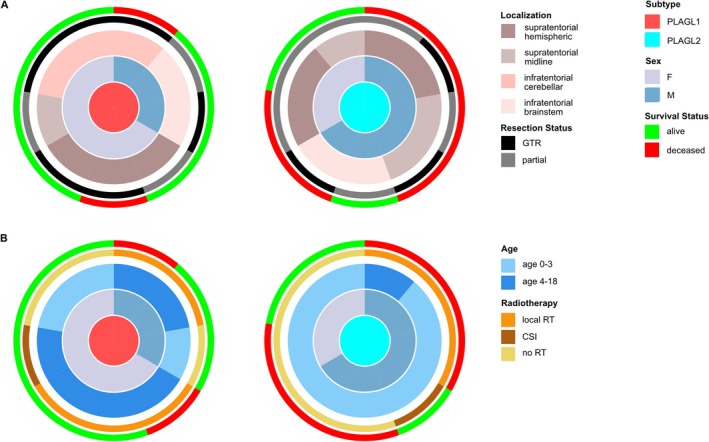
Results: Patients with PLAGL1-amplified tumours (ET, PLAGL1) had fewer relapses (3/9), while PLAGL2-amplified tumours (ET, PLAGL2) were prone to early relapse or progression (8/9) and to distant, leptomeningeal and intraventricular relapses. Progression-free survival differed significantly between the subtypes (log-rank test, p = 0.0055). Postoperative treatment included chemotherapy (n = 17, various protocols), alone (n = 8) or combined with radiotherapy (n = 9). Responses to chemotherapy were observed in both subtypes, and incomplete resection was not associated with inferior survival. All three survivors with ET, PLAGL2 were treated with induction and high-dose chemotherapy with (n = 1-low-dose CSI and boost) or without (n = 2) radiotherapy, whereas five patients with less intensive chemotherapy relapsed. All six survivors with ET, PLAGL1 were treated with conventional chemotherapy regimens, with (n = 4-local radiotherapy n = 3; CSI and boost n = 1) or without (n = 2) radiotherapy. Two patients with ET, PLAGL1 relapsed after 8 years.
Conclusions: Adjuvant therapy should be considered for all ET, PLAGL patients: Patients with ET, PLAGL2 might benefit from intensified chemotherapy regimens. In contrast, patients with ET, PLAGL1 showed superior outcomes without high-dose chemotherapy or craniospinal irradiation.
期刊介绍:
Neuropathology and Applied Neurobiology is an international journal for the publication of original papers, both clinical and experimental, on problems and pathological processes in neuropathology and muscle disease. Established in 1974, this reputable and well respected journal is an international journal sponsored by the British Neuropathological Society, one of the world leading societies for Neuropathology, pioneering research and scientific endeavour with a global membership base. Additionally members of the British Neuropathological Society get 50% off the cost of print colour on acceptance of their article.





 京公网安备 11010802042870号
京ICP备2023020795号-1
京公网安备 11010802042870号
京ICP备2023020795号-1

 分享
分享
 求助内容:
求助内容: 应助结果提醒方式:
 扫码关注我们
