{"title":"Diagnosis of Tuberculous Pericarditis in Zhejiang, China: A Diagnostic Prediction Model Based on LASSO Logistic Regression.","authors":"Xiaoqun Xu, Xiao Liu, Chao Yang, Long Cai, Libin Liu, Tielong Chen, Houyong Zhu, Hui Wei","doi":"10.2147/JIR.S504183","DOIUrl":null,"url":null,"abstract":"<p><strong>Background and aims: </strong>Tuberculous pericarditis (TBP) is a severe, life-threatening complication, yet its diagnosis is highly challenging due to the lack of sufficient diagnostic tools. The aim of this study was to develop and validate a diagnostic prediction model suitable for primary healthcare institutions to predict the risk of TBP.</p><p><strong>Methods: </strong>We collected detailed medical histories, imaging examination results, laboratory test data, and clinical characteristics of patients and used the Least Absolute Shrinkage and Selection Operator (LASSO) technique combined with logistic regression analysis to construct a predictive model. The diagnostic efficacy of the model was assessed using the Receiver Operating Characteristic (ROC) curve, calibration curve, and Decision Curve Analysis (DCA).</p><p><strong>Results: </strong>A total of 304 patients were included in the study, with a median age of 64 years, of which 144 were diagnosed with tuberculous pericarditis. Patients were randomly assigned to the training and validation sets in a 7:3 ratio. LASSO logistic regression analysis revealed that weight loss (P=0.011), body mass index (BMI) (P=0.061), history of tuberculosis (P=0.022), history of dust exposure (P=0.03), moderate to severe kidney disease (P=0.005), erythrocyte sedimentation rate (ESR) (P=0.084), and B-type natriuretic peptide (BNP) (P<0.001) are independent risk factors for TBP. Based on these factors, we constructed a nomogram with an Area Under the Receiver Operating Characteristic Curve (AUC) of 0.757 in both the training and validation sets, indicating high discriminative ability of the model. Calibration curve analysis showed good consistency of the model. DCA results indicated that the model has significant clinical application value when the threshold probability is set between 1-100% (training set) and 30-100% (validation set).</p><p><strong>Conclusion: </strong>We successfully developed a nomogram model for predicting tuberculous pericarditis, which can assist clinicians in improving diagnostic accuracy and reducing misdiagnoses and missed diagnoses in primary healthcare settings.</p>","PeriodicalId":16107,"journal":{"name":"Journal of Inflammation Research","volume":"18 ","pages":"4681-4693"},"PeriodicalIF":4.1000,"publicationDate":"2025-04-03","publicationTypes":"Journal Article","fieldsOfStudy":null,"isOpenAccess":false,"openAccessPdf":"https://www.ncbi.nlm.nih.gov/pmc/articles/PMC11975061/pdf/","citationCount":"0","resultStr":null,"platform":"Semanticscholar","paperid":null,"PeriodicalName":"Journal of Inflammation Research","FirstCategoryId":"3","ListUrlMain":"https://doi.org/10.2147/JIR.S504183","RegionNum":2,"RegionCategory":"医学","ArticlePicture":[],"TitleCN":null,"AbstractTextCN":null,"PMCID":null,"EPubDate":"2025/1/1 0:00:00","PubModel":"eCollection","JCR":"Q2","JCRName":"IMMUNOLOGY","Score":null,"Total":0}
引用次数: 0
Abstract
Background and aims: Tuberculous pericarditis (TBP) is a severe, life-threatening complication, yet its diagnosis is highly challenging due to the lack of sufficient diagnostic tools. The aim of this study was to develop and validate a diagnostic prediction model suitable for primary healthcare institutions to predict the risk of TBP.
Methods: We collected detailed medical histories, imaging examination results, laboratory test data, and clinical characteristics of patients and used the Least Absolute Shrinkage and Selection Operator (LASSO) technique combined with logistic regression analysis to construct a predictive model. The diagnostic efficacy of the model was assessed using the Receiver Operating Characteristic (ROC) curve, calibration curve, and Decision Curve Analysis (DCA).
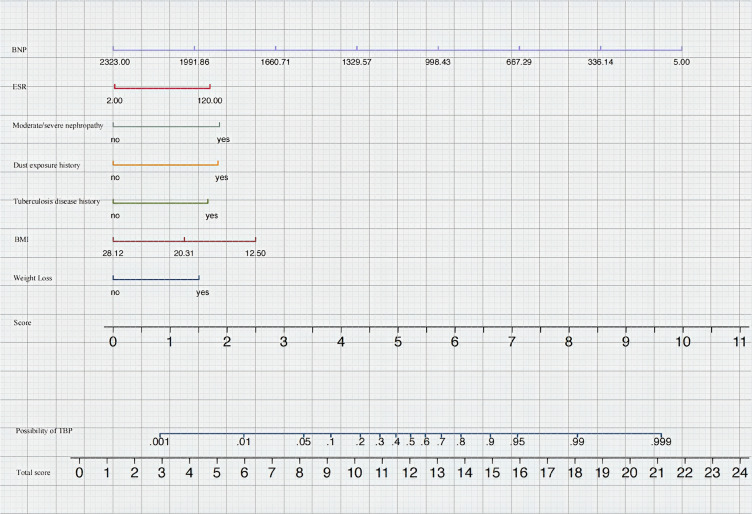
Results: A total of 304 patients were included in the study, with a median age of 64 years, of which 144 were diagnosed with tuberculous pericarditis. Patients were randomly assigned to the training and validation sets in a 7:3 ratio. LASSO logistic regression analysis revealed that weight loss (P=0.011), body mass index (BMI) (P=0.061), history of tuberculosis (P=0.022), history of dust exposure (P=0.03), moderate to severe kidney disease (P=0.005), erythrocyte sedimentation rate (ESR) (P=0.084), and B-type natriuretic peptide (BNP) (P<0.001) are independent risk factors for TBP. Based on these factors, we constructed a nomogram with an Area Under the Receiver Operating Characteristic Curve (AUC) of 0.757 in both the training and validation sets, indicating high discriminative ability of the model. Calibration curve analysis showed good consistency of the model. DCA results indicated that the model has significant clinical application value when the threshold probability is set between 1-100% (training set) and 30-100% (validation set).
Conclusion: We successfully developed a nomogram model for predicting tuberculous pericarditis, which can assist clinicians in improving diagnostic accuracy and reducing misdiagnoses and missed diagnoses in primary healthcare settings.
期刊介绍:
An international, peer-reviewed, open access, online journal that welcomes laboratory and clinical findings on the molecular basis, cell biology and pharmacology of inflammation.






 京公网安备 11010802042870号
京ICP备2023020795号-1
京公网安备 11010802042870号
京ICP备2023020795号-1

 分享
分享
 求助内容:
求助内容: 应助结果提醒方式:
 扫码关注我们
