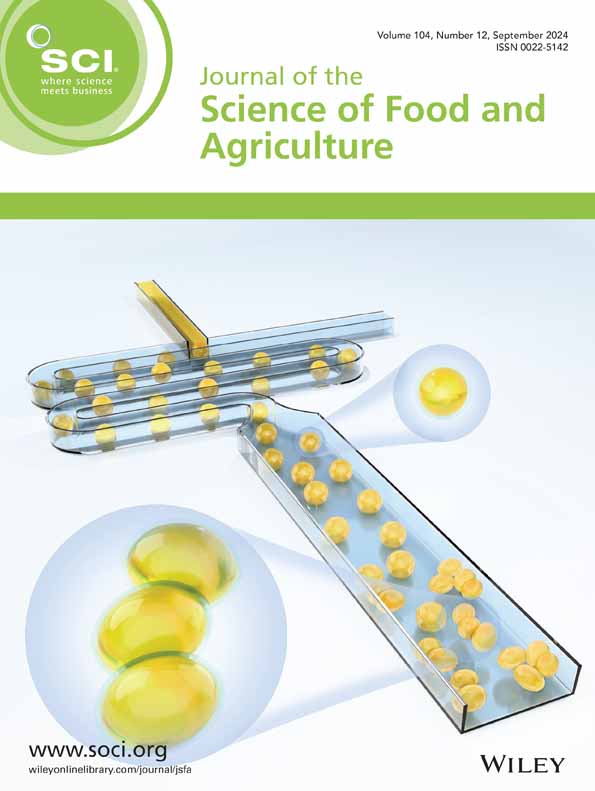
Influence of sulfur fumigation on the volatile composition of lily bulbs evaluated by HS-SPME/GC–MS and multivariate statistical analysis

IF 3.5 2区 农林科学 Q1 AGRICULTURE, MULTIDISCIPLINARY Journal of the Science of Food and Agriculture Pub Date : 2025-04-08 DOI:10.1002/jsfa.14277
Ping Li, Jianing Li, Yan Ding, Qi Wu, Dong Chen, Jialiang Chen, Zhaofang Liu, Shuhong Ye
{"title":"Influence of sulfur fumigation on the volatile composition of lily bulbs evaluated by HS-SPME/GC–MS and multivariate statistical analysis","authors":"Ping Li,&nbsp;Jianing Li,&nbsp;Yan Ding,&nbsp;Qi Wu,&nbsp;Dong Chen,&nbsp;Jialiang Chen,&nbsp;Zhaofang Liu,&nbsp;Shuhong Ye","doi":"10.1002/jsfa.14277","DOIUrl":null,"url":null,"abstract":"<div>\n \n \n <section>\n \n <h3> BACKGROUND</h3>\n \n <p>Lily bulbs are used as food and herbal medicine in the Chinese market. These are often sulfur-fumigated during postharvest processing for bleaching and preservation. This study aimed to compare the volatile compounds in non-fumigation and sulfur-fumigation lily bulbs by headspace solid-phase microextraction (HS-SPME) coupled with gas chromatography–mass spectrometry (GC–MS) detection and multivariate statistical analysis.</p>\n </section>\n \n <section>\n \n <h3> RESULTS</h3>\n \n <p>The results showed that sulfur fumigation led to the chemical transformation of certain original components and significantly changed the chemical characteristics of lily bulbs. A total of 56 volatile compounds were identified in the 12 samples, including one non-fumigated and 11 sulfur-fumigated lily bulbs. Based on multivariate statistical analysis, 13 most characteristic chemical markers were selected to distinguish non-fumigated and sulfur-fumigated lily bulbs. Moreover, the transformation mechanism of the four sulfur compounds and several chemical markers was inferred, which showed that an addition reaction and rearrangement reaction most occurred in the process of sulfur fumigation.</p>\n </section>\n \n <section>\n \n <h3> CONCLUSION</h3>\n \n <p>This newly proposed approach can be applied to ensure consistent quality associated with sulfur fumigation for lily bulbs and other food products. © 2025 Society of Chemical Industry.</p>\n </section>\n </div>","PeriodicalId":17725,"journal":{"name":"Journal of the Science of Food and Agriculture","volume":"105 8","pages":"4598-4608"},"PeriodicalIF":3.5000,"publicationDate":"2025-04-08","publicationTypes":"Journal Article","fieldsOfStudy":null,"isOpenAccess":false,"openAccessPdf":"","citationCount":"0","resultStr":null,"platform":"Semanticscholar","paperid":null,"PeriodicalName":"Journal of the Science of Food and Agriculture","FirstCategoryId":"97","ListUrlMain":"https://scijournals.onlinelibrary.wiley.com/doi/10.1002/jsfa.14277","RegionNum":2,"RegionCategory":"农林科学","ArticlePicture":[],"TitleCN":null,"AbstractTextCN":null,"PMCID":null,"EPubDate":"","PubModel":"","JCR":"Q1","JCRName":"AGRICULTURE, MULTIDISCIPLINARY","Score":null,"Total":0}
引用次数: 0

Abstract

BACKGROUND

Lily bulbs are used as food and herbal medicine in the Chinese market. These are often sulfur-fumigated during postharvest processing for bleaching and preservation. This study aimed to compare the volatile compounds in non-fumigation and sulfur-fumigation lily bulbs by headspace solid-phase microextraction (HS-SPME) coupled with gas chromatography–mass spectrometry (GC–MS) detection and multivariate statistical analysis.

RESULTS

The results showed that sulfur fumigation led to the chemical transformation of certain original components and significantly changed the chemical characteristics of lily bulbs. A total of 56 volatile compounds were identified in the 12 samples, including one non-fumigated and 11 sulfur-fumigated lily bulbs. Based on multivariate statistical analysis, 13 most characteristic chemical markers were selected to distinguish non-fumigated and sulfur-fumigated lily bulbs. Moreover, the transformation mechanism of the four sulfur compounds and several chemical markers was inferred, which showed that an addition reaction and rearrangement reaction most occurred in the process of sulfur fumigation.

CONCLUSION

This newly proposed approach can be applied to ensure consistent quality associated with sulfur fumigation for lily bulbs and other food products. © 2025 Society of Chemical Industry.

查看原文
分享 分享
微信好友 朋友圈 QQ好友 复制链接
本刊更多论文
采用HS-SPME/GC-MS及多元统计分析评价硫熏蒸对百合鳞茎挥发性成分的影响。
背景:百合球茎在中国市场上被用作食品和草药。在采收后的加工过程中,为了漂白和保存,通常要用硫磺熏蒸。采用顶空固相微萃取(HS-SPME)、气相色谱-质谱联用(GC-MS)检测和多元统计分析的方法,比较了未熏蒸和硫磺熏蒸百合球茎中挥发性成分的差异。结果:硫熏蒸使百合部分原始成分发生化学转化,显著改变了百合鳞茎的化学特性。12份样品中共鉴定出56种挥发性化合物,其中1份未经熏蒸,11份经硫磺熏蒸。通过多元统计分析,选择了13个最具特征的化学标记来区分未熏蒸和硫磺熏蒸的百合鳞茎。此外,还推测了4种含硫化合物和几种化学标记物的转化机理,表明硫熏蒸过程中主要发生加成反应和重排反应。结论:该方法可用于保证百合球茎及其他食品硫熏蒸质量的一致性。©2025化学工业协会。
本文章由计算机程序翻译,如有差异,请以英文原文为准。
求助全文
约1分钟内获得全文 去求助
来源期刊
CiteScore
8.10
自引率
4.90%
发文量
634
审稿时长
3.1 months
期刊介绍: The Journal of the Science of Food and Agriculture publishes peer-reviewed original research, reviews, mini-reviews, perspectives and spotlights in these areas, with particular emphasis on interdisciplinary studies at the agriculture/ food interface. Published for SCI by John Wiley & Sons Ltd. SCI (Society of Chemical Industry) is a unique international forum where science meets business on independent, impartial ground. Anyone can join and current Members include consumers, business people, environmentalists, industrialists, farmers, and researchers. The Society offers a chance to share information between sectors as diverse as food and agriculture, pharmaceuticals, biotechnology, materials, chemicals, environmental science and safety. As well as organising educational events, SCI awards a number of prestigious honours and scholarships each year, publishes peer-reviewed journals, and provides Members with news from their sectors in the respected magazine, Chemistry & Industry . Originally established in London in 1881 and in New York in 1894, SCI is a registered charity with Members in over 70 countries.

期刊最新文献
Effect of pea (Pisum sativum) cooking water on the in vitro predicted glycaemic response of wheat pasta. Efficient quality classification of pretreated and dehydrated carrots using feature selection and intelligent models. Preparation and characterization of novel nanoparticles using waxy and non-waxy proso millet protein, NaCas and EGCG for efficient delivery of Cur. Upcycling lignosulfonate into bio-based polyhydroxybutyrate films for eco-friendly antimicrobial and antioxidant food packaging. Phenolic compounds and bioactive peptides from Prosopis pod flours inhibit molecular markers of type 2 diabetes.
×
引用
GB/T 7714-2015
复制
MLA
复制
APA
复制
导出至
BibTeX EndNote RefMan NoteFirst NoteExpress
×
×
提示
您的信息不完整,为了账户安全,请先补充。
现在去补充
×
提示
您因"违规操作"
具体请查看互助需知
我知道了
×
提示
现在去查看 取消
×
提示
确定
0
微信
客服QQ
Book学术公众号 扫码关注我们
反馈
×
意见反馈
请填写您的意见或建议
请填写您的手机或邮箱
已复制链接
已复制链接
快去分享给好友吧!
我知道了
×
扫码分享
扫码分享
Book学术官方微信
Book学术文献互助
Book学术文献互助群
群 号:604180095
Book学术
文献互助 智能选刊 最新文献 互助须知 联系我们:info@booksci.cn
Book学术提供免费学术资源搜索服务,方便国内外学者检索中英文文献。致力于提供最便捷和优质的服务体验。
Copyright © 2023 Book学术 All rights reserved.
ghs 京公网安备 11010802042870号 京ICP备2023020795号-1