{"title":"Comparison of Modified Oblique Lateral Interbody Fusion and Posterior-Only Approach in the Treatment of Degenerative Lumbar Scoliosis.","authors":"Xiang Zhang, Yongqiang Wang, Yilin Lu, Junyu Li, Zhuoran Sun, Yan Zeng, Weishi Li, Miao Yu","doi":"10.1111/os.70038","DOIUrl":null,"url":null,"abstract":"<p><strong>Objective: </strong>Degenerative lumbar scoliosis (DLS) often requires surgical intervention, but traditional posterior-only approaches, despite their effectiveness, result in significant muscle damage and high complication rates. Minimally invasive techniques like oblique lumbar interbody fusion (OLIF) and the Wiltse approach are preferred for preserving posterior structures. However, the lack of controlled studies comparing combined approaches to traditional methods limits their efficacy evaluation. The purpose of this study is to explore the clinical and radiological outcomes of OLIF with posterior fixation through Wiltse approach versus a posterior-only approach in treating DLS.</p><p><strong>Methods: </strong>This retrospective study included 88 DLS patients underwent surgery from January 2019 to September 2021. The patients were divided into the OLIF group (n = 32) and the posterior group (n = 56). Comprehensive evaluations of clinical and radiological outcomes, including Cobb angle, coronal balance distance (CBD), sagittal vertical axis (SVA), thoracic kyphosis (TK), lumbar lordosis (LL), pelvic incidence (PI), pelvic tilt (PT), and sacral slope (SS) were conducted, with a subsequent subgrouping of OLIF group based on preoperative sagittal vertical axis (SVA) into Subgroup A (SVA ≤ 50 mm) and Subgroup B (SVA > 50 mm) for further analysis. The t-test or Wilcoxon's rank sum test is used to compare continuous variables, and the chi-square test is used to compare categorical variables.</p><p><strong>Results: </strong>The OLIF group had fewer fixation levels (4.25 ± 1.08 vs. 5.56 ± 2.04, p < 0.001) and shorter hospitalization (5.22 ± 2.25 d vs. 6.66 ± 2.16 d, p < 0.001), fewer drainage volume (371.94 mL vs. 1065.25 mL, p < 0.001), but longer surgical time. Postoperatively, the OLIF group showed better clinical outcomes. In both groups, Cobb angle, coronal balance distance, and sagittal spinal pelvic parameters improved significantly. The OLIF group achieved a lower SVA (23.84 mm ± 36.70 mm vs. 42.84 mm ± 36.25 mm, p = 0.027), which was not maintained at the final follow-up. Subgroup A maintained sagittal balance (34.55 mm ± 24.99 mm vs. 83.73 mm ± 61.90 mm, p = 0.029). Moreover, the OLIF group had fewer complications.</p><p><strong>Conclusion: </strong>Minimally invasive multi-level OLIF with posterior fixation through Wiltse approach, as compared to the conventional posterior approach, has fewer fixation segments, offers comparable radiographic outcomes and, more importantly, superior clinical results. In addition, patients with a preoperative SVA > 50 mm could benefit from more fixation levels to maintain sagittal balance.</p>","PeriodicalId":19566,"journal":{"name":"Orthopaedic Surgery","volume":" ","pages":"1680-1690"},"PeriodicalIF":2.1000,"publicationDate":"2025-06-01","publicationTypes":"Journal Article","fieldsOfStudy":null,"isOpenAccess":false,"openAccessPdf":"https://www.ncbi.nlm.nih.gov/pmc/articles/PMC12146131/pdf/","citationCount":"0","resultStr":null,"platform":"Semanticscholar","paperid":null,"PeriodicalName":"Orthopaedic Surgery","FirstCategoryId":"3","ListUrlMain":"https://doi.org/10.1111/os.70038","RegionNum":2,"RegionCategory":"医学","ArticlePicture":[],"TitleCN":null,"AbstractTextCN":null,"PMCID":null,"EPubDate":"2025/4/7 0:00:00","PubModel":"Epub","JCR":"Q2","JCRName":"ORTHOPEDICS","Score":null,"Total":0}
引用次数: 0
Abstract
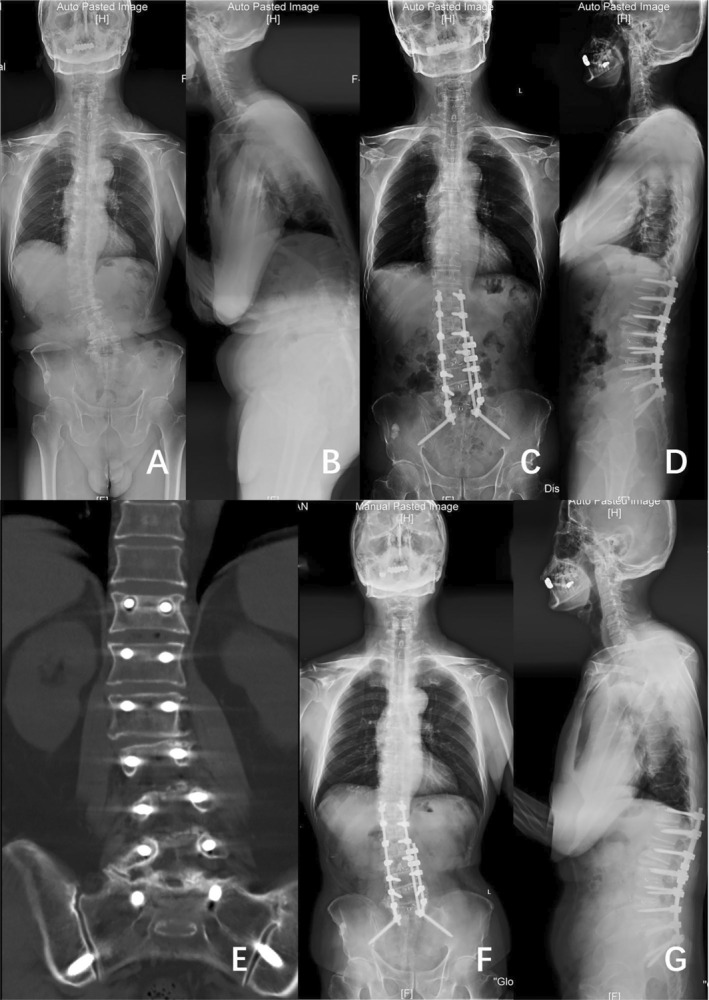
Objective: Degenerative lumbar scoliosis (DLS) often requires surgical intervention, but traditional posterior-only approaches, despite their effectiveness, result in significant muscle damage and high complication rates. Minimally invasive techniques like oblique lumbar interbody fusion (OLIF) and the Wiltse approach are preferred for preserving posterior structures. However, the lack of controlled studies comparing combined approaches to traditional methods limits their efficacy evaluation. The purpose of this study is to explore the clinical and radiological outcomes of OLIF with posterior fixation through Wiltse approach versus a posterior-only approach in treating DLS.
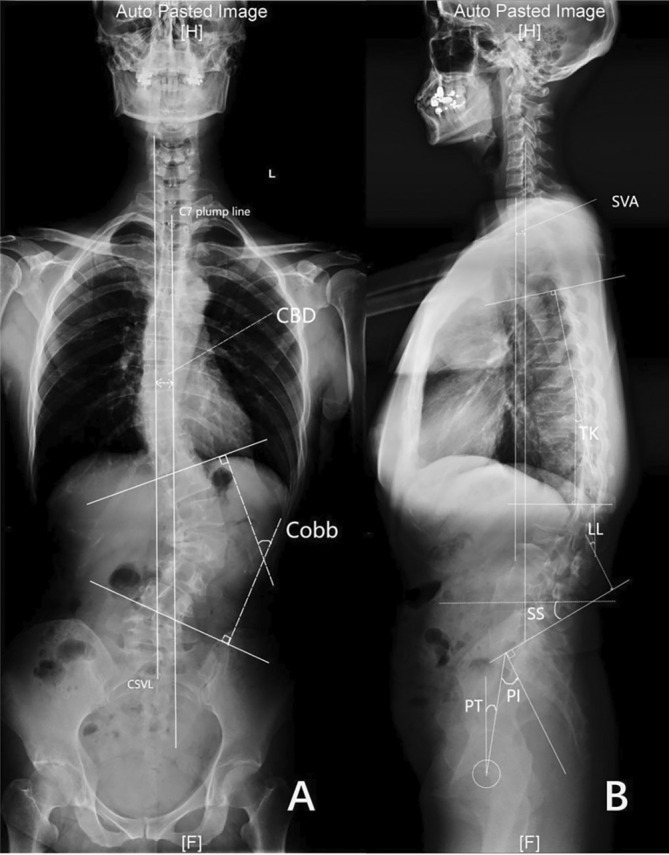
Methods: This retrospective study included 88 DLS patients underwent surgery from January 2019 to September 2021. The patients were divided into the OLIF group (n = 32) and the posterior group (n = 56). Comprehensive evaluations of clinical and radiological outcomes, including Cobb angle, coronal balance distance (CBD), sagittal vertical axis (SVA), thoracic kyphosis (TK), lumbar lordosis (LL), pelvic incidence (PI), pelvic tilt (PT), and sacral slope (SS) were conducted, with a subsequent subgrouping of OLIF group based on preoperative sagittal vertical axis (SVA) into Subgroup A (SVA ≤ 50 mm) and Subgroup B (SVA > 50 mm) for further analysis. The t-test or Wilcoxon's rank sum test is used to compare continuous variables, and the chi-square test is used to compare categorical variables.
Results: The OLIF group had fewer fixation levels (4.25 ± 1.08 vs. 5.56 ± 2.04, p < 0.001) and shorter hospitalization (5.22 ± 2.25 d vs. 6.66 ± 2.16 d, p < 0.001), fewer drainage volume (371.94 mL vs. 1065.25 mL, p < 0.001), but longer surgical time. Postoperatively, the OLIF group showed better clinical outcomes. In both groups, Cobb angle, coronal balance distance, and sagittal spinal pelvic parameters improved significantly. The OLIF group achieved a lower SVA (23.84 mm ± 36.70 mm vs. 42.84 mm ± 36.25 mm, p = 0.027), which was not maintained at the final follow-up. Subgroup A maintained sagittal balance (34.55 mm ± 24.99 mm vs. 83.73 mm ± 61.90 mm, p = 0.029). Moreover, the OLIF group had fewer complications.
Conclusion: Minimally invasive multi-level OLIF with posterior fixation through Wiltse approach, as compared to the conventional posterior approach, has fewer fixation segments, offers comparable radiographic outcomes and, more importantly, superior clinical results. In addition, patients with a preoperative SVA > 50 mm could benefit from more fixation levels to maintain sagittal balance.
期刊介绍:
Orthopaedic Surgery (OS) is the official journal of the Chinese Orthopaedic Association, focusing on all aspects of orthopaedic technique and surgery.
The journal publishes peer-reviewed articles in the following categories: Original Articles, Clinical Articles, Review Articles, Guidelines, Editorials, Commentaries, Surgical Techniques, Case Reports and Meeting Reports.




 京公网安备 11010802042870号
京ICP备2023020795号-1
京公网安备 11010802042870号
京ICP备2023020795号-1

 分享
分享
 求助内容:
求助内容: 应助结果提醒方式:
 扫码关注我们
