Martín Moret, Alicia Serrano, Angjelina Belaj, Lorenzo León, Raúl de la Rosa, Francisco Luque
{"title":"Genetic markers of olive fruit weight selected to be used in breeding experiments.","authors":"Martín Moret, Alicia Serrano, Angjelina Belaj, Lorenzo León, Raúl de la Rosa, Francisco Luque","doi":"10.1007/s11032-025-01562-4","DOIUrl":null,"url":null,"abstract":"<p><p>Olive fruit weight is a crucial trait to consider in olive breeding programs due to its impact on final yield and its relevance for mechanical harvesting and fruit processing. Although environmental conditions influence this trait, fruit weight is primarily determined by genetic factors and exhibits a high degree of heritability in breeding progenies. Despite several studies identifying potential markers associated with fruit weight, these markers have not been validated. In this study, we analyzed 40 genetic markers linked to fruit weight using a dataset comprising 73 cultivars (including 33 newly sequenced varieties) and 10 wild olives with a wide range of phenotypic characteristics, spanning from very light (0.41 g) to very heavy fruits (8.57 g). By examining the phenotype distribution for each genotype of the newly sequenced varieties, we successfully validated 16 genetic markers. Additionally, machine learning tools demonstrated that 9 out of the 16 validated markers have a high predictive ability for fruit weight. As a result, our work provides, for the first time, a set of 9 well-validated genetic markers suitable for use in marker-assisted selection during the early stages of olive breeding programs.</p>","PeriodicalId":18769,"journal":{"name":"Molecular Breeding","volume":"45 4","pages":"40"},"PeriodicalIF":3.0000,"publicationDate":"2025-04-07","publicationTypes":"Journal Article","fieldsOfStudy":null,"isOpenAccess":false,"openAccessPdf":"https://www.ncbi.nlm.nih.gov/pmc/articles/PMC11973041/pdf/","citationCount":"0","resultStr":null,"platform":"Semanticscholar","paperid":null,"PeriodicalName":"Molecular Breeding","FirstCategoryId":"97","ListUrlMain":"https://doi.org/10.1007/s11032-025-01562-4","RegionNum":3,"RegionCategory":"农林科学","ArticlePicture":[],"TitleCN":null,"AbstractTextCN":null,"PMCID":null,"EPubDate":"2025/4/1 0:00:00","PubModel":"eCollection","JCR":"Q1","JCRName":"AGRONOMY","Score":null,"Total":0}
引用次数: 0
Abstract
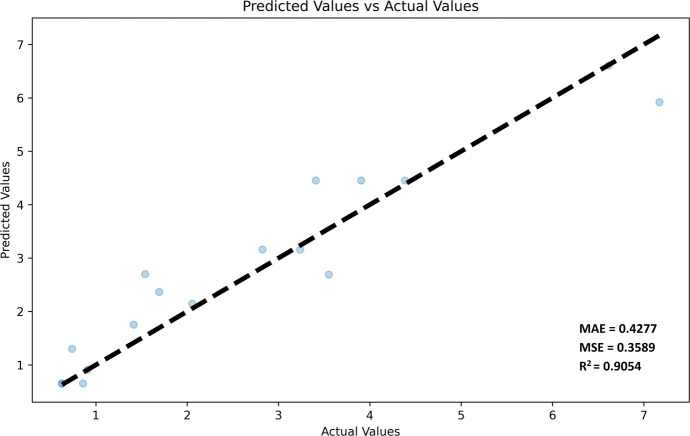
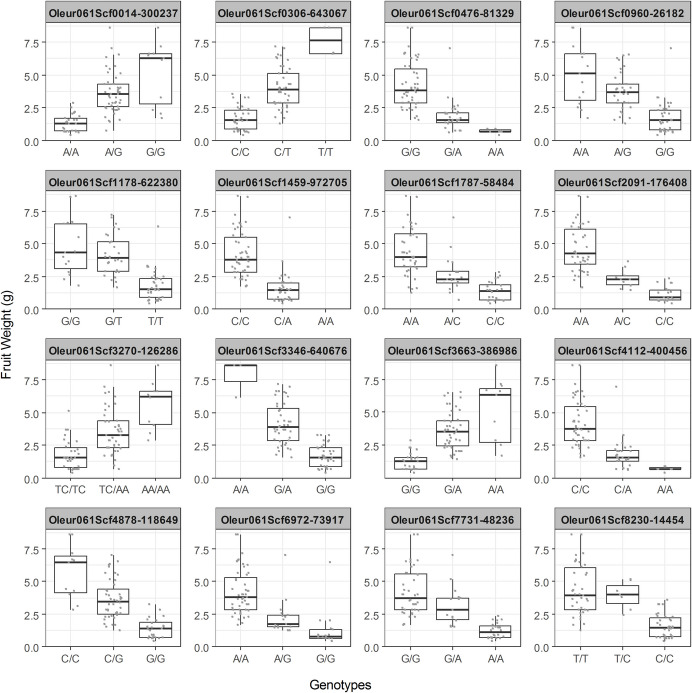
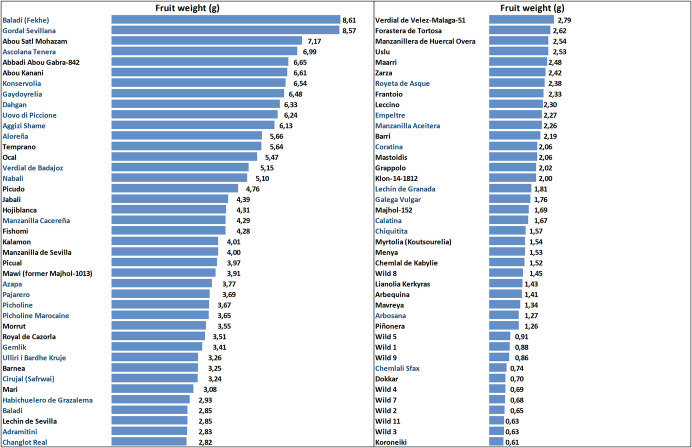
Olive fruit weight is a crucial trait to consider in olive breeding programs due to its impact on final yield and its relevance for mechanical harvesting and fruit processing. Although environmental conditions influence this trait, fruit weight is primarily determined by genetic factors and exhibits a high degree of heritability in breeding progenies. Despite several studies identifying potential markers associated with fruit weight, these markers have not been validated. In this study, we analyzed 40 genetic markers linked to fruit weight using a dataset comprising 73 cultivars (including 33 newly sequenced varieties) and 10 wild olives with a wide range of phenotypic characteristics, spanning from very light (0.41 g) to very heavy fruits (8.57 g). By examining the phenotype distribution for each genotype of the newly sequenced varieties, we successfully validated 16 genetic markers. Additionally, machine learning tools demonstrated that 9 out of the 16 validated markers have a high predictive ability for fruit weight. As a result, our work provides, for the first time, a set of 9 well-validated genetic markers suitable for use in marker-assisted selection during the early stages of olive breeding programs.
期刊介绍:
Molecular Breeding is an international journal publishing papers on applications of plant molecular biology, i.e., research most likely leading to practical applications. The practical applications might relate to the Developing as well as the industrialised World and have demonstrable benefits for the seed industry, farmers, processing industry, the environment and the consumer.
All papers published should contribute to the understanding and progress of modern plant breeding, encompassing the scientific disciplines of molecular biology, biochemistry, genetics, physiology, pathology, plant breeding, and ecology among others.
Molecular Breeding welcomes the following categories of papers: full papers, short communications, papers describing novel methods and review papers. All submission will be subject to peer review ensuring the highest possible scientific quality standards.
Molecular Breeding core areas:
Molecular Breeding will consider manuscripts describing contemporary methods of molecular genetics and genomic analysis, structural and functional genomics in crops, proteomics and metabolic profiling, abiotic stress and field evaluation of transgenic crops containing particular traits. Manuscripts on marker assisted breeding are also of major interest, in particular novel approaches and new results of marker assisted breeding, QTL cloning, integration of conventional and marker assisted breeding, and QTL studies in crop plants.



 京公网安备 11010802042870号
京ICP备2023020795号-1
京公网安备 11010802042870号
京ICP备2023020795号-1

 分享
分享
 求助内容:
求助内容: 应助结果提醒方式:
 扫码关注我们
