Jaewoo Park, Jung Yeon Jang, Jeong Heon Kim, Se Eun Yi, Yeong Ju Lee, Myeong Sang Yu, Yoo-Sam Chung, Yong Ju Jang, Ji Heui Kim, Kyuho Kang
{"title":"SLC27A2 marks lipid peroxidation in nasal epithelial cells driven by type 2 inflammation in chronic rhinosinusitis with nasal polyps","authors":"Jaewoo Park, Jung Yeon Jang, Jeong Heon Kim, Se Eun Yi, Yeong Ju Lee, Myeong Sang Yu, Yoo-Sam Chung, Yong Ju Jang, Ji Heui Kim, Kyuho Kang","doi":"10.1038/s12276-025-01440-1","DOIUrl":null,"url":null,"abstract":"Chronic rhinosinusitis with nasal polyps (CRSwNP) is characterized by persistent inflammation and epithelial cell dysfunction, but the underlying molecular mechanisms remain poorly understood. Here we show that dysregulated lipid metabolism and increased lipid peroxidation in nasal polyp epithelial cells contribute to the pathogenesis of CRSwNP. Integrated analysis of bulk and single-cell RNA sequencing data reveals upregulation of SLC27A2/FATP2 in nasal polyp epithelium, which correlates with increased lipid peroxidation. SLC27A2-positive epithelial cells exhibit enriched expression of lipid peroxidation pathway genes and enhanced responsiveness to IL-4/IL-13 signaling from Th2 and ILC2 cells. Inhibition of IL-4/IL-13 signaling by dupilumab reduces expression of lipid peroxidation-associated genes, including SLC27A2. In eosinophilic CRSwNP, SLC27A2 expression correlates with disease severity. Pharmacological inhibition of FATP2 in air–liquid interface cultures of nasal epithelial cells decreases expression of IL13RA1 and lipid peroxidation-related genes. Our findings identify FATP2-mediated lipid peroxidation as a key driver of epithelial dysfunction and inflammation in CRSwNP, providing new insights into disease mechanisms and potential therapeutic targets. Chronic rhinosinusitis with nasal polyps affects many people, causing symptoms such as nasal congestion and loss of smell. Here the researchers found that type 2 inflammation drives molecular changes leading to epithelial dysfunction through lipid peroxidation in the nasal epithelium. A comprehensive study of patient tissue samples revealed the fatty acid transporter FATP2, encoded by the SLC27A2 gene, in nasal polyp epithelium. IL-13 signaling from type 2 immune cells strongly induced SLC27A2 expression in epithelial cells. The researchers also discovered that pharmacological blockade of the IL-4/IL-13 pathway using dupilumab suppressed the expression of genes associated with lipid peroxidation. These findings suggest that targeting SLC27A2 and related pathways could lead to new treatments for chronic rhinosinusitis with nasal polyps. This summary was initially drafted using artificial intelligence, then revised and fact-checked by the author.","PeriodicalId":50466,"journal":{"name":"Experimental and Molecular Medicine","volume":"57 4","pages":"856-871"},"PeriodicalIF":12.9000,"publicationDate":"2025-04-07","publicationTypes":"Journal Article","fieldsOfStudy":null,"isOpenAccess":false,"openAccessPdf":"https://www.ncbi.nlm.nih.gov/pmc/articles/PMC12045986/pdf/","citationCount":"0","resultStr":null,"platform":"Semanticscholar","paperid":null,"PeriodicalName":"Experimental and Molecular Medicine","FirstCategoryId":"3","ListUrlMain":"https://www.nature.com/articles/s12276-025-01440-1","RegionNum":2,"RegionCategory":"医学","ArticlePicture":[],"TitleCN":null,"AbstractTextCN":null,"PMCID":null,"EPubDate":"","PubModel":"","JCR":"Q1","JCRName":"BIOCHEMISTRY & MOLECULAR BIOLOGY","Score":null,"Total":0}
引用次数: 0
Abstract
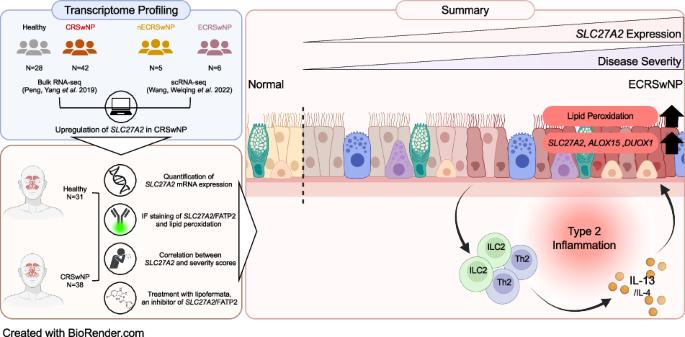
Chronic rhinosinusitis with nasal polyps (CRSwNP) is characterized by persistent inflammation and epithelial cell dysfunction, but the underlying molecular mechanisms remain poorly understood. Here we show that dysregulated lipid metabolism and increased lipid peroxidation in nasal polyp epithelial cells contribute to the pathogenesis of CRSwNP. Integrated analysis of bulk and single-cell RNA sequencing data reveals upregulation of SLC27A2/FATP2 in nasal polyp epithelium, which correlates with increased lipid peroxidation. SLC27A2-positive epithelial cells exhibit enriched expression of lipid peroxidation pathway genes and enhanced responsiveness to IL-4/IL-13 signaling from Th2 and ILC2 cells. Inhibition of IL-4/IL-13 signaling by dupilumab reduces expression of lipid peroxidation-associated genes, including SLC27A2. In eosinophilic CRSwNP, SLC27A2 expression correlates with disease severity. Pharmacological inhibition of FATP2 in air–liquid interface cultures of nasal epithelial cells decreases expression of IL13RA1 and lipid peroxidation-related genes. Our findings identify FATP2-mediated lipid peroxidation as a key driver of epithelial dysfunction and inflammation in CRSwNP, providing new insights into disease mechanisms and potential therapeutic targets. Chronic rhinosinusitis with nasal polyps affects many people, causing symptoms such as nasal congestion and loss of smell. Here the researchers found that type 2 inflammation drives molecular changes leading to epithelial dysfunction through lipid peroxidation in the nasal epithelium. A comprehensive study of patient tissue samples revealed the fatty acid transporter FATP2, encoded by the SLC27A2 gene, in nasal polyp epithelium. IL-13 signaling from type 2 immune cells strongly induced SLC27A2 expression in epithelial cells. The researchers also discovered that pharmacological blockade of the IL-4/IL-13 pathway using dupilumab suppressed the expression of genes associated with lipid peroxidation. These findings suggest that targeting SLC27A2 and related pathways could lead to new treatments for chronic rhinosinusitis with nasal polyps. This summary was initially drafted using artificial intelligence, then revised and fact-checked by the author.
期刊介绍:
Experimental & Molecular Medicine (EMM) stands as Korea's pioneering biochemistry journal, established in 1964 and rejuvenated in 1996 as an Open Access, fully peer-reviewed international journal. Dedicated to advancing translational research and showcasing recent breakthroughs in the biomedical realm, EMM invites submissions encompassing genetic, molecular, and cellular studies of human physiology and diseases. Emphasizing the correlation between experimental and translational research and enhanced clinical benefits, the journal actively encourages contributions employing specific molecular tools. Welcoming studies that bridge basic discoveries with clinical relevance, alongside articles demonstrating clear in vivo significance and novelty, Experimental & Molecular Medicine proudly serves as an open-access, online-only repository of cutting-edge medical research.



 京公网安备 11010802042870号
京ICP备2023020795号-1
京公网安备 11010802042870号
京ICP备2023020795号-1

 分享
分享
 求助内容:
求助内容: 应助结果提醒方式:
 扫码关注我们
