M D Cherne, D Snyder, B Sidar, K Blackwell, B Jenkins, S Huang, T A Sebrell, J F Hedges, J R Spence, C B Chang, J N Wilking, S T Walk, M A Jutila, E K Loveday, D Bimczok
{"title":"Strain- and vaccine-specific effects of serum antibodies in the protection of intestinal SARS-CoV-2 infection.","authors":"M D Cherne, D Snyder, B Sidar, K Blackwell, B Jenkins, S Huang, T A Sebrell, J F Hedges, J R Spence, C B Chang, J N Wilking, S T Walk, M A Jutila, E K Loveday, D Bimczok","doi":"10.1101/2025.03.24.25324570","DOIUrl":null,"url":null,"abstract":"<p><strong>Background: </strong>Severe acute respiratory syndrome coronavirus 2 (SARS-CoV-2) infection remains a public health challenge worldwide. The gastrointestinal tract has emerged as an important site of infection and has been implicated as a reservoir for long-term infection, particularly for post-acute COVID-19 syndrome. However, whether vaccine-induced systemic antibodies can prevent intestinal infection with SARS-CoV-2 is unclear. Compared to Vero cells commonly used to assess SARS-CoV-2 neutralization, the intestinal epithelium has a functional interferon response and expresses higher levels of ACE2, enzymes, and antibody-binding Fc receptors that may impact SARS-CoV-2 immune elimination.</p><p><strong>Methods: </strong>We evaluated the potential of antibodies from both naturally infected and vaccinated human subjects to inhibit SARS-CoV-2 infection of the intestinal epithelium. Serum samples were collected from human volunteers who had undergone natural infection with SARS-CoV-2 in 2020 (n=5) or who had received the Pfizer BNT162b2 COVID-19 vaccine (n=13). Banked sera collected in 2016 served as negative controls (n=2). SARS-CoV-2 (WA01, Delta or Omicron) was pre-treated with sera and then used to infect iPSC-derived human intestinal organoids (HIO) or Caco-2 colonic epithelial cells, and SARS-CoV-2 infection was quantified by plaque assay, PCR, or immunofluorescence (IF) after 48-96 h.</p><p><strong>Results: </strong>Both HIOs and Caco-2 cells supported robust infection with SARS-CoV-2. In HIOs, pretreatment of SARS-CoV-2 with a high titer post-vaccine serum completely blocked replication of WA01. Similarly, sera from both naturally infected donors collected in 2020 and sera from individuals who had received a BNT162b2 vaccine significantly inhibited replication of the WA01 strain in Caco-2 cells. In contrast, none of the sera significantly inhibited infection with the Delta variant of SARS-CoV-2. For Omicron, only sera from individuals who had received an Omicron-based vaccine significantly inhibited infection with SARS-CoV-2 in the plaque assay. Across all virus types, sera from individuals who had received Omicron-based BNT162b2 boosters were the most effective at reducing infection in Caco-2 cells.</p><p><strong>Conclusion: </strong>Our results suggest that vaccine-induced antibody responses to SARS-CoV-2 are protective in the gut. Our study also supports previous reports indicating that SARS-CoV-2 vaccines need to be adapted to circulating virus strains to convey full protection from infection.</p>","PeriodicalId":94281,"journal":{"name":"medRxiv : the preprint server for health sciences","volume":" ","pages":""},"PeriodicalIF":0.0000,"publicationDate":"2025-03-28","publicationTypes":"Journal Article","fieldsOfStudy":null,"isOpenAccess":false,"openAccessPdf":"https://www.ncbi.nlm.nih.gov/pmc/articles/PMC11974977/pdf/","citationCount":"0","resultStr":null,"platform":"Semanticscholar","paperid":null,"PeriodicalName":"medRxiv : the preprint server for health sciences","FirstCategoryId":"1085","ListUrlMain":"https://doi.org/10.1101/2025.03.24.25324570","RegionNum":0,"RegionCategory":null,"ArticlePicture":[],"TitleCN":null,"AbstractTextCN":null,"PMCID":null,"EPubDate":"","PubModel":"","JCR":"","JCRName":"","Score":null,"Total":0}
引用次数: 0
Abstract
Background: Severe acute respiratory syndrome coronavirus 2 (SARS-CoV-2) infection remains a public health challenge worldwide. The gastrointestinal tract has emerged as an important site of infection and has been implicated as a reservoir for long-term infection, particularly for post-acute COVID-19 syndrome. However, whether vaccine-induced systemic antibodies can prevent intestinal infection with SARS-CoV-2 is unclear. Compared to Vero cells commonly used to assess SARS-CoV-2 neutralization, the intestinal epithelium has a functional interferon response and expresses higher levels of ACE2, enzymes, and antibody-binding Fc receptors that may impact SARS-CoV-2 immune elimination.
Methods: We evaluated the potential of antibodies from both naturally infected and vaccinated human subjects to inhibit SARS-CoV-2 infection of the intestinal epithelium. Serum samples were collected from human volunteers who had undergone natural infection with SARS-CoV-2 in 2020 (n=5) or who had received the Pfizer BNT162b2 COVID-19 vaccine (n=13). Banked sera collected in 2016 served as negative controls (n=2). SARS-CoV-2 (WA01, Delta or Omicron) was pre-treated with sera and then used to infect iPSC-derived human intestinal organoids (HIO) or Caco-2 colonic epithelial cells, and SARS-CoV-2 infection was quantified by plaque assay, PCR, or immunofluorescence (IF) after 48-96 h.
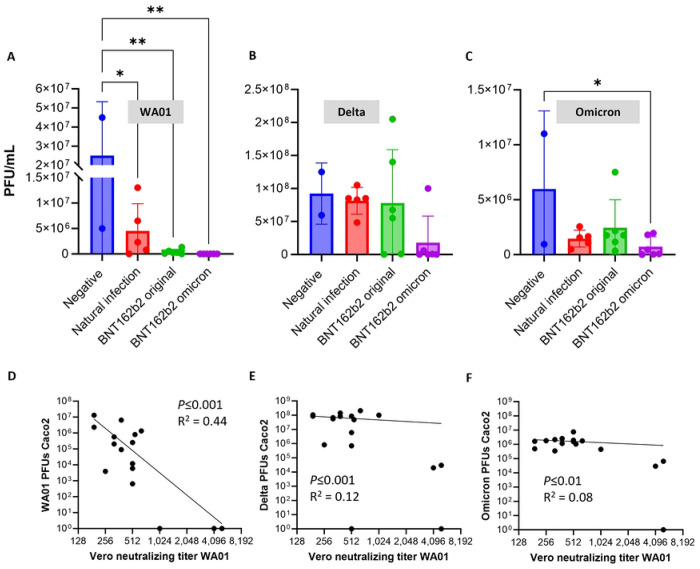
Results: Both HIOs and Caco-2 cells supported robust infection with SARS-CoV-2. In HIOs, pretreatment of SARS-CoV-2 with a high titer post-vaccine serum completely blocked replication of WA01. Similarly, sera from both naturally infected donors collected in 2020 and sera from individuals who had received a BNT162b2 vaccine significantly inhibited replication of the WA01 strain in Caco-2 cells. In contrast, none of the sera significantly inhibited infection with the Delta variant of SARS-CoV-2. For Omicron, only sera from individuals who had received an Omicron-based vaccine significantly inhibited infection with SARS-CoV-2 in the plaque assay. Across all virus types, sera from individuals who had received Omicron-based BNT162b2 boosters were the most effective at reducing infection in Caco-2 cells.
Conclusion: Our results suggest that vaccine-induced antibody responses to SARS-CoV-2 are protective in the gut. Our study also supports previous reports indicating that SARS-CoV-2 vaccines need to be adapted to circulating virus strains to convey full protection from infection.





 京公网安备 11010802042870号
京ICP备2023020795号-1
京公网安备 11010802042870号
京ICP备2023020795号-1

 分享
分享

 求助内容:
求助内容: 应助结果提醒方式:
 扫码关注我们
