Mahmut Tuncez, Tugrul Bulut, Yilmaz Onder, Abdulhakim Ceyhan
{"title":"The Effect of Proximal Cortical Screw Length of Volar Locking Plates on Clinical Outcomes in Distal Radius Fractures.","authors":"Mahmut Tuncez, Tugrul Bulut, Yilmaz Onder, Abdulhakim Ceyhan","doi":"10.7759/cureus.81823","DOIUrl":null,"url":null,"abstract":"<p><p>Objective The aim of this study is to examine whether the length of the proximal diaphyseal screws of volar locking plates used in distal radius fractures affects the clinical outcomes. Material and methods The study included patients who were over 18 years of age and underwent volar locking plate application due to distal radius fracture with a minimum follow-up period of 12 months. Demographic data, Quick Disabilities of the Arm, Shoulder, and Hand (QDASH), grip strength, range of motion, and extensor tendon irritations were evaluated in patients. The prominence of the proximal cortical screws of the plates from the dorsal cortex was measured (in mm) on the lateral radiographs of the patients. Results The median follow-up time of the 73 patients in our study was 17 (14-26) months. The median age of the patients was 51 (44-58) years. Extensor tenosynovitis was detected in 22 patients due to proximal screw length. Proximal screw prominence over 1.2 mm was found to be statistically significant for extensor synovitis (p<0.05). Range of motion, radiological measurements, grip strength, QDASH, and other demographic data had no association with extensor tenosynovitis. Conclusion In the surgical treatment of distal radius fractures, dorsal cortex protrusion of proximal cortical screws of volar locking plates more than 1.2 mm plays a role in postoperative patient dissatisfaction.</p>","PeriodicalId":93960,"journal":{"name":"Cureus","volume":"17 4","pages":"e81823"},"PeriodicalIF":1.3000,"publicationDate":"2025-04-07","publicationTypes":"Journal Article","fieldsOfStudy":null,"isOpenAccess":false,"openAccessPdf":"https://www.ncbi.nlm.nih.gov/pmc/articles/PMC11974232/pdf/","citationCount":"0","resultStr":null,"platform":"Semanticscholar","paperid":null,"PeriodicalName":"Cureus","FirstCategoryId":"1085","ListUrlMain":"https://doi.org/10.7759/cureus.81823","RegionNum":0,"RegionCategory":null,"ArticlePicture":[],"TitleCN":null,"AbstractTextCN":null,"PMCID":null,"EPubDate":"2025/4/1 0:00:00","PubModel":"eCollection","JCR":"Q3","JCRName":"MEDICINE, GENERAL & INTERNAL","Score":null,"Total":0}
引用次数: 0
Abstract
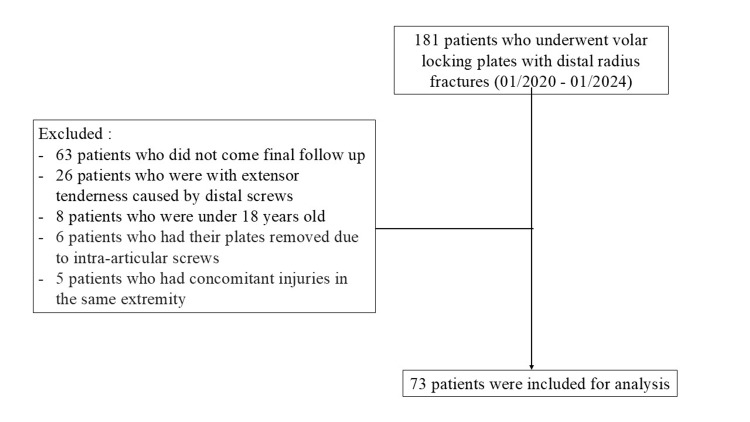
Objective The aim of this study is to examine whether the length of the proximal diaphyseal screws of volar locking plates used in distal radius fractures affects the clinical outcomes. Material and methods The study included patients who were over 18 years of age and underwent volar locking plate application due to distal radius fracture with a minimum follow-up period of 12 months. Demographic data, Quick Disabilities of the Arm, Shoulder, and Hand (QDASH), grip strength, range of motion, and extensor tendon irritations were evaluated in patients. The prominence of the proximal cortical screws of the plates from the dorsal cortex was measured (in mm) on the lateral radiographs of the patients. Results The median follow-up time of the 73 patients in our study was 17 (14-26) months. The median age of the patients was 51 (44-58) years. Extensor tenosynovitis was detected in 22 patients due to proximal screw length. Proximal screw prominence over 1.2 mm was found to be statistically significant for extensor synovitis (p<0.05). Range of motion, radiological measurements, grip strength, QDASH, and other demographic data had no association with extensor tenosynovitis. Conclusion In the surgical treatment of distal radius fractures, dorsal cortex protrusion of proximal cortical screws of volar locking plates more than 1.2 mm plays a role in postoperative patient dissatisfaction.





 京公网安备 11010802042870号
京ICP备2023020795号-1
京公网安备 11010802042870号
京ICP备2023020795号-1

 分享
分享

 求助内容:
求助内容: 应助结果提醒方式:
 扫码关注我们
