Faster reaction times of CSF Alpha-Synuclein Seed Amplification Assay predict the Diffuse Malignant subtype of Parkinson's Disease at 10-year follow-up.
Piergiorgio Grillo, Giulietta Maria Riboldi, Antonio Pisani, Un Jung Kang, Seyed-Mohammad Fereshtehnejad
{"title":"Faster reaction times of CSF Alpha-Synuclein Seed Amplification Assay predict the Diffuse Malignant subtype of Parkinson's Disease at 10-year follow-up.","authors":"Piergiorgio Grillo, Giulietta Maria Riboldi, Antonio Pisani, Un Jung Kang, Seyed-Mohammad Fereshtehnejad","doi":"10.1101/2025.03.27.25324778","DOIUrl":null,"url":null,"abstract":"<p><strong>Background: </strong>Data-driven approaches identified Mild Motor Predominant (MMP), Intermediate (IM), and Diffuse Malignant (DM) as Parkinson's Disease (PD) subtypes with different motor and non-motor impairment at diagnosis. It remains unclear whether these subtypes remain stable over time or whether they represent distinct biological substrates. The alpha-synuclein seed amplification assay in CSF (CSF-αSyn-SAA) might provide further insights.</p><p><strong>Objective: </strong>to evaluate the association between baseline CSF-αSyn-SAA parameters and 10-year clinical evolution of PD subtypes.</p><p><strong>Methods: </strong>323 sporadic PD patients from PPMI dataset were classified as MMP, IM, or DM at baseline and 10-year follow-up based on motor, cognitive, sleep and dysautonomia features. CSF-αSyn-SAA parameters were collected at baseline using a 150-hrs protocol. CSF Aβ1-42, tTau and pTau181, CSF and serum NfL were also considered at baseline.</p><p><strong>Results: </strong>Reaction times (T50, TTT) and area under the curve (AUC) respectively were shorter and larger in DM compared to IM/MMP. The difference in baseline amplification parameters was more evident when comparing subtypes based on 10-year clinical features (T50, η2=0.036; TTT, η2=0.031; AUC, η2=0.033; all p values < 0.05) than when comparing subtypes based on baseline clinical features (T50, η2=0.012; TTT, η2=0.012; AUC, η2=0.013; all p<0.05). Shorter T50 and TTT at baseline were associated with greater risk of DM versus MMP at 10-year follow-up (T50, OR=3.3, 95%CI: 1.3-8.1, p=0.010; TTT, OR=4.6, 95%CI: 1.8-11.6, p=0.001). Aβ, Tau and NfL were similar between groups.</p><p><strong>Conclusions: </strong>Baseline CSF-αSyn-SAA parameters predicted long-term PD progression. Faster reactions were associated with a more severe 10-year PD phenotype considering motor and non-motor features.</p>","PeriodicalId":94281,"journal":{"name":"medRxiv : the preprint server for health sciences","volume":" ","pages":""},"PeriodicalIF":0.0000,"publicationDate":"2025-08-25","publicationTypes":"Journal Article","fieldsOfStudy":null,"isOpenAccess":false,"openAccessPdf":"https://www.ncbi.nlm.nih.gov/pmc/articles/PMC11974992/pdf/","citationCount":"0","resultStr":null,"platform":"Semanticscholar","paperid":null,"PeriodicalName":"medRxiv : the preprint server for health sciences","FirstCategoryId":"1085","ListUrlMain":"https://doi.org/10.1101/2025.03.27.25324778","RegionNum":0,"RegionCategory":null,"ArticlePicture":[],"TitleCN":null,"AbstractTextCN":null,"PMCID":null,"EPubDate":"","PubModel":"","JCR":"","JCRName":"","Score":null,"Total":0}
引用次数: 0
Abstract
Background: Data-driven approaches identified Mild Motor Predominant (MMP), Intermediate (IM), and Diffuse Malignant (DM) as Parkinson's Disease (PD) subtypes with different motor and non-motor impairment at diagnosis. It remains unclear whether these subtypes remain stable over time or whether they represent distinct biological substrates. The alpha-synuclein seed amplification assay in CSF (CSF-αSyn-SAA) might provide further insights.
Objective: to evaluate the association between baseline CSF-αSyn-SAA parameters and 10-year clinical evolution of PD subtypes.
Methods: 323 sporadic PD patients from PPMI dataset were classified as MMP, IM, or DM at baseline and 10-year follow-up based on motor, cognitive, sleep and dysautonomia features. CSF-αSyn-SAA parameters were collected at baseline using a 150-hrs protocol. CSF Aβ1-42, tTau and pTau181, CSF and serum NfL were also considered at baseline.
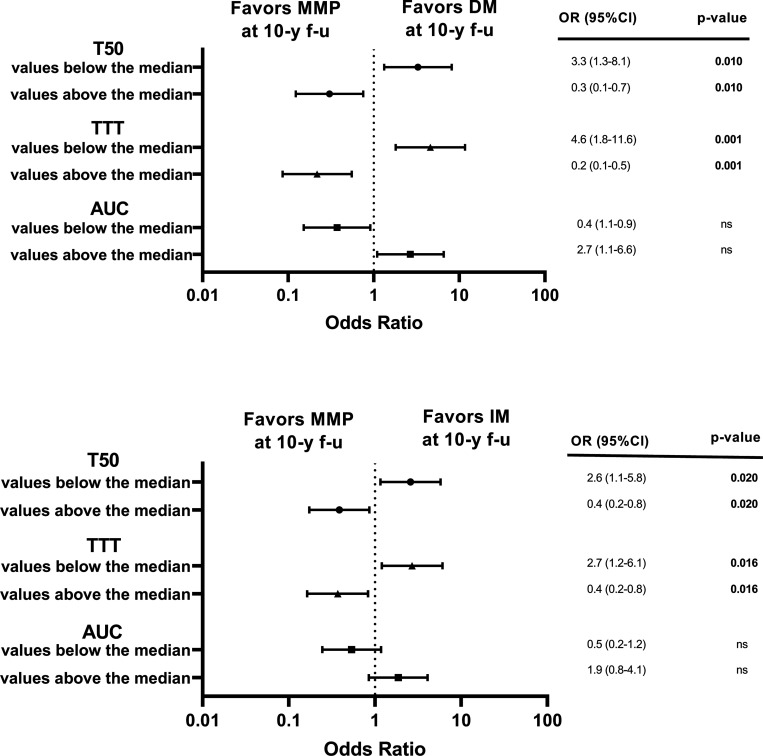
Results: Reaction times (T50, TTT) and area under the curve (AUC) respectively were shorter and larger in DM compared to IM/MMP. The difference in baseline amplification parameters was more evident when comparing subtypes based on 10-year clinical features (T50, η2=0.036; TTT, η2=0.031; AUC, η2=0.033; all p values < 0.05) than when comparing subtypes based on baseline clinical features (T50, η2=0.012; TTT, η2=0.012; AUC, η2=0.013; all p<0.05). Shorter T50 and TTT at baseline were associated with greater risk of DM versus MMP at 10-year follow-up (T50, OR=3.3, 95%CI: 1.3-8.1, p=0.010; TTT, OR=4.6, 95%CI: 1.8-11.6, p=0.001). Aβ, Tau and NfL were similar between groups.
Conclusions: Baseline CSF-αSyn-SAA parameters predicted long-term PD progression. Faster reactions were associated with a more severe 10-year PD phenotype considering motor and non-motor features.




 京公网安备 11010802042870号
京ICP备2023020795号-1
京公网安备 11010802042870号
京ICP备2023020795号-1

 分享
分享

 求助内容:
求助内容: 应助结果提醒方式:
 扫码关注我们
