Mohammad Anas Anees;Saad Mekhilef;Marizan Mubin;Mostefa Kermadi;Marif Daula Siddique
{"title":"Reduced-Sensor-Based Optimal Switching Sequence Model Predictive Current Control for Grid-Tied Inverter With LCL Filter","authors":"Mohammad Anas Anees;Saad Mekhilef;Marizan Mubin;Mostefa Kermadi;Marif Daula Siddique","doi":"10.1109/JESTPE.2025.3558767","DOIUrl":null,"url":null,"abstract":"This article presents an improved reduced-sensor-based optimal switching sequence model predictive current control (OSS-MPCC) algorithm for a grid-tied inverter with the LCL filter with only injected grid current measurements. The OSS-MPCC algorithm utilizes four types of signals, namely, the estimated grid voltage symmetrical components obtained from the virtual flux observer, the state estimates obtained from the full-state Luenberger observer, the reference of positive sequence injected grid current obtained from the SOGI-QSG-based symmetrical voltage estimations, and switching states of the inverter to perform predictive current tracking in grid-tied operation. The proposed algorithm offers several advantages simultaneously. It successfully limits the switching frequency spectrum of inverter voltage, reduces the number of sensors from nine to three, keeps the grid current total harmonic distortion (THD), even in the advent of voltage unbalancing, below 2.5%, demonstrates robustness against the filter parameter mismatches, and still keeps the computational time below <inline-formula> <tex-math>$15~\\mu s$ </tex-math></inline-formula> comparable with previous OSS-MPC algorithms. The results were numerically verified through simulations in MATLAB and validated using a 1.5-kW experimental setup with a two-level inverter, programmable ac supply as a grid, and Microlab box controller with EMC block set for pulsewidth modulator (PWM) generation.","PeriodicalId":13093,"journal":{"name":"IEEE Journal of Emerging and Selected Topics in Power Electronics","volume":"13 3","pages":"3740-3755"},"PeriodicalIF":5.7000,"publicationDate":"2025-04-08","publicationTypes":"Journal Article","fieldsOfStudy":null,"isOpenAccess":false,"openAccessPdf":"","citationCount":"0","resultStr":null,"platform":"Semanticscholar","paperid":null,"PeriodicalName":"IEEE Journal of Emerging and Selected Topics in Power Electronics","FirstCategoryId":"5","ListUrlMain":"https://ieeexplore.ieee.org/document/10955418/","RegionNum":2,"RegionCategory":"工程技术","ArticlePicture":[],"TitleCN":null,"AbstractTextCN":null,"PMCID":null,"EPubDate":"","PubModel":"","JCR":"Q1","JCRName":"ENGINEERING, ELECTRICAL & ELECTRONIC","Score":null,"Total":0}
引用次数: 0
Abstract
This article presents an improved reduced-sensor-based optimal switching sequence model predictive current control (OSS-MPCC) algorithm for a grid-tied inverter with the LCL filter with only injected grid current measurements. The OSS-MPCC algorithm utilizes four types of signals, namely, the estimated grid voltage symmetrical components obtained from the virtual flux observer, the state estimates obtained from the full-state Luenberger observer, the reference of positive sequence injected grid current obtained from the SOGI-QSG-based symmetrical voltage estimations, and switching states of the inverter to perform predictive current tracking in grid-tied operation. The proposed algorithm offers several advantages simultaneously. It successfully limits the switching frequency spectrum of inverter voltage, reduces the number of sensors from nine to three, keeps the grid current total harmonic distortion (THD), even in the advent of voltage unbalancing, below 2.5%, demonstrates robustness against the filter parameter mismatches, and still keeps the computational time below $15~\mu s$ comparable with previous OSS-MPC algorithms. The results were numerically verified through simulations in MATLAB and validated using a 1.5-kW experimental setup with a two-level inverter, programmable ac supply as a grid, and Microlab box controller with EMC block set for pulsewidth modulator (PWM) generation.
期刊介绍:
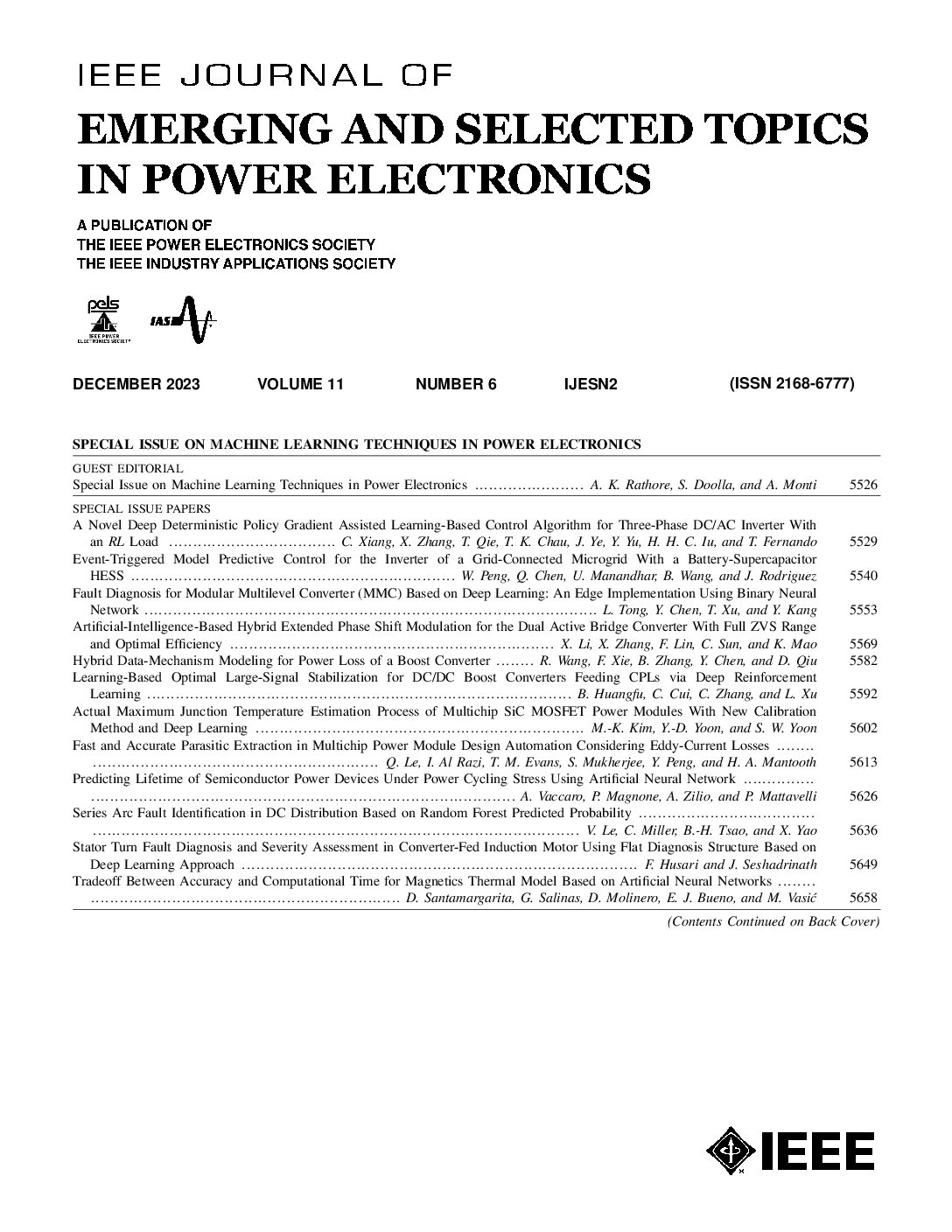
The aim of the journal is to enable the power electronics community to address the emerging and selected topics in power electronics in an agile fashion. It is a forum where multidisciplinary and discriminating technologies and applications are discussed by and for both practitioners and researchers on timely topics in power electronics from components to systems.




 京公网安备 11010802042870号
京ICP备2023020795号-1
京公网安备 11010802042870号
京ICP备2023020795号-1

 分享
分享
 求助内容:
求助内容: 应助结果提醒方式:
 扫码关注我们
