Development of bio-nano-herbicide using Eucalyptus citriodora essential oil against a notorious weed Echinochloa crus-galli

IF 3.8 1区 农林科学 Q1 AGRONOMY Pest Management Science Pub Date : 2025-04-09 DOI:10.1002/ps.8815
Swathika Nataraj, Kizhaeral S. Subramanian, Marimuthu Subramanian, Chandrakumar Kalichamy
{"title":"Development of bio-nano-herbicide using Eucalyptus citriodora essential oil against a notorious weed Echinochloa crus-galli","authors":"Swathika Nataraj,&nbsp;Kizhaeral S. Subramanian,&nbsp;Marimuthu Subramanian,&nbsp;Chandrakumar Kalichamy","doi":"10.1002/ps.8815","DOIUrl":null,"url":null,"abstract":"<div>\n \n \n <section>\n \n <h3> BACKGROUND</h3>\n \n <p>Weeds are a menace in agriculture causing crop yield reductions to the tune of 40–50%. To overcome the problems of weeds, herbicides have been used excessively to the extent that they have caused resistance in weeds, in addition to the environmental hazards. Nano-herbicides are intended to exploit botanicals to develop novel bio-nano-herbicide formulations. Bio-nano herbicide was developed using <i>Eucalyptus citriodora</i> essential oil combined high-energy approaches such as ultra-sonication and high-pressure homogenization. The formulation has hydrodynamic and physical sizes of 95.5 and 32.3–57.7 nm, respectively. The product was tested for their pre-emergence and post-emergence herbicidal activity against <i>Echinochloa crus-galli.</i></p>\n </section>\n \n <section>\n \n <h3> RESULTS</h3>\n \n <p>Increased concentration of bio-nano-herbicide inhibited the pre-emergence of weed seeds. Treated weed seeds registered lower dehydrogenase (0.80 to 0.32), alpha-amylase (1.349 to 0.101 mg maltose), catalase (3.87 to 3.52 μmol H₂O₂ min<sup>−1</sup> g<sup>−1</sup> protein), peroxidase (3.96 to 3.61 U mg<sup>−1</sup> protein min<sup>−1</sup>) and super oxide dismutase (0.94 to 0.56 U mg<sup>−1</sup> protein min<sup>−1</sup>) activities than control. Further, foliar spray of 1% nanoemulsion recorded significantly lower total chlorophyll content (1.62 mg g<sup>−1</sup> fresh weight), than the crude oil (2.58 mg g<sup>−1</sup>). The antioxidant enzyme activities increased immediately after the first spray and the weeds wilted after the second spray.</p>\n </section>\n \n <section>\n \n <h3> CONCLUSION</h3>\n \n <p>This study is a maiden attempt to clearly demonstrate that bio-nano-herbicide can be developed using <i>Eucalyptus citriodora</i> essential oil which has both pre-emergence and post-emergence inhibitory activities against the notorious weed <i>Echinochloa crus-galli</i>. Field studies are to be taken up in the near future to validate the herbicidal efficacy of the novel nano herbicide formulation. © 2025 Society of Chemical Industry.</p>\n </section>\n </div>","PeriodicalId":218,"journal":{"name":"Pest Management Science","volume":"81 9","pages":"4993-5009"},"PeriodicalIF":3.8000,"publicationDate":"2025-04-09","publicationTypes":"Journal Article","fieldsOfStudy":null,"isOpenAccess":false,"openAccessPdf":"","citationCount":"0","resultStr":null,"platform":"Semanticscholar","paperid":null,"PeriodicalName":"Pest Management Science","FirstCategoryId":"97","ListUrlMain":"https://scijournals.onlinelibrary.wiley.com/doi/10.1002/ps.8815","RegionNum":1,"RegionCategory":"农林科学","ArticlePicture":[],"TitleCN":null,"AbstractTextCN":null,"PMCID":null,"EPubDate":"","PubModel":"","JCR":"Q1","JCRName":"AGRONOMY","Score":null,"Total":0}
引用次数: 0

Abstract

BACKGROUND

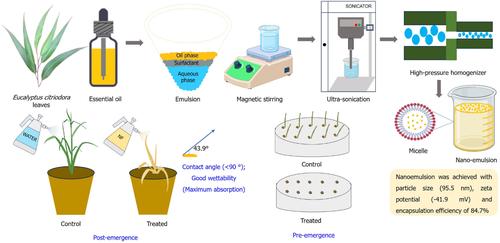
Weeds are a menace in agriculture causing crop yield reductions to the tune of 40–50%. To overcome the problems of weeds, herbicides have been used excessively to the extent that they have caused resistance in weeds, in addition to the environmental hazards. Nano-herbicides are intended to exploit botanicals to develop novel bio-nano-herbicide formulations. Bio-nano herbicide was developed using Eucalyptus citriodora essential oil combined high-energy approaches such as ultra-sonication and high-pressure homogenization. The formulation has hydrodynamic and physical sizes of 95.5 and 32.3–57.7 nm, respectively. The product was tested for their pre-emergence and post-emergence herbicidal activity against Echinochloa crus-galli.

RESULTS

Increased concentration of bio-nano-herbicide inhibited the pre-emergence of weed seeds. Treated weed seeds registered lower dehydrogenase (0.80 to 0.32), alpha-amylase (1.349 to 0.101 mg maltose), catalase (3.87 to 3.52 μmol H₂O₂ min−1 g−1 protein), peroxidase (3.96 to 3.61 U mg−1 protein min−1) and super oxide dismutase (0.94 to 0.56 U mg−1 protein min−1) activities than control. Further, foliar spray of 1% nanoemulsion recorded significantly lower total chlorophyll content (1.62 mg g−1 fresh weight), than the crude oil (2.58 mg g−1). The antioxidant enzyme activities increased immediately after the first spray and the weeds wilted after the second spray.

CONCLUSION

This study is a maiden attempt to clearly demonstrate that bio-nano-herbicide can be developed using Eucalyptus citriodora essential oil which has both pre-emergence and post-emergence inhibitory activities against the notorious weed Echinochloa crus-galli. Field studies are to be taken up in the near future to validate the herbicidal efficacy of the novel nano herbicide formulation. © 2025 Society of Chemical Industry.
Abstract Image

查看原文
分享 分享
微信好友 朋友圈 QQ好友 复制链接
本刊更多论文
利用桉树精油开发生物纳米除草剂防治一种臭名昭著的杂草刺青藻
杂草是农业的一大威胁,导致农作物减产40-50%。为了克服杂草的问题,除草剂被过度使用,除了对环境造成危害外,还造成了杂草的抗药性。纳米除草剂旨在利用植物物质开发新型生物纳米除草剂配方。以桉叶精油为原料,结合超声波和高压均质等高能方法,研制了生物纳米除草剂。该配方的水动力尺寸为95.5 nm,物理尺寸为32.3 ~ 57.7 nm。对该产品进行了羽化前和羽化后的除草活性测定。
本文章由计算机程序翻译,如有差异,请以英文原文为准。
求助全文
约1分钟内获得全文 去求助
来源期刊
Pest Management Science
Pest Management Science 农林科学-昆虫学
CiteScore
7.90
自引率
9.80%
发文量
553
审稿时长
4.8 months
期刊介绍: Pest Management Science is the international journal of research and development in crop protection and pest control. Since its launch in 1970, the journal has become the premier forum for papers on the discovery, application, and impact on the environment of products and strategies designed for pest management. Published for SCI by John Wiley & Sons Ltd.
期刊最新文献
Potential of endophytic Beauveria bassiana against Coraebus (Coleoptera: Buprestidae) oak borers. Artificial shelters as dual-purpose tools for monitoring natural enemies and providing microhabitats in orchards. Residue dynamics and metabolic pathways of sulfoxaflor in Cirsium japonicum var. maackii and Olea europaea L. Molecular co-assembly engineering towards natural tea saponin-based nanopesticides for synergistic enhanced foliar affinity. Cytochrome P450 and glutathione S-transferase may confer bensulfuron-methyl resistance in Cyperus iria.
×
引用
GB/T 7714-2015
复制
MLA
复制
APA
复制
导出至
BibTeX EndNote RefMan NoteFirst NoteExpress
×
×
提示
您的信息不完整,为了账户安全,请先补充。
现在去补充
×
提示
您因"违规操作"
具体请查看互助需知
我知道了
×
提示
现在去查看 取消
×
提示
确定
0
微信
客服QQ
Book学术公众号 扫码关注我们
反馈
×
意见反馈
请填写您的意见或建议
请填写您的手机或邮箱
已复制链接
已复制链接
快去分享给好友吧!
我知道了
×
扫码分享
扫码分享
Book学术官方微信
Book学术文献互助
Book学术文献互助群
群 号:604180095
Book学术
文献互助 智能选刊 最新文献 互助须知 联系我们:info@booksci.cn
Book学术提供免费学术资源搜索服务,方便国内外学者检索中英文文献。致力于提供最便捷和优质的服务体验。
Copyright © 2023 Book学术 All rights reserved.
ghs 京公网安备 11010802042870号 京ICP备2023020795号-1





