Tong Xu, Yingrui Zhang, Shiyu Chen, Zengnan Wu, Xian-Li Meng, Yi Zhang, Jin-Ming Lin
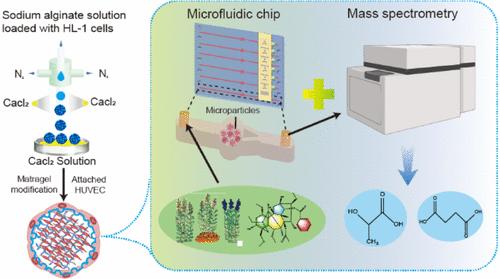
{"title":"Biomimetic Microparticles with Myocardial and Endocardial Integration for Drug Toxicity Studies","authors":"Tong Xu, Yingrui Zhang, Shiyu Chen, Zengnan Wu, Xian-Li Meng, Yi Zhang, Jin-Ming Lin","doi":"10.1021/acs.analchem.5c00672","DOIUrl":null,"url":null,"abstract":"Hydrogel microparticles are versatile tools for organ modeling due to their simplicity, uniformity, and customizability, yet their limited physiological relevance constrains practical applications. In this study, a heart microparticle model that incorporates endocardial and myocardial structures and functions was developed. Hydrogel microparticles with rough surfaces, embedded with cardiomyocytes, were created using a custom-designed microfluidic device. Surface modification with matrigel enhanced the adhesion and connectivity of endothelial cells, enabling the formation of a densely packed endothelial layer. Real-time analysis, combining microparticle culture with a microfluidic chip-mass spectrometry system, demonstrated the utility of these particles in detecting the cardiotoxicity of heart-related drugs. For example, the analysis revealed that the cardiotoxicity of aconitine and Tie-bang-chui (TBC) was associated with elevated lactate and succinate levels, while processed TBC mitigated this toxicity of TBC by reducing these metabolites. These biomimetic microparticle models provide a novel platform for real-time metabolite analysis and cardiotoxicity research.","PeriodicalId":27,"journal":{"name":"Analytical Chemistry","volume":"40 1","pages":""},"PeriodicalIF":7.3000,"publicationDate":"2025-04-08","publicationTypes":"Journal Article","fieldsOfStudy":null,"isOpenAccess":false,"openAccessPdf":"","citationCount":"0","resultStr":null,"platform":"Semanticscholar","paperid":null,"PeriodicalName":"Analytical Chemistry","FirstCategoryId":"92","ListUrlMain":"https://doi.org/10.1021/acs.analchem.5c00672","RegionNum":1,"RegionCategory":"化学","ArticlePicture":[],"TitleCN":null,"AbstractTextCN":null,"PMCID":null,"EPubDate":"","PubModel":"","JCR":"Q1","JCRName":"CHEMISTRY, ANALYTICAL","Score":null,"Total":0}
引用次数: 0
Abstract
Hydrogel microparticles are versatile tools for organ modeling due to their simplicity, uniformity, and customizability, yet their limited physiological relevance constrains practical applications. In this study, a heart microparticle model that incorporates endocardial and myocardial structures and functions was developed. Hydrogel microparticles with rough surfaces, embedded with cardiomyocytes, were created using a custom-designed microfluidic device. Surface modification with matrigel enhanced the adhesion and connectivity of endothelial cells, enabling the formation of a densely packed endothelial layer. Real-time analysis, combining microparticle culture with a microfluidic chip-mass spectrometry system, demonstrated the utility of these particles in detecting the cardiotoxicity of heart-related drugs. For example, the analysis revealed that the cardiotoxicity of aconitine and Tie-bang-chui (TBC) was associated with elevated lactate and succinate levels, while processed TBC mitigated this toxicity of TBC by reducing these metabolites. These biomimetic microparticle models provide a novel platform for real-time metabolite analysis and cardiotoxicity research.
期刊介绍:
Analytical Chemistry, a peer-reviewed research journal, focuses on disseminating new and original knowledge across all branches of analytical chemistry. Fundamental articles may explore general principles of chemical measurement science and need not directly address existing or potential analytical methodology. They can be entirely theoretical or report experimental results. Contributions may cover various phases of analytical operations, including sampling, bioanalysis, electrochemistry, mass spectrometry, microscale and nanoscale systems, environmental analysis, separations, spectroscopy, chemical reactions and selectivity, instrumentation, imaging, surface analysis, and data processing. Papers discussing known analytical methods should present a significant, original application of the method, a notable improvement, or results on an important analyte.




 京公网安备 11010802042870号
京ICP备2023020795号-1
京公网安备 11010802042870号
京ICP备2023020795号-1

 分享
分享
 求助内容:
求助内容: 应助结果提醒方式:
 扫码关注我们
