Thomas D. Emmerich, Eleanor J. Taylor-Chilton, Elena Caballero, Iryna Hushcha, Kathryn Dickens, Izabela Stasik, Jane Alder, Santiago Saavedra-Castano, Erwin Berenschot, Niels R. Tas, Arturo Susarrey-Arce, Loreto Martinez-Gonzalez, Alina Oknianska, Tamara Zwain, Ana Martinez, Joseph M. Hayes
{"title":"Structure-Based Discovery Targeting GSK-3α Reveals Potent Nanomolar Selective 4-Phenyl-1H-benzofuro[3,2-b]pyrazolo[4,3-e]pyridine Inhibitor with Promising Glioblastoma and CNS-Active Potential in Cellular Models","authors":"Thomas D. Emmerich, Eleanor J. Taylor-Chilton, Elena Caballero, Iryna Hushcha, Kathryn Dickens, Izabela Stasik, Jane Alder, Santiago Saavedra-Castano, Erwin Berenschot, Niels R. Tas, Arturo Susarrey-Arce, Loreto Martinez-Gonzalez, Alina Oknianska, Tamara Zwain, Ana Martinez, Joseph M. Hayes","doi":"10.1021/acs.jmedchem.5c00377","DOIUrl":null,"url":null,"abstract":"Glycogen synthase kinase-3 (GSK-3) is linked with multiple CNS conditions, including glioblastoma (GBM). Compared to the GSK-3β isoform, structure-based inhibitor design targeting GSK-3α is limited. Virtual screening was employed to identify GSK-3α inhibitors with CNS-active potential. Using a GSK-3α homology model, an optimized protocol with three-dimensional (3D)-pharmacophore filtering and Glide-SP docking was used to screen the ZINC20 biogenic subset. From 14 compounds selected for binding assay validation, three novel hit compounds were identified, with <b>1</b> (4-phenyl-1<i>H</i>-benzofuro[3,2-<i>b</i>]pyrazolo[4,3-<i>e</i>]pyridine scaffold) exhibiting nanomolar activity against GSK-3α/β (IC<sub>50</sub>s ∼ 0.26 μM). Selectivity profiling (12 homologous kinases) revealed selectivity for GSK-3α/β and protein kinase A (PKA). Compound <b>1</b> was more potent against three GBM cell lines (cell viability IC<sub>50</sub>s = 3–6 μM at 72 h) compared to benchmark GSK-3 inhibitor, 4-benzyl-2-methyl-1,2,4-thiadiazolidine-3,5-dione (TDZD-8), and nontoxic to human astrocytes. It demonstrated CNS-active potential in an all-human <i>in vitro</i> blood–brain barrier GBM model, good <i>in vitro</i> metabolic stability, excellent predicted oral bioavailability and represents a promising lead compound for development.","PeriodicalId":46,"journal":{"name":"Journal of Medicinal Chemistry","volume":"217 1","pages":""},"PeriodicalIF":6.8000,"publicationDate":"2025-04-08","publicationTypes":"Journal Article","fieldsOfStudy":null,"isOpenAccess":false,"openAccessPdf":"","citationCount":"0","resultStr":null,"platform":"Semanticscholar","paperid":null,"PeriodicalName":"Journal of Medicinal Chemistry","FirstCategoryId":"3","ListUrlMain":"https://doi.org/10.1021/acs.jmedchem.5c00377","RegionNum":1,"RegionCategory":"医学","ArticlePicture":[],"TitleCN":null,"AbstractTextCN":null,"PMCID":null,"EPubDate":"","PubModel":"","JCR":"Q1","JCRName":"CHEMISTRY, MEDICINAL","Score":null,"Total":0}
引用次数: 0
Abstract
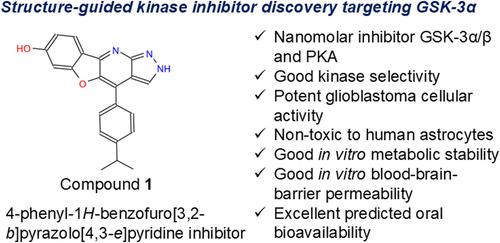
Glycogen synthase kinase-3 (GSK-3) is linked with multiple CNS conditions, including glioblastoma (GBM). Compared to the GSK-3β isoform, structure-based inhibitor design targeting GSK-3α is limited. Virtual screening was employed to identify GSK-3α inhibitors with CNS-active potential. Using a GSK-3α homology model, an optimized protocol with three-dimensional (3D)-pharmacophore filtering and Glide-SP docking was used to screen the ZINC20 biogenic subset. From 14 compounds selected for binding assay validation, three novel hit compounds were identified, with 1 (4-phenyl-1H-benzofuro[3,2-b]pyrazolo[4,3-e]pyridine scaffold) exhibiting nanomolar activity against GSK-3α/β (IC50s ∼ 0.26 μM). Selectivity profiling (12 homologous kinases) revealed selectivity for GSK-3α/β and protein kinase A (PKA). Compound 1 was more potent against three GBM cell lines (cell viability IC50s = 3–6 μM at 72 h) compared to benchmark GSK-3 inhibitor, 4-benzyl-2-methyl-1,2,4-thiadiazolidine-3,5-dione (TDZD-8), and nontoxic to human astrocytes. It demonstrated CNS-active potential in an all-human in vitro blood–brain barrier GBM model, good in vitro metabolic stability, excellent predicted oral bioavailability and represents a promising lead compound for development.
期刊介绍:
The Journal of Medicinal Chemistry is a prestigious biweekly peer-reviewed publication that focuses on the multifaceted field of medicinal chemistry. Since its inception in 1959 as the Journal of Medicinal and Pharmaceutical Chemistry, it has evolved to become a cornerstone in the dissemination of research findings related to the design, synthesis, and development of therapeutic agents.
The Journal of Medicinal Chemistry is recognized for its significant impact in the scientific community, as evidenced by its 2022 impact factor of 7.3. This metric reflects the journal's influence and the importance of its content in shaping the future of drug discovery and development. The journal serves as a vital resource for chemists, pharmacologists, and other researchers interested in the molecular mechanisms of drug action and the optimization of therapeutic compounds.




 京公网安备 11010802042870号
京ICP备2023020795号-1
京公网安备 11010802042870号
京ICP备2023020795号-1

 分享
分享
 求助内容:
求助内容: 应助结果提醒方式:
 扫码关注我们
