Letícia A. Souza, Beatriz R. de Moraes, Rafael M. de Souza, Gabriel A. L. Porto, Adriaan van den Bruinhorst, Margarida Costa Gomes, Mauro C. C. Ribeiro and Rômulo A. Ando
{"title":"Unveiling molecular interactions in glycerol-based deep eutectic solvents†","authors":"Letícia A. Souza, Beatriz R. de Moraes, Rafael M. de Souza, Gabriel A. L. Porto, Adriaan van den Bruinhorst, Margarida Costa Gomes, Mauro C. C. Ribeiro and Rômulo A. Ando","doi":"10.1039/D5CP00230C","DOIUrl":null,"url":null,"abstract":"<p >Elucidating the liquid structure of deep eutectic solvents (DES) is crucial to understand how local interactions determine their properties. In this work, the impact of the anion on the liquid structure and local interactions was investigated for mixtures of tetrabutylammonium chloride and bromide ([N<small><sub>4444</sub></small>]Cl and [N<small><sub>4444</sub></small>]Br) with glycerol (Gly). The phase behavior was explored across various compositions using differential scanning calorimetry (DSC) showing that these mixtures form a (<em>meta</em>)stable liquid at room temperature and <em>x</em><small><sub>salt</sub></small> = 0.25. At this composition, infrared spectroscopy (IR) revealed strong hydrogen bonding between glycerol and the anion that is more pronounced for chloride than bromide. This finding is supported by the enthalpy of mixing measurements and by quantum chemical calculations. Molecular dynamics (MD) simulations demonstrated that intermolecular hydrogen bonds between glycerol molecules persist, maintaining a long-range liquid structure even in the presence of salt. Far-infrared spectroscopy (FIR) combined with MD simulations revealed changes in local intermolecular dynamics due to a confinement effect caused by the strong anion–glycerol interactions. These results highlight the critical influence of local interactions driven by the anion on DES properties.</p>","PeriodicalId":99,"journal":{"name":"Physical Chemistry Chemical Physics","volume":" 17","pages":" 9123-9131"},"PeriodicalIF":2.9000,"publicationDate":"2025-04-09","publicationTypes":"Journal Article","fieldsOfStudy":null,"isOpenAccess":false,"openAccessPdf":"","citationCount":"0","resultStr":null,"platform":"Semanticscholar","paperid":null,"PeriodicalName":"Physical Chemistry Chemical Physics","FirstCategoryId":"92","ListUrlMain":"https://pubs.rsc.org/en/content/articlelanding/2025/cp/d5cp00230c","RegionNum":3,"RegionCategory":"化学","ArticlePicture":[],"TitleCN":null,"AbstractTextCN":null,"PMCID":null,"EPubDate":"","PubModel":"","JCR":"Q3","JCRName":"CHEMISTRY, PHYSICAL","Score":null,"Total":0}
引用次数: 0
Abstract
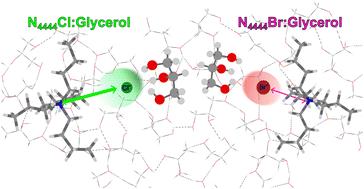
Elucidating the liquid structure of deep eutectic solvents (DES) is crucial to understand how local interactions determine their properties. In this work, the impact of the anion on the liquid structure and local interactions was investigated for mixtures of tetrabutylammonium chloride and bromide ([N4444]Cl and [N4444]Br) with glycerol (Gly). The phase behavior was explored across various compositions using differential scanning calorimetry (DSC) showing that these mixtures form a (meta)stable liquid at room temperature and xsalt = 0.25. At this composition, infrared spectroscopy (IR) revealed strong hydrogen bonding between glycerol and the anion that is more pronounced for chloride than bromide. This finding is supported by the enthalpy of mixing measurements and by quantum chemical calculations. Molecular dynamics (MD) simulations demonstrated that intermolecular hydrogen bonds between glycerol molecules persist, maintaining a long-range liquid structure even in the presence of salt. Far-infrared spectroscopy (FIR) combined with MD simulations revealed changes in local intermolecular dynamics due to a confinement effect caused by the strong anion–glycerol interactions. These results highlight the critical influence of local interactions driven by the anion on DES properties.
期刊介绍:
Physical Chemistry Chemical Physics (PCCP) is an international journal co-owned by 19 physical chemistry and physics societies from around the world. This journal publishes original, cutting-edge research in physical chemistry, chemical physics and biophysical chemistry. To be suitable for publication in PCCP, articles must include significant innovation and/or insight into physical chemistry; this is the most important criterion that reviewers and Editors will judge against when evaluating submissions.
The journal has a broad scope and welcomes contributions spanning experiment, theory, computation and data science. Topical coverage includes spectroscopy, dynamics, kinetics, statistical mechanics, thermodynamics, electrochemistry, catalysis, surface science, quantum mechanics, quantum computing and machine learning. Interdisciplinary research areas such as polymers and soft matter, materials, nanoscience, energy, surfaces/interfaces, and biophysical chemistry are welcomed if they demonstrate significant innovation and/or insight into physical chemistry. Joined experimental/theoretical studies are particularly appreciated when complementary and based on up-to-date approaches.





 京公网安备 11010802042870号
京ICP备2023020795号-1
京公网安备 11010802042870号
京ICP备2023020795号-1

 分享
分享
 求助内容:
求助内容: 应助结果提醒方式:
 扫码关注我们
