Jiaqi Zhang, Jiaxin Jiang, Hongyan Guo, Xiaowei Sheng, Weiyi Wang, Zhiwen Zhuo and Ning Lu
{"title":"Layered carbon nitride bulk as a versatile cathode material for fast ion batteries†","authors":"Jiaqi Zhang, Jiaxin Jiang, Hongyan Guo, Xiaowei Sheng, Weiyi Wang, Zhiwen Zhuo and Ning Lu","doi":"10.1039/D5CP00187K","DOIUrl":null,"url":null,"abstract":"<p >The development of high-comprehensive-performance cathode materials is significant and urgent for ion battery systems. Based on density functional theory methods, we systematically expand and investigate a porous and van der Waals layered bulk structure of carbon nitride as a versatile cathode material for various ion batteries. The calculated results indicate that the layered bulk carbon nitride structure is a semiconductor material with good thermal stability. The structure has high-density one-dimensional transport channels for fast K/Na/Ca ion migration with low activation energy barriers of only 0.125, 0.281, and 0.296 eV, respectively. The theoretical specific capacity, open-circuit voltage, and energy density can reach 137, 150, and 273 mA h g<small><sup>−1</sup></small>, 3.788–3.614, 3.251–3.037, and 3.376–2.821 V, and 506.1, 470.8, and 847.3 W h kg<small><sup>−1</sup></small> for K, Na and Ca ions, respectively. Compared to common cathode materials, layered carbon nitride possesses significant advantages such as fast ion migration, high energy density, low cost, and environmental friendliness.</p>","PeriodicalId":99,"journal":{"name":"Physical Chemistry Chemical Physics","volume":" 18","pages":" 9711-9720"},"PeriodicalIF":2.9000,"publicationDate":"2025-04-09","publicationTypes":"Journal Article","fieldsOfStudy":null,"isOpenAccess":false,"openAccessPdf":"","citationCount":"0","resultStr":null,"platform":"Semanticscholar","paperid":null,"PeriodicalName":"Physical Chemistry Chemical Physics","FirstCategoryId":"92","ListUrlMain":"https://pubs.rsc.org/en/content/articlelanding/2025/cp/d5cp00187k","RegionNum":3,"RegionCategory":"化学","ArticlePicture":[],"TitleCN":null,"AbstractTextCN":null,"PMCID":null,"EPubDate":"","PubModel":"","JCR":"Q3","JCRName":"CHEMISTRY, PHYSICAL","Score":null,"Total":0}
引用次数: 0
Abstract
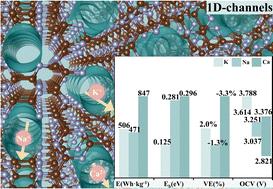
The development of high-comprehensive-performance cathode materials is significant and urgent for ion battery systems. Based on density functional theory methods, we systematically expand and investigate a porous and van der Waals layered bulk structure of carbon nitride as a versatile cathode material for various ion batteries. The calculated results indicate that the layered bulk carbon nitride structure is a semiconductor material with good thermal stability. The structure has high-density one-dimensional transport channels for fast K/Na/Ca ion migration with low activation energy barriers of only 0.125, 0.281, and 0.296 eV, respectively. The theoretical specific capacity, open-circuit voltage, and energy density can reach 137, 150, and 273 mA h g−1, 3.788–3.614, 3.251–3.037, and 3.376–2.821 V, and 506.1, 470.8, and 847.3 W h kg−1 for K, Na and Ca ions, respectively. Compared to common cathode materials, layered carbon nitride possesses significant advantages such as fast ion migration, high energy density, low cost, and environmental friendliness.
期刊介绍:
Physical Chemistry Chemical Physics (PCCP) is an international journal co-owned by 19 physical chemistry and physics societies from around the world. This journal publishes original, cutting-edge research in physical chemistry, chemical physics and biophysical chemistry. To be suitable for publication in PCCP, articles must include significant innovation and/or insight into physical chemistry; this is the most important criterion that reviewers and Editors will judge against when evaluating submissions.
The journal has a broad scope and welcomes contributions spanning experiment, theory, computation and data science. Topical coverage includes spectroscopy, dynamics, kinetics, statistical mechanics, thermodynamics, electrochemistry, catalysis, surface science, quantum mechanics, quantum computing and machine learning. Interdisciplinary research areas such as polymers and soft matter, materials, nanoscience, energy, surfaces/interfaces, and biophysical chemistry are welcomed if they demonstrate significant innovation and/or insight into physical chemistry. Joined experimental/theoretical studies are particularly appreciated when complementary and based on up-to-date approaches.




 京公网安备 11010802042870号
京ICP备2023020795号-1
京公网安备 11010802042870号
京ICP备2023020795号-1

 分享
分享
 求助内容:
求助内容: 应助结果提醒方式:
 扫码关注我们
