Mahmoud G. Ahmed, Yi Fei Phang, Ying Fan Tay, Anupam Sadhu, Pritish Mishra, Akhmad Herman Yuwono and Lydia H. Wong
{"title":"Trimetallic spinel NiCo2−xMoxO4 oxygen evolution catalyst enabling bias-free solar water splitting with inverted perovskite solar cells†","authors":"Mahmoud G. Ahmed, Yi Fei Phang, Ying Fan Tay, Anupam Sadhu, Pritish Mishra, Akhmad Herman Yuwono and Lydia H. Wong","doi":"10.1039/D4TA08267B","DOIUrl":null,"url":null,"abstract":"<p >Efficient spinel oxide catalysts are pivotal for driving the oxygen evolution reaction (OER) for hydrogen production <em>via</em> solar-driven water splitting. Designing trimetallic spinel oxides with high-valence metal ions which leach out to promote surface reconstruction is an effective strategy to maximize active sites for the OER. Herein, we report a trimetallic spinel oxide, NiCo<small><sub>2−<em>x</em></sub></small>Mo<small><sub><em>x</em></sub></small>O<small><sub>4</sub></small> as an efficient OER catalyst, generating 10 mA cm<small><sup>−2</sup></small> at a low overpotential of 250 mV, and demonstrating stability for over 25 h. Experimental and spectroscopic results indicate that the partial leaching of Mo ions from tetrahedral sites in the electrolyte facilitates Ni<small><sup>2+</sup></small> oxidation to Ni<small><sup>3+</sup></small>, leading to the formation of an active nickel (oxy)hydroxide with numerous catalytic sites. Furthermore, integrating this spinel oxide in a 2-electrode water electrolyzer coupled with an inverted p-i-n perovskite solar cell enables bias-free solar water splitting with a solar-to-hydrogen efficiency of 8.8%. This work underscores the efficacy of using high-valence metal ions as effective dopants in activating spinel oxide pre-catalysts for the OER, thereby broadening their application in solar-driven water splitting technologies.</p>","PeriodicalId":82,"journal":{"name":"Journal of Materials Chemistry A","volume":" 19","pages":" 14172-14180"},"PeriodicalIF":9.5000,"publicationDate":"2025-04-09","publicationTypes":"Journal Article","fieldsOfStudy":null,"isOpenAccess":false,"openAccessPdf":"https://pubs.rsc.org/en/content/articlepdf/2025/ta/d4ta08267b?page=search","citationCount":"0","resultStr":null,"platform":"Semanticscholar","paperid":null,"PeriodicalName":"Journal of Materials Chemistry A","FirstCategoryId":"88","ListUrlMain":"https://pubs.rsc.org/en/content/articlelanding/2025/ta/d4ta08267b","RegionNum":2,"RegionCategory":"材料科学","ArticlePicture":[],"TitleCN":null,"AbstractTextCN":null,"PMCID":null,"EPubDate":"","PubModel":"","JCR":"Q1","JCRName":"CHEMISTRY, PHYSICAL","Score":null,"Total":0}
引用次数: 0
Abstract
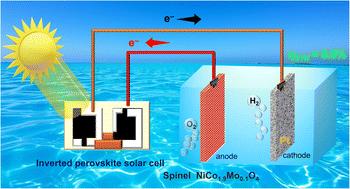
Efficient spinel oxide catalysts are pivotal for driving the oxygen evolution reaction (OER) for hydrogen production via solar-driven water splitting. Designing trimetallic spinel oxides with high-valence metal ions which leach out to promote surface reconstruction is an effective strategy to maximize active sites for the OER. Herein, we report a trimetallic spinel oxide, NiCo2−xMoxO4 as an efficient OER catalyst, generating 10 mA cm−2 at a low overpotential of 250 mV, and demonstrating stability for over 25 h. Experimental and spectroscopic results indicate that the partial leaching of Mo ions from tetrahedral sites in the electrolyte facilitates Ni2+ oxidation to Ni3+, leading to the formation of an active nickel (oxy)hydroxide with numerous catalytic sites. Furthermore, integrating this spinel oxide in a 2-electrode water electrolyzer coupled with an inverted p-i-n perovskite solar cell enables bias-free solar water splitting with a solar-to-hydrogen efficiency of 8.8%. This work underscores the efficacy of using high-valence metal ions as effective dopants in activating spinel oxide pre-catalysts for the OER, thereby broadening their application in solar-driven water splitting technologies.
高效的尖晶石氧化物催化剂是驱动太阳能驱动水裂解制氢的析氧反应(OER)的关键。设计具有高价金属离子的三金属尖晶石氧化物促进表面重构是最大化OER活性位点的有效策略。本文中,我们报道了一种三金属尖晶石氧化物NiCo2−xMoxO4作为一种高效的OER催化剂,在250 mV的低过电位下产生10 mA cm−2,并表现出超过25小时的稳定性。实验和光谱结果表明,电解质中四面体位置的Mo离子的部分浸出促进了Ni2+氧化为Ni3+,从而形成了具有许多催化位点的活性镍(氧)氢氧化物。此外,将这种尖晶石氧化物集成到双电极水电解槽中,再加上倒置的p-i-n钙钛矿太阳能电池,可以实现无偏压的太阳能水分解,太阳能-氢效率为8.8%。这项工作强调了使用高价金属离子作为有效掺杂剂激活OER尖晶石氧化物预催化剂的有效性,从而扩大了它们在太阳能驱动的水分解技术中的应用。
期刊介绍:
The Journal of Materials Chemistry A, B & C covers a wide range of high-quality studies in the field of materials chemistry, with each section focusing on specific applications of the materials studied. Journal of Materials Chemistry A emphasizes applications in energy and sustainability, including topics such as artificial photosynthesis, batteries, and fuel cells. Journal of Materials Chemistry B focuses on applications in biology and medicine, while Journal of Materials Chemistry C covers applications in optical, magnetic, and electronic devices. Example topic areas within the scope of Journal of Materials Chemistry A include catalysis, green/sustainable materials, sensors, and water treatment, among others.




 京公网安备 11010802042870号
京ICP备2023020795号-1
京公网安备 11010802042870号
京ICP备2023020795号-1

 分享
分享
 求助内容:
求助内容: 应助结果提醒方式:
 扫码关注我们
