Abraham A. Rosenberg, Daniel T. Lintz, Juncheng Li, Yiren Zhang, Joseph T. Doane, Miranda N. Bristol, Alma Kolakji, Ting Wang and Michael T. Yeung
{"title":"Tailoring high-entropy borides for hydrogenation: crystal morphology and catalytic pathways†","authors":"Abraham A. Rosenberg, Daniel T. Lintz, Juncheng Li, Yiren Zhang, Joseph T. Doane, Miranda N. Bristol, Alma Kolakji, Ting Wang and Michael T. Yeung","doi":"10.1039/D5QI00311C","DOIUrl":null,"url":null,"abstract":"<p >The high-entropy boride (HEB) Al<small><sub>0.2</sub></small>Nb<small><sub>0.2</sub></small>Pt<small><sub>0.2</sub></small>Ta<small><sub>0.2</sub></small>Ti<small><sub>0.2</sub></small>B<small><sub>2</sub></small>, with its unique crystal structure and high coordination (platinum coordinated to 12 boron atoms), has been shown in our previous work to exhibit exceptional catalytic properties, especially in sulfur-rich environments, where traditional platinum catalysts would succumb to sulfur poisoning. In this work, we investigate the mechanism of the HEB catalyst, first by comparing the synthesis by flux growth, as previously reported, to an arc-melting preparation. It is evident that the aluminum flux growth synthesis encourages the growth of single crystals, with clear and defined crystal facets, whereas the arc-melted sample exhibits poorly defined facets with non-uniform morphology. Here, we explore two potential mechanisms: hydrogen spillover effect (HSPE) and hydrogen atom transfer (HAT), by which the catalytic pathway is performed. Hydrogenation reactions were performed using WO<small><sub>3</sub></small> and 2,2,6,6-tetramethyl-1-piperidinyloxyl (TEMPO), which highlight the ability of the heterogeneous HEB catalyst to perform hydrogenation through a suspended solid solution in addition to a dissolved solution. We propose that the HEB Al<small><sub>0.2</sub></small>Nb<small><sub>0.2</sub></small>Pt<small><sub>0.2</sub></small>Ta<small><sub>0.2</sub></small>Ti<small><sub>0.2</sub></small>B<small><sub>2</sub></small> follows a hybrid HAT/HSPE mechanism, where H<small><sub>2</sub></small> binds to the platinum atoms on the edges of the HEB and dissociates, and then the radical hydrogen departs to the substrate.</p>","PeriodicalId":79,"journal":{"name":"Inorganic Chemistry Frontiers","volume":" 16","pages":" 4828-4834"},"PeriodicalIF":6.4000,"publicationDate":"2025-04-08","publicationTypes":"Journal Article","fieldsOfStudy":null,"isOpenAccess":false,"openAccessPdf":"","citationCount":"0","resultStr":null,"platform":"Semanticscholar","paperid":null,"PeriodicalName":"Inorganic Chemistry Frontiers","FirstCategoryId":"92","ListUrlMain":"https://pubs.rsc.org/en/content/articlelanding/2025/qi/d5qi00311c","RegionNum":1,"RegionCategory":"化学","ArticlePicture":[],"TitleCN":null,"AbstractTextCN":null,"PMCID":null,"EPubDate":"","PubModel":"","JCR":"Q1","JCRName":"CHEMISTRY, INORGANIC & NUCLEAR","Score":null,"Total":0}
引用次数: 0
Abstract
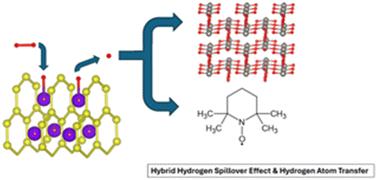
The high-entropy boride (HEB) Al0.2Nb0.2Pt0.2Ta0.2Ti0.2B2, with its unique crystal structure and high coordination (platinum coordinated to 12 boron atoms), has been shown in our previous work to exhibit exceptional catalytic properties, especially in sulfur-rich environments, where traditional platinum catalysts would succumb to sulfur poisoning. In this work, we investigate the mechanism of the HEB catalyst, first by comparing the synthesis by flux growth, as previously reported, to an arc-melting preparation. It is evident that the aluminum flux growth synthesis encourages the growth of single crystals, with clear and defined crystal facets, whereas the arc-melted sample exhibits poorly defined facets with non-uniform morphology. Here, we explore two potential mechanisms: hydrogen spillover effect (HSPE) and hydrogen atom transfer (HAT), by which the catalytic pathway is performed. Hydrogenation reactions were performed using WO3 and 2,2,6,6-tetramethyl-1-piperidinyloxyl (TEMPO), which highlight the ability of the heterogeneous HEB catalyst to perform hydrogenation through a suspended solid solution in addition to a dissolved solution. We propose that the HEB Al0.2Nb0.2Pt0.2Ta0.2Ti0.2B2 follows a hybrid HAT/HSPE mechanism, where H2 binds to the platinum atoms on the edges of the HEB and dissociates, and then the radical hydrogen departs to the substrate.



 京公网安备 11010802042870号
京ICP备2023020795号-1
京公网安备 11010802042870号
京ICP备2023020795号-1

 分享
分享
 求助内容:
求助内容: 应助结果提醒方式:
 扫码关注我们
