Lan Yu, Chengxu Liu, Li Sun, Wei Kan, Ying Xie, Xiuwen Wang, Yuying Cao, Bing Zhao and Chunmei Lv
{"title":"Boosting hydrogen evolution and triiodide reduction via electronic coupling on a (1T, 2H) MoS2@N-doped carbon dodecahedron†","authors":"Lan Yu, Chengxu Liu, Li Sun, Wei Kan, Ying Xie, Xiuwen Wang, Yuying Cao, Bing Zhao and Chunmei Lv","doi":"10.1039/D5QI00437C","DOIUrl":null,"url":null,"abstract":"<p >Designing a noble-metal-free catalyst with the desired composition and structure is highly significant for accelerating the catalytic kinetics of the hydrogen evolution reaction (HER) and triiodide reduction reaction (IRR), which is essential for advancing green hydrogen production from water electrolysis and improving the power conversion efficiency (PCE) of dye-sensitized solar cells (DSSCs). Herein, small-sized (1T, 2H) phase MoS<small><sub>2</sub></small> nanosheets were uniformly wrapped around an N-doped C dodecahedron (MoS<small><sub>2</sub></small>@NC) through a continuous synthesis strategy with ZIF-8 serving as the original template. When MoS<small><sub>2</sub></small>@NC is used as a catalyst for the HER, it only requires a low overpotential of 93 mV to reach 10 mA cm<small><sup>−2</sup></small>, surpassing most reported MoS<small><sub>2</sub></small>-based catalysts. Furthermore, a device fabricated with MoS<small><sub>2</sub></small>@NC achieves a PCE of 8.20%, which is comparable to that of a Pt-based one (8.59%). Theoretical calculations revealed that the enhanced HER activity of MoS<small><sub>2</sub></small>@NC is mainly attributed to the enhanced water adsorption energy and a reduced energy barrier for overcoming the rate-determining step during the HER process. Additionally, the interfacial S sites in MoS<small><sub>2</sub></small>@NC are responsible for the excellent catalytic activity in the IRR. The experimental and theoretical results collectively confirm that the as-designed MoS<small><sub>2</sub></small>@NC is a promising bifunctional catalyst.</p>","PeriodicalId":79,"journal":{"name":"Inorganic Chemistry Frontiers","volume":" 16","pages":" 4844-4855"},"PeriodicalIF":6.4000,"publicationDate":"2025-04-09","publicationTypes":"Journal Article","fieldsOfStudy":null,"isOpenAccess":false,"openAccessPdf":"","citationCount":"0","resultStr":null,"platform":"Semanticscholar","paperid":null,"PeriodicalName":"Inorganic Chemistry Frontiers","FirstCategoryId":"92","ListUrlMain":"https://pubs.rsc.org/en/content/articlelanding/2025/qi/d5qi00437c","RegionNum":1,"RegionCategory":"化学","ArticlePicture":[],"TitleCN":null,"AbstractTextCN":null,"PMCID":null,"EPubDate":"","PubModel":"","JCR":"Q1","JCRName":"CHEMISTRY, INORGANIC & NUCLEAR","Score":null,"Total":0}
引用次数: 0
Abstract
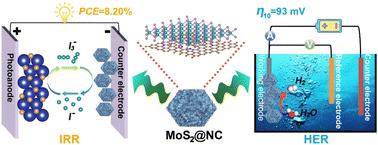
Designing a noble-metal-free catalyst with the desired composition and structure is highly significant for accelerating the catalytic kinetics of the hydrogen evolution reaction (HER) and triiodide reduction reaction (IRR), which is essential for advancing green hydrogen production from water electrolysis and improving the power conversion efficiency (PCE) of dye-sensitized solar cells (DSSCs). Herein, small-sized (1T, 2H) phase MoS2 nanosheets were uniformly wrapped around an N-doped C dodecahedron (MoS2@NC) through a continuous synthesis strategy with ZIF-8 serving as the original template. When MoS2@NC is used as a catalyst for the HER, it only requires a low overpotential of 93 mV to reach 10 mA cm−2, surpassing most reported MoS2-based catalysts. Furthermore, a device fabricated with MoS2@NC achieves a PCE of 8.20%, which is comparable to that of a Pt-based one (8.59%). Theoretical calculations revealed that the enhanced HER activity of MoS2@NC is mainly attributed to the enhanced water adsorption energy and a reduced energy barrier for overcoming the rate-determining step during the HER process. Additionally, the interfacial S sites in MoS2@NC are responsible for the excellent catalytic activity in the IRR. The experimental and theoretical results collectively confirm that the as-designed MoS2@NC is a promising bifunctional catalyst.
设计具有理想组成和结构的无贵金属催化剂,对加快析氢反应(HER)和三碘还原反应(IRR)的催化动力学具有重要意义,对推进绿色水电解制氢和提高染料敏化太阳能电池(DSSCs)的功率转换效率(PCE)具有重要意义。本文以ZIF-8为原始模板,采用连续合成策略,将小尺寸(1T, 2H)相MoS2纳米片均匀包裹在n掺杂C十二面体(MoS2@NC)周围。当MoS2@NC用作HER催化剂时,只需要93 mV的低过电位就可以达到10 mA cm - 2,超过了大多数基于mos2的催化剂。此外,用MoS2@NC制作的器件的PCE为8.20%,与基于pt的器件(8.59%)相当。理论计算表明,MoS2@NC的HER活性增强主要是由于HER过程中水吸附能的提高和克服速率决定步骤的能垒的降低。此外,MoS2@NC中的界面S位点在IRR中具有优异的催化活性。实验和理论结果共同证实了所设计的MoS2@NC是一种很有前途的双功能催化剂。



 京公网安备 11010802042870号
京ICP备2023020795号-1
京公网安备 11010802042870号
京ICP备2023020795号-1

 分享
分享
 求助内容:
求助内容: 应助结果提醒方式:
 扫码关注我们
