Design of an inflorescence-type phosphorus-doped (Ni,Co)–molybdate architecture with an atomically thin cobalt oxide layer for high-efficiency energy storage systems†
Sangeeta Adhikari, Amarnath T. Sivagurunathan and Do-Heyoung Kim
{"title":"Design of an inflorescence-type phosphorus-doped (Ni,Co)–molybdate architecture with an atomically thin cobalt oxide layer for high-efficiency energy storage systems†","authors":"Sangeeta Adhikari, Amarnath T. Sivagurunathan and Do-Heyoung Kim","doi":"10.1039/D5QI00355E","DOIUrl":null,"url":null,"abstract":"<p >High-performance asymmetric supercapacitors (ASCs) need to promote the diffusion of the electrolyte into the electrode, a process that is governed by the electron transfer kinetics and morphology of the electrode material. In line with this, the present study designed a phosphorus (P)-doped (Ni,Co)-MoO<small><sub>4</sub></small> electrode with an inflorescence-like architecture on a central stem and an atomically thin coating of Co<small><sub>3</sub></small>O<small><sub>4</sub></small> to improve the electron conductivity of the resulting electrode. This unique structure was prepared using a three-step process that included hydrothermal processing, phosphorylation, and atomic layer deposition of Co<small><sub>3</sub></small>O<small><sub>4</sub></small>. The presence of P in (Ni,Co)-MoO<small><sub>4</sub></small> improves the surface redox behavior of the material. Additionally, the formation of Ni<small><sub>2</sub></small>P and CoP<small><sub>3</sub></small> nanoparticles on the surface of the inflorescence architecture <em>via</em> the nanoscale Kirkendall effect boosts the charge storage behavior by increasing the active sites in the electrode system. As a result, the optimized P-doped (Ni,Co)-MoO<small><sub>4</sub></small> electrode with a 7 nm layer of Co<small><sub>3</sub></small>O<small><sub>4</sub></small> (NCMP-7Co) achieved a high specific capacity of 2374 C g<small><sup>−1</sup></small> at a current density of 2 A g<small><sup>−1</sup></small> with 79.8% capacity retention after 5000 cycles at 10 A g<small><sup>−1</sup></small> current density. The mechanism for the optimized electrode based on electrochemical analysis indicates a dominant diffusion-governed behavior. On the other hand, postmortem analysis revealed dissolution of P and Mo from the electrode material to electrolyte with significant structural change. An ASC constructed device with reduced graphene oxide displays fairly high energy density compared to reported systems. Convincingly, a synergistic improvement with outstanding performance could be ascribed to the inflorescence flower-like architecture, compositional arrangement after P-doping, and deposition of the Co<small><sub>3</sub></small>O<small><sub>4</sub></small> atomic layer.</p>","PeriodicalId":79,"journal":{"name":"Inorganic Chemistry Frontiers","volume":" 16","pages":" 4887-4900"},"PeriodicalIF":6.4000,"publicationDate":"2025-04-09","publicationTypes":"Journal Article","fieldsOfStudy":null,"isOpenAccess":false,"openAccessPdf":"","citationCount":"0","resultStr":null,"platform":"Semanticscholar","paperid":null,"PeriodicalName":"Inorganic Chemistry Frontiers","FirstCategoryId":"92","ListUrlMain":"https://pubs.rsc.org/en/content/articlelanding/2025/qi/d5qi00355e","RegionNum":1,"RegionCategory":"化学","ArticlePicture":[],"TitleCN":null,"AbstractTextCN":null,"PMCID":null,"EPubDate":"","PubModel":"","JCR":"Q1","JCRName":"CHEMISTRY, INORGANIC & NUCLEAR","Score":null,"Total":0}
引用次数: 0
Abstract
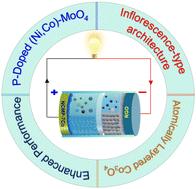
High-performance asymmetric supercapacitors (ASCs) need to promote the diffusion of the electrolyte into the electrode, a process that is governed by the electron transfer kinetics and morphology of the electrode material. In line with this, the present study designed a phosphorus (P)-doped (Ni,Co)-MoO4 electrode with an inflorescence-like architecture on a central stem and an atomically thin coating of Co3O4 to improve the electron conductivity of the resulting electrode. This unique structure was prepared using a three-step process that included hydrothermal processing, phosphorylation, and atomic layer deposition of Co3O4. The presence of P in (Ni,Co)-MoO4 improves the surface redox behavior of the material. Additionally, the formation of Ni2P and CoP3 nanoparticles on the surface of the inflorescence architecture via the nanoscale Kirkendall effect boosts the charge storage behavior by increasing the active sites in the electrode system. As a result, the optimized P-doped (Ni,Co)-MoO4 electrode with a 7 nm layer of Co3O4 (NCMP-7Co) achieved a high specific capacity of 2374 C g−1 at a current density of 2 A g−1 with 79.8% capacity retention after 5000 cycles at 10 A g−1 current density. The mechanism for the optimized electrode based on electrochemical analysis indicates a dominant diffusion-governed behavior. On the other hand, postmortem analysis revealed dissolution of P and Mo from the electrode material to electrolyte with significant structural change. An ASC constructed device with reduced graphene oxide displays fairly high energy density compared to reported systems. Convincingly, a synergistic improvement with outstanding performance could be ascribed to the inflorescence flower-like architecture, compositional arrangement after P-doping, and deposition of the Co3O4 atomic layer.



 京公网安备 11010802042870号
京ICP备2023020795号-1
京公网安备 11010802042870号
京ICP备2023020795号-1

 分享
分享
 求助内容:
求助内容: 应助结果提醒方式:
 扫码关注我们
