Cherish Nie, Chloe Park, Junho Kim, Paul J. Chirik
{"title":"Activation and Reactivity of Vinylcyclobutane with Phosphine Nickel Catalysts","authors":"Cherish Nie, Chloe Park, Junho Kim, Paul J. Chirik","doi":"10.1021/acscatal.5c00920","DOIUrl":null,"url":null,"abstract":"A series of monodentate phosphine ligands was evaluated for the nickel-mediated activation of vinylcyclobutane (VCB) by oxidative addition to form the corresponding η<sup>1</sup>,η<sup>3</sup>-metallacycles. The addition of VCB to equimolar mixtures of phosphine and Ni(COD)<sub>2</sub> (COD = 1,5-cyclooctadiene) produced a mixture of P<sub>2</sub>Ni(COD), P<sub>2</sub>Ni(VCB), and/or P<sub>1</sub>Ni(VCB)<sub>2</sub>. The accessibility of a VCB-derived P<sub>1</sub>Ni(II) alkyl,allyl-metallacycle correlated with an increasing number of alkyl substituents on the phosphine. Among trialkyl phosphines, PCy<sub>3</sub> and P<sup><i>i</i></sup>Pr<sub>3</sub> were the most effective for metallacycle formation. The VCB-derived metallacycles (Cy<sub>3</sub>P)Ni(C<sub>6</sub>H<sub>10</sub>) and (<sup><i>i</i></sup>Pr<sub>3</sub>P)Ni(C<sub>6</sub>H<sub>10</sub>) were isolated and characterized by NMR spectroscopy and single-crystal X-ray diffraction. The thermal and photochemical reactivity of (Cy<sub>3</sub>P)Ni(C<sub>6</sub>H<sub>10</sub>) was explored and compared to related (NHC)Ni(C<sub>6</sub>H<sub>10</sub>) metallacycles (NHC = <i>N</i>-heterocyclic carbene). Catalytic VCB-activation was observed with (Cy<sub>3</sub>P)Ni(C<sub>6</sub>H<sub>10</sub>) at 120 °C and furnished products from retro-[2 + 2] cycloaddition – ethylene, vinylcyclohexene, and cyclooctadiene – as well as 2,4-hexadiene arising from β-H elimination. Catalytic activation of VCB was observed upon irradiation of (Cy<sub>3</sub>P)Ni(C<sub>6</sub>H<sub>10</sub>) with blue light at 60 °C with improved selectivity for retro-[2 + 2] products over β-Η elimination and [2 + 1] cycloaddition products compared to NHC analogues. (Cy<sub>3</sub>P)Ni(C<sub>6</sub>H<sub>10</sub>) was also found to catalyze the retro-[2 + 2] depolymerization of (1,<i>n</i>′-divinyl)oligocyclobutane, but the presence of substituents on the cyclobutane ring resulted in an increased preference for β-H elimination.","PeriodicalId":9,"journal":{"name":"ACS Catalysis ","volume":"33 1","pages":""},"PeriodicalIF":13.6000,"publicationDate":"2025-04-09","publicationTypes":"Journal Article","fieldsOfStudy":null,"isOpenAccess":false,"openAccessPdf":"","citationCount":"0","resultStr":null,"platform":"Semanticscholar","paperid":null,"PeriodicalName":"ACS Catalysis ","FirstCategoryId":"92","ListUrlMain":"https://doi.org/10.1021/acscatal.5c00920","RegionNum":1,"RegionCategory":"化学","ArticlePicture":[],"TitleCN":null,"AbstractTextCN":null,"PMCID":null,"EPubDate":"","PubModel":"","JCR":"Q1","JCRName":"CHEMISTRY, PHYSICAL","Score":null,"Total":0}
引用次数: 0
Abstract
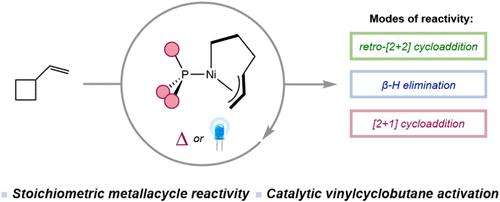
A series of monodentate phosphine ligands was evaluated for the nickel-mediated activation of vinylcyclobutane (VCB) by oxidative addition to form the corresponding η1,η3-metallacycles. The addition of VCB to equimolar mixtures of phosphine and Ni(COD)2 (COD = 1,5-cyclooctadiene) produced a mixture of P2Ni(COD), P2Ni(VCB), and/or P1Ni(VCB)2. The accessibility of a VCB-derived P1Ni(II) alkyl,allyl-metallacycle correlated with an increasing number of alkyl substituents on the phosphine. Among trialkyl phosphines, PCy3 and PiPr3 were the most effective for metallacycle formation. The VCB-derived metallacycles (Cy3P)Ni(C6H10) and (iPr3P)Ni(C6H10) were isolated and characterized by NMR spectroscopy and single-crystal X-ray diffraction. The thermal and photochemical reactivity of (Cy3P)Ni(C6H10) was explored and compared to related (NHC)Ni(C6H10) metallacycles (NHC = N-heterocyclic carbene). Catalytic VCB-activation was observed with (Cy3P)Ni(C6H10) at 120 °C and furnished products from retro-[2 + 2] cycloaddition – ethylene, vinylcyclohexene, and cyclooctadiene – as well as 2,4-hexadiene arising from β-H elimination. Catalytic activation of VCB was observed upon irradiation of (Cy3P)Ni(C6H10) with blue light at 60 °C with improved selectivity for retro-[2 + 2] products over β-Η elimination and [2 + 1] cycloaddition products compared to NHC analogues. (Cy3P)Ni(C6H10) was also found to catalyze the retro-[2 + 2] depolymerization of (1,n′-divinyl)oligocyclobutane, but the presence of substituents on the cyclobutane ring resulted in an increased preference for β-H elimination.
期刊介绍:
ACS Catalysis is an esteemed journal that publishes original research in the fields of heterogeneous catalysis, molecular catalysis, and biocatalysis. It offers broad coverage across diverse areas such as life sciences, organometallics and synthesis, photochemistry and electrochemistry, drug discovery and synthesis, materials science, environmental protection, polymer discovery and synthesis, and energy and fuels.
The scope of the journal is to showcase innovative work in various aspects of catalysis. This includes new reactions and novel synthetic approaches utilizing known catalysts, the discovery or modification of new catalysts, elucidation of catalytic mechanisms through cutting-edge investigations, practical enhancements of existing processes, as well as conceptual advances in the field. Contributions to ACS Catalysis can encompass both experimental and theoretical research focused on catalytic molecules, macromolecules, and materials that exhibit catalytic turnover.




 京公网安备 11010802042870号
京ICP备2023020795号-1
京公网安备 11010802042870号
京ICP备2023020795号-1

 分享
分享
 求助内容:
求助内容: 应助结果提醒方式:
 扫码关注我们
