Sang Bin Kim, Jiyull Kim, Deok Woo Kim, Sung Beom Hwang and Ji Bong Joo*,
{"title":"Role of Organic Additives and pH on the Wet Absorption Process for SO2 Removal in Flue Gas","authors":"Sang Bin Kim, Jiyull Kim, Deok Woo Kim, Sung Beom Hwang and Ji Bong Joo*, ","doi":"10.1021/acs.energyfuels.4c06173","DOIUrl":null,"url":null,"abstract":"<p >In this study, to explore the effective conditions and methods for SO<sub>2</sub> removal from flue gas, a CaCO<sub>3</sub> absorbent and various additives were used to investigate the pH changes and removal efficiency of SO<sub>2</sub> from aqueous solutions. Desulfurization performance was investigated using the CaCO<sub>3</sub> absorbent concentration and additive type as variables. CaCO<sub>3</sub> was dissolved in an appropriate pH range to produce HCO<sub>3</sub><sup>–</sup> ions to provide a buffering effect for the H<sup>+</sup> ions generated via its reaction with SO<sub>2</sub> in an aqueous solution. This process extended the absorption duration of the SO<sub>2</sub>. With a higher CaCO<sub>3</sub> concentration, the alkalinity of the absorption solution remained longer and the SO<sub>2</sub> removal efficiency and absorption duration were higher. Organic acids, such as acetic, adipic, and citric acids, and the organic salts of sodium acetate, magnesium acetate, potassium acetate, and calcium acetate were used as additives. The removal efficiency of the additives in the SO<sub>2</sub> absorption reaction was as follows: citric acid < adipic acid < no addition < acetic acid < potassium acetate ≤ magnesium acetate ≤ sodium acetate ≤ calcium acetate. Organic acid additives lowered the initial pH of the absorption solution and effectively promoted CaCO<sub>3</sub> dissolution. The chemical buffering system using metal acetate salts exhibited a high SO<sub>2</sub> absorption performance with a gradual decrease in pH. Additionally, experiments were conducted using a simulated flue gas whose composition was similar to that of actual flue gas. The HCO<sub>3</sub><sup>–</sup> from CO<sub>2</sub> increased the SO<sub>2</sub> removal efficiency and absorption duration owing to a buffering effect. This study demonstrates the potential of a system capable of long duration absorption of low-concentration SO<sub>2</sub> and confirms that the presence of calcium acetate and CO<sub>2</sub> enhances SO<sub>2</sub> removal capacity in desulfurization processes.</p>","PeriodicalId":35,"journal":{"name":"Energy & Fuels","volume":"39 14","pages":"6905–6914 6905–6914"},"PeriodicalIF":5.3000,"publicationDate":"2025-04-02","publicationTypes":"Journal Article","fieldsOfStudy":null,"isOpenAccess":false,"openAccessPdf":"","citationCount":"0","resultStr":null,"platform":"Semanticscholar","paperid":null,"PeriodicalName":"Energy & Fuels","FirstCategoryId":"5","ListUrlMain":"https://pubs.acs.org/doi/10.1021/acs.energyfuels.4c06173","RegionNum":3,"RegionCategory":"工程技术","ArticlePicture":[],"TitleCN":null,"AbstractTextCN":null,"PMCID":null,"EPubDate":"","PubModel":"","JCR":"Q2","JCRName":"ENERGY & FUELS","Score":null,"Total":0}
引用次数: 0
Abstract
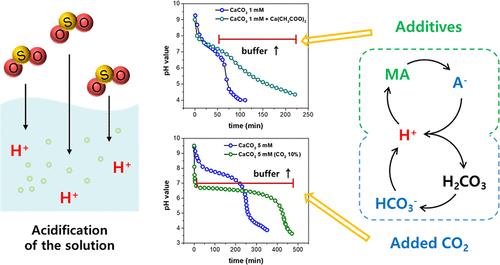
In this study, to explore the effective conditions and methods for SO2 removal from flue gas, a CaCO3 absorbent and various additives were used to investigate the pH changes and removal efficiency of SO2 from aqueous solutions. Desulfurization performance was investigated using the CaCO3 absorbent concentration and additive type as variables. CaCO3 was dissolved in an appropriate pH range to produce HCO3– ions to provide a buffering effect for the H+ ions generated via its reaction with SO2 in an aqueous solution. This process extended the absorption duration of the SO2. With a higher CaCO3 concentration, the alkalinity of the absorption solution remained longer and the SO2 removal efficiency and absorption duration were higher. Organic acids, such as acetic, adipic, and citric acids, and the organic salts of sodium acetate, magnesium acetate, potassium acetate, and calcium acetate were used as additives. The removal efficiency of the additives in the SO2 absorption reaction was as follows: citric acid < adipic acid < no addition < acetic acid < potassium acetate ≤ magnesium acetate ≤ sodium acetate ≤ calcium acetate. Organic acid additives lowered the initial pH of the absorption solution and effectively promoted CaCO3 dissolution. The chemical buffering system using metal acetate salts exhibited a high SO2 absorption performance with a gradual decrease in pH. Additionally, experiments were conducted using a simulated flue gas whose composition was similar to that of actual flue gas. The HCO3– from CO2 increased the SO2 removal efficiency and absorption duration owing to a buffering effect. This study demonstrates the potential of a system capable of long duration absorption of low-concentration SO2 and confirms that the presence of calcium acetate and CO2 enhances SO2 removal capacity in desulfurization processes.
期刊介绍:
Energy & Fuels publishes reports of research in the technical area defined by the intersection of the disciplines of chemistry and chemical engineering and the application domain of non-nuclear energy and fuels. This includes research directed at the formation of, exploration for, and production of fossil fuels and biomass; the properties and structure or molecular composition of both raw fuels and refined products; the chemistry involved in the processing and utilization of fuels; fuel cells and their applications; and the analytical and instrumental techniques used in investigations of the foregoing areas.




 京公网安备 11010802042870号
京ICP备2023020795号-1
京公网安备 11010802042870号
京ICP备2023020795号-1

 分享
分享
 求助内容:
求助内容: 应助结果提醒方式:
 扫码关注我们
