Broad-spectrum pathogenic bacteria SERS sensing with face-centered high-index facets Au CPNCs & microarray chips: A novel platform able to achieve dual-readout detection
Hao-yu Zhang , Jing-yuan Wang , Jian-jun Li , Jian Zhu , Guo-jun Weng , Ya-li Li , Jun-wu Zhao
{"title":"Broad-spectrum pathogenic bacteria SERS sensing with face-centered high-index facets Au CPNCs & microarray chips: A novel platform able to achieve dual-readout detection","authors":"Hao-yu Zhang , Jing-yuan Wang , Jian-jun Li , Jian Zhu , Guo-jun Weng , Ya-li Li , Jun-wu Zhao","doi":"10.1016/j.jcis.2025.137485","DOIUrl":null,"url":null,"abstract":"<div><div>Non-specificity and inadequate quantitative capability are the primary challenges faced by the surface-enhanced Raman scattering (SERS) technique, especially when it comes to detecting bacteria in real samples. Herein, a novel face-centered Au Convex Polyhedral Nanocrystal (Au CPNC) with high-index facets and its assembly Au CPNCs microarray chip were designed and fabricated to address these challenges, within the process where 4-mercaptophenylboronic acid (4-MPBA) was utilized as a multifunctional element. The as-prepared Au CPNC possesses anisotropic raised edges enjoying tunable localized surface plasmon resonance modes for SERS enhancement. Then we obtained long-region ordered Au CPNCs microarrays equipping even greater “hot spots” with a SERS enhancement factor (EF) up to 5.38 × 10<sup>7</sup>. The constructed SERS probes excellently leveraged the outstanding SERS performance of Au CPNC and the superior functions of 4-MPBA, which enabled the differences among the bacterial “fingerprints” to be highlighted. Through partial least squares discriminant analysis (PLS-DA), we successfully identified <em>Escherichia coli, Staphylococcus aureus, Pseudomonas aeruginosa</em> and <em>Listeria monocytogenes</em> with achieving limits of detection (LODs) in spiked whole blood samples of 3, 1, 2, and 2 cfu/mL, respectively. Notably, the LODs for all samples by SERS mapping visual readout mode were as low as 10 cfu/mL. In practical applications, our method demonstrated its efficacy by 100 % accurately classifying (20 cases) of real blood samples. Altogether, the theoretical significance and application value of this study reside in providing fundamental insights and approaches for the development of pathogenic bacteria detection field.</div></div>","PeriodicalId":351,"journal":{"name":"Journal of Colloid and Interface Science","volume":"692 ","pages":"Article 137485"},"PeriodicalIF":9.7000,"publicationDate":"2025-08-15","publicationTypes":"Journal Article","fieldsOfStudy":null,"isOpenAccess":false,"openAccessPdf":"","citationCount":"0","resultStr":null,"platform":"Semanticscholar","paperid":null,"PeriodicalName":"Journal of Colloid and Interface Science","FirstCategoryId":"92","ListUrlMain":"https://www.sciencedirect.com/science/article/pii/S0021979725008768","RegionNum":1,"RegionCategory":"化学","ArticlePicture":[],"TitleCN":null,"AbstractTextCN":null,"PMCID":null,"EPubDate":"2025/3/31 0:00:00","PubModel":"Epub","JCR":"Q1","JCRName":"CHEMISTRY, PHYSICAL","Score":null,"Total":0}
引用次数: 0
Abstract
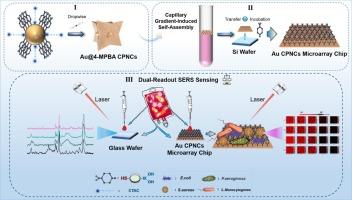
Non-specificity and inadequate quantitative capability are the primary challenges faced by the surface-enhanced Raman scattering (SERS) technique, especially when it comes to detecting bacteria in real samples. Herein, a novel face-centered Au Convex Polyhedral Nanocrystal (Au CPNC) with high-index facets and its assembly Au CPNCs microarray chip were designed and fabricated to address these challenges, within the process where 4-mercaptophenylboronic acid (4-MPBA) was utilized as a multifunctional element. The as-prepared Au CPNC possesses anisotropic raised edges enjoying tunable localized surface plasmon resonance modes for SERS enhancement. Then we obtained long-region ordered Au CPNCs microarrays equipping even greater “hot spots” with a SERS enhancement factor (EF) up to 5.38 × 10⁷. The constructed SERS probes excellently leveraged the outstanding SERS performance of Au CPNC and the superior functions of 4-MPBA, which enabled the differences among the bacterial “fingerprints” to be highlighted. Through partial least squares discriminant analysis (PLS-DA), we successfully identified Escherichia coli, Staphylococcus aureus, Pseudomonas aeruginosa and Listeria monocytogenes with achieving limits of detection (LODs) in spiked whole blood samples of 3, 1, 2, and 2 cfu/mL, respectively. Notably, the LODs for all samples by SERS mapping visual readout mode were as low as 10 cfu/mL. In practical applications, our method demonstrated its efficacy by 100 % accurately classifying (20 cases) of real blood samples. Altogether, the theoretical significance and application value of this study reside in providing fundamental insights and approaches for the development of pathogenic bacteria detection field.
期刊介绍:
The Journal of Colloid and Interface Science publishes original research findings on the fundamental principles of colloid and interface science, as well as innovative applications in various fields. The criteria for publication include impact, quality, novelty, and originality.
Emphasis:
The journal emphasizes fundamental scientific innovation within the following categories:
A.Colloidal Materials and Nanomaterials
B.Soft Colloidal and Self-Assembly Systems
C.Adsorption, Catalysis, and Electrochemistry
D.Interfacial Processes, Capillarity, and Wetting
E.Biomaterials and Nanomedicine
F.Energy Conversion and Storage, and Environmental Technologies




 京公网安备 11010802042870号
京ICP备2023020795号-1
京公网安备 11010802042870号
京ICP备2023020795号-1

 分享
分享
 求助内容:
求助内容: 应助结果提醒方式:
 扫码关注我们
