Chunrong Lu, Xiaojun Wang, Xiaochun Chen, Tao Qin, Pengpeng Ye, Jianqun Liu, Shuai Wang, Weifei Luo
{"title":"Causal Analysis Between Gut Microbes, Aging Indicator, and Age-Related Disease, Involving the Discovery and Validation of Biomarkers","authors":"Chunrong Lu, Xiaojun Wang, Xiaochun Chen, Tao Qin, Pengpeng Ye, Jianqun Liu, Shuai Wang, Weifei Luo","doi":"10.1111/acel.70057","DOIUrl":null,"url":null,"abstract":"<p>The influence of gut microbes on aging has been reported in several studies, but the mediating pathways of gut microbiota, whether there is a causal relationship between the two, and biomarker screening and validation have not been fully discussed. In this study, Mendelian Randomization (MR) and Linkage Disequilibrium Score Regression (LDSC) are used to systematically investigate the associations between gut microbiota, three aging indicators, and 14 age-related diseases. Additionally, this study integrates machine learning algorithms to explore the potential of MR and LDSC methods for biomarker screening. Gut microbiota is found to be a potential risk factor for 14 age-related diseases. The causal effects of gut microbiota on chronic kidney disease, cirrhosis, and heart failure are partially mediated by aging indicators. Additionally, gut microbiota identified through MR and LDSC methods exhibit biomarker properties for disease prediction (average AUC = 0.731). These methods can serve as auxiliary tools for conventional biomarker screening, effectively enhancing the performance of disease models (average AUC increased from 0.808 to 0.832). This study provides evidence that supports the association between the gut microbiota and aging and highlights the potential of genetic correlation and causal relationship analysis in biomarker discovery. These findings may help to develop new approaches for healthy aging detection and intervention.</p>","PeriodicalId":55543,"journal":{"name":"Aging Cell","volume":"24 7","pages":""},"PeriodicalIF":7.1000,"publicationDate":"2025-04-09","publicationTypes":"Journal Article","fieldsOfStudy":null,"isOpenAccess":false,"openAccessPdf":"https://onlinelibrary.wiley.com/doi/epdf/10.1111/acel.70057","citationCount":"0","resultStr":null,"platform":"Semanticscholar","paperid":null,"PeriodicalName":"Aging Cell","FirstCategoryId":"99","ListUrlMain":"https://onlinelibrary.wiley.com/doi/10.1111/acel.70057","RegionNum":1,"RegionCategory":"医学","ArticlePicture":[],"TitleCN":null,"AbstractTextCN":null,"PMCID":null,"EPubDate":"","PubModel":"","JCR":"Q1","JCRName":"Biochemistry, Genetics and Molecular Biology","Score":null,"Total":0}
引用次数: 0
Abstract
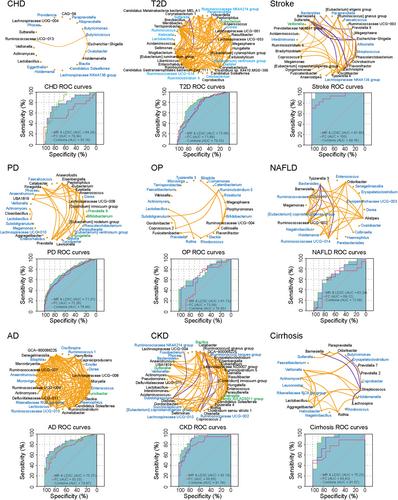
The influence of gut microbes on aging has been reported in several studies, but the mediating pathways of gut microbiota, whether there is a causal relationship between the two, and biomarker screening and validation have not been fully discussed. In this study, Mendelian Randomization (MR) and Linkage Disequilibrium Score Regression (LDSC) are used to systematically investigate the associations between gut microbiota, three aging indicators, and 14 age-related diseases. Additionally, this study integrates machine learning algorithms to explore the potential of MR and LDSC methods for biomarker screening. Gut microbiota is found to be a potential risk factor for 14 age-related diseases. The causal effects of gut microbiota on chronic kidney disease, cirrhosis, and heart failure are partially mediated by aging indicators. Additionally, gut microbiota identified through MR and LDSC methods exhibit biomarker properties for disease prediction (average AUC = 0.731). These methods can serve as auxiliary tools for conventional biomarker screening, effectively enhancing the performance of disease models (average AUC increased from 0.808 to 0.832). This study provides evidence that supports the association between the gut microbiota and aging and highlights the potential of genetic correlation and causal relationship analysis in biomarker discovery. These findings may help to develop new approaches for healthy aging detection and intervention.
期刊介绍:
Aging Cell, an Open Access journal, delves into fundamental aspects of aging biology. It comprehensively explores geroscience, emphasizing research on the mechanisms underlying the aging process and the connections between aging and age-related diseases.



 京公网安备 11010802042870号
京ICP备2023020795号-1
京公网安备 11010802042870号
京ICP备2023020795号-1

 分享
分享
 求助内容:
求助内容: 应助结果提醒方式:
 扫码关注我们
