Ping Wu, Lieselot Vandemeulebroucke, Huaihan Cai, Bart P. Braeckman
{"title":"The Proprotein Convertase BLI-4 Is Required for Axenic Dietary Restriction Mediated Longevity in Caenorhabditis elegans","authors":"Ping Wu, Lieselot Vandemeulebroucke, Huaihan Cai, Bart P. Braeckman","doi":"10.1111/acel.70058","DOIUrl":null,"url":null,"abstract":"<p>Dietary restriction (DR) is a well-established method for extending lifespan across various species, including <i>C. elegans</i>. Among the different DR regimens, axenic dietary restriction (ADR), in which worms are grown in a nutrient-rich sterile liquid medium, yields the most powerful lifespan extension. However, the molecular mechanisms underlying this longevity phenotype remain largely unexplored. Through a pilot screen of candidate genes, we identified the proprotein convertase BLI-4 as a crucial factor in neurons for modulating lifespan under ADR conditions. BLI-4's role appears to be specific to ADR, as it does not significantly impact longevity under other DR regimens. We further explored the involvement of different <i>bli-4</i> isoforms and found that isoforms <i>b, f, i</i> and <i>j</i> redundantly contribute to the ADR-mediated lifespan extension, while the <i>bli-4d</i> isoform is mainly involved in development. Proteomics analysis revealed that the loss of BLI-4 function under ADR conditions specifically downregulates GOLG-2, involved in Golgi complex organization. This gene also partially mediates the longevity effects of BLI-4 under ADR conditions. Our findings highlight the importance of neuronal BLI-4 and its downstream targets in regulating lifespan extension induced by ADR in <i>C. elegans</i>.</p>","PeriodicalId":55543,"journal":{"name":"Aging Cell","volume":"24 7","pages":""},"PeriodicalIF":7.1000,"publicationDate":"2025-04-08","publicationTypes":"Journal Article","fieldsOfStudy":null,"isOpenAccess":false,"openAccessPdf":"https://onlinelibrary.wiley.com/doi/epdf/10.1111/acel.70058","citationCount":"0","resultStr":null,"platform":"Semanticscholar","paperid":null,"PeriodicalName":"Aging Cell","FirstCategoryId":"99","ListUrlMain":"https://onlinelibrary.wiley.com/doi/10.1111/acel.70058","RegionNum":1,"RegionCategory":"医学","ArticlePicture":[],"TitleCN":null,"AbstractTextCN":null,"PMCID":null,"EPubDate":"","PubModel":"","JCR":"Q1","JCRName":"Biochemistry, Genetics and Molecular Biology","Score":null,"Total":0}
引用次数: 0
Abstract
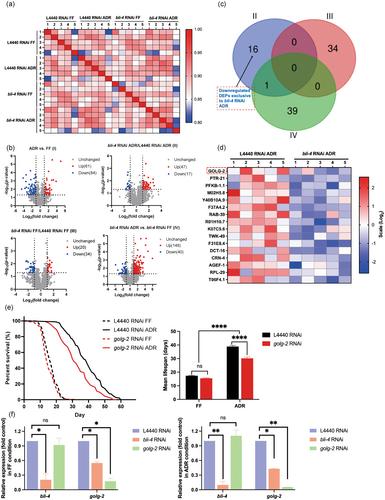
Dietary restriction (DR) is a well-established method for extending lifespan across various species, including C. elegans. Among the different DR regimens, axenic dietary restriction (ADR), in which worms are grown in a nutrient-rich sterile liquid medium, yields the most powerful lifespan extension. However, the molecular mechanisms underlying this longevity phenotype remain largely unexplored. Through a pilot screen of candidate genes, we identified the proprotein convertase BLI-4 as a crucial factor in neurons for modulating lifespan under ADR conditions. BLI-4's role appears to be specific to ADR, as it does not significantly impact longevity under other DR regimens. We further explored the involvement of different bli-4 isoforms and found that isoforms b, f, i and j redundantly contribute to the ADR-mediated lifespan extension, while the bli-4d isoform is mainly involved in development. Proteomics analysis revealed that the loss of BLI-4 function under ADR conditions specifically downregulates GOLG-2, involved in Golgi complex organization. This gene also partially mediates the longevity effects of BLI-4 under ADR conditions. Our findings highlight the importance of neuronal BLI-4 and its downstream targets in regulating lifespan extension induced by ADR in C. elegans.
期刊介绍:
Aging Cell, an Open Access journal, delves into fundamental aspects of aging biology. It comprehensively explores geroscience, emphasizing research on the mechanisms underlying the aging process and the connections between aging and age-related diseases.



 京公网安备 11010802042870号
京ICP备2023020795号-1
京公网安备 11010802042870号
京ICP备2023020795号-1

 分享
分享
 求助内容:
求助内容: 应助结果提醒方式:
 扫码关注我们
